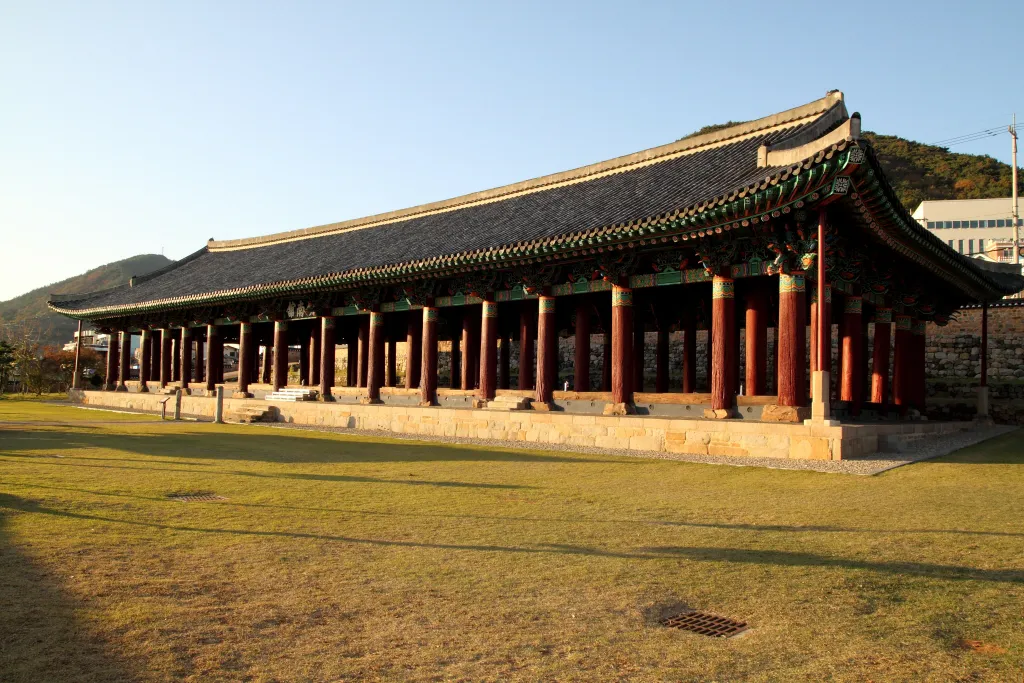
Jinnamgwan Hall, Yeosu
麗水 鎭南館
전라남도 여수시
Basic information
- Designation
- National Treasure No.304
- Category
- Architecture
- Era
- 조선 선조32년(1599)
- Designated year
- 2001
- Location
- 여수시, 전라남도— 전남 여수시 동문로 11 (군자동) / (지번)전남 여수시 군자동 472
- Coordinates
- 34.742001, 127.736594
AI Docent
Coming soonAn AI-generated, friendly retelling of this heritage site is available in Korean. An English version is on our roadmap — for now, please see the official description below.
Description
Built in 1598, and used as both a guesthouse for government dignitaries and as a naval headquarters during the Japanese invasions in 1592 and 1597, Jinnamgwan is the largest extant local government building in Korea being 14m high, 75m long and 240-pyeong large (1 pyeong equals 3.3 square meters). This landmark also retains traces of renovation works carried out by Admiral Yi Je-myeon in 1718. Jinnamgwan is supported by 68 large, round pillars, which are arranged and connected with a variety of crossbeams to support the structure in a complicated and scientific way. Those pillars are thicker at the bottom, getting thinner toward the top. The tops of the pillars are finished with elegant plates supporting the roof. From the outside, those plates are adorned with sophisticated lotus buds, especially, the front and corner pillars feature dragon heads on the top. Between the pillars are arranged wooden pieces of boards generating three-dimensional effects. Most part of the structure preserves dancheong (decorative wood carvings with attractive colors and designs) patterns in their original shape. In addition, to enhance space efficiency, the corner pillars are moved a little backward, which makes the interior space look larger. Its simple design and reliable materials add more magnificent touches to the building. Moreover, two supporting beams are placed at either side of the structure to give more stability. Though built in the early 18th Century, Jinnamgwan is highly valued in historic, academic and artistic aspects.
Location
지도를 불러오는 중…
Have you visited this place?
Log in and verify your visit on-site via GPS to record a stamp in My Journey. (QR verification coming later.)
Images: KOGL (khs.go.kr) · Data source: Korea Heritage Service Open API (khs.go.kr)