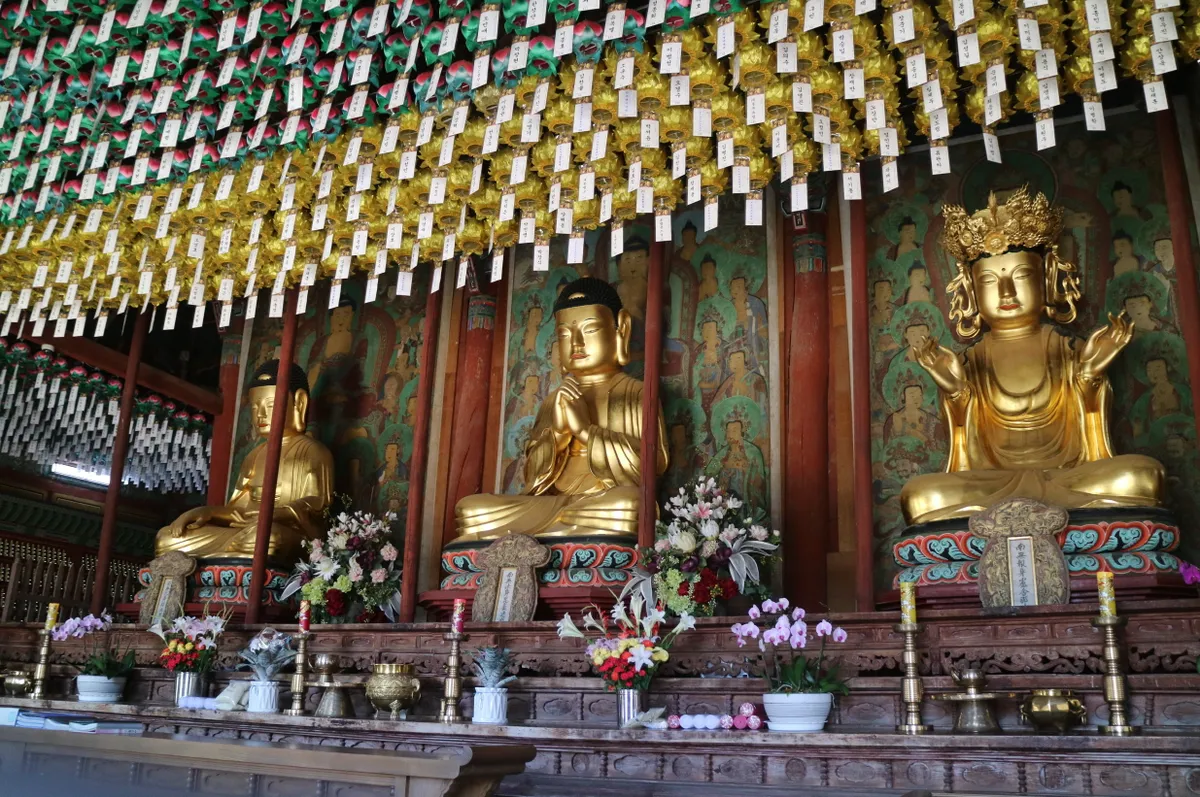
Wooden Seated Vairocana Buddha Triad of Hwaeomsa Temple in Gurye
求禮 華嚴寺 木造毘盧遮那三身佛坐像
전라남도 구례군
Basic information
- Designation
- National Treasure No.336
- Category
- Sculpture
- Era
- 1635년(인조 13)
- Designated year
- 2021
- Location
- 구례군, 전라남도— 전라남도 구례군 화엄사로 539 (마산면, 대한불교조계종 화엄사)
- Coordinates
- 35.227700, 127.500200Museum-based location
AI Docent
Coming soonAn AI-generated, friendly retelling of this heritage site is available in Korean. An English version is on our roadmap — for now, please see the official description below.
Description
Machine-translatedThis English description was machine-translated and may contain inaccuracies. Refer to the original Korean text for details.
The "Wooden Seated Buddha Triad of Vairocana at Hwaeomsa Temple, Gurye" is enshrined in the Main Hall of Hwaeomsa Temple and is a representative Buddhist sculpture of the 17th century completed in 1635 (the 13th year of King Injo's reign) through the collaborative effort of renowned sculptors of late Joseon, including Cheongheon (淸軒, 淸憲), Eungwon (應元), and Ingyun (印均), along with their disciples. The "Three Bodies of Buddha" refers to Vairocana Buddha (毘盧舍那佛) of the Dharma Body (法身), Locana Buddha (盧舍那佛) of the Reward Body (報身), and Shakyamuni Buddha (釋迦佛) of the Emanation Body (化身), an iconographic form rooted in Huayan Buddhist thought. While frequently seen in pictorial tableaux, copying of Buddhist scriptures, and Buddhist paintings, this sculptural work is unique, and has been valued as an indispensable example in the intellectual history of Buddhism and sculpture history of late Joseon. Recently, with the discovery of ritual deposits and related records, the creation period, process, patrons, and participants of the "Wooden Seated Buddha Triad of Vairocana at Hwaeomsa Temple, Gurye" have been clarified more distinctly. This Three Bodies of Buddha was created in 1634–1635 to be enshrined in the Main Hall during the reconstruction of Hwaeomsa Temple (1630–1636), which had been destroyed during the Imjin War. Under the direction of Beoam (碧巖) Gakseong (覺性, 1575–1660), who served as the Chief Metropolitan (八道都摠攝) representing monks nationwide, 1,320 patrons participated, including approximately 580 monks, the couples of Uichang-gun (義昌君) Yi Gwang (李珖, 1589–1645), the eighth son of King Seonjo (宣祖, r. 1567–1608), and Dongyang-wi (東陽尉) Sin Ikseong (申翊聖, 1588–1644), a son-in-law of King Seonjo, along with numerous royal court ladies. Beoam Gakseong, who directed the Buddhist construction project, took the lead in major temple reconstruction projects at temples such as Songgwangsa in Wanju, Beopjusa, Hwaeomsa, and Ssanggyesa, which had been damaged by warfare following the Imjin War, and occupied an important position in the Buddhist history of late Joseon. The Three Bodies of Buddha sit in a lotus position on a wooden octagonal pedestal with an ornate lotus-flower base. Along with their monumental scale of over 3 meters in total height including the pedestal, sculptural techniques expressed with simple yet bold lines impart a grave and dignified feeling. As both the Cheongheon school and the Eungwon and Ingyun schools participated in creating this Three Bodies of Buddha, the work exhibits the sculptural characteristics of each school in its expression. While the solemnly featured Vairocana Buddha and Shakyamuni Buddha are judged to have been created by the Cheongheon school, the Locana Buddha with a gentle face, small eyes, and thickly rendered eyelids is presumed to be the work of Eungwon and Ingyun. The "Wooden Seated Buddha Triad of Vairocana at Hwaeomsa Temple, Gurye" is a monumental masterwork completed with the highest expertise by 17th-century master sculptors Cheongheon, Eungwon, and Ingyun and their disciples, and this may be said to be the result of the combined patronage of Beoam Gakseong, who directed the Buddhist construction project, and the royal court, including Uichang-gun. Being the largest wooden Buddhist sculpture made in the 17th century and the only sculptural representation of the Three Bodies of Buddha iconography (Vairocana–Locana–Shakyamuni), its status in the history of Buddhist sculpture is extremely significant and important, and its artistic and formal level is notably outstanding among Buddhist sculptures of that era.
Location
지도를 불러오는 중…
Have you visited this place?
Log in and verify your visit on-site via GPS to record a stamp in My Journey. (QR verification coming later.)
Images: KOGL (khs.go.kr) · Data source: Korea Heritage Service Open API (khs.go.kr)