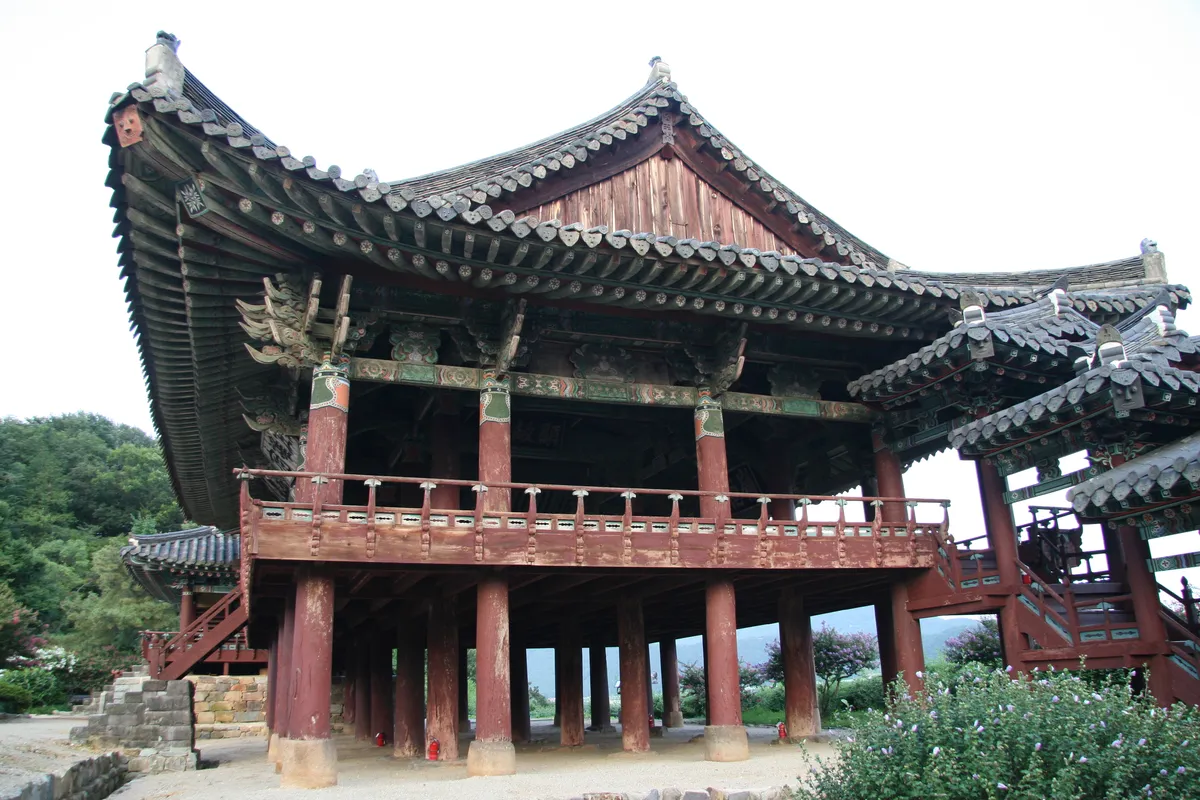
Yeongnam Pavilion, Miryang
密陽 嶺南樓
경상남도 밀양시
Basic information
- Designation
- National Treasure No.344
- Category
- Architecture
- Era
- 조선시대
- Designated year
- 2023
- Location
- 밀양시, 경상남도— 경상남도 밀양시 중앙로 324 (내일동, 영남루)
- Coordinates
- 35.491545, 128.755608Kakao address conversion
AI Docent
Coming soonAn AI-generated, friendly retelling of this heritage site is available in Korean. An English version is on our roadmap — for now, please see the official description below.
Description
Machine-translatedThis English description was machine-translated and may contain inaccuracies. Refer to the original Korean text for details.
Yeongnamnu Pavilion, Miryang. Miryang's Yeongnamnu pavilion traces its origins to a small pavilion at Yeongnamsa Temple in Unified Silla and developed into an official government pavilion when it was reconstructed and renamed Yeongnamnu in 1365 (Goryeo, King Gongmin's 14th year) by Miryang County Magistrate Kim Ju. The present structure was completed in 1844 when Magistrate Lee In-jae expanded the main pavilion and flanked it with the Neungpagak and Chimmryugak wings. The main pavilion is a large wooden structure measuring five bays across and four bays deep with a hip-and-gable double-eave roof. The multi-building composition — main pavilion connected to east and west wings via an intermediate structure on sloped terrain — demonstrates exceptional architectural ingenuity and scenic beauty. Twelve plaques remain, including the central 'Yeongnamnu' plaque by Cho Yun-hyung (1725-1799) and flanking inscriptions by Yi Yu-won (1814-1888). With its panoramic scenery blending with the Miryang River, Yeongnamnu has inspired countless literary works by historical luminaries and stands as a representative pavilion of the southern Yeongnam region, possessing outstanding historical, architectural, and artistic value.
Location
지도를 불러오는 중…
Have you visited this place?
Log in and verify your visit on-site via GPS to record a stamp in My Journey. (QR verification coming later.)
Images: KOGL (khs.go.kr) · Data source: Korea Heritage Service Open API (khs.go.kr)