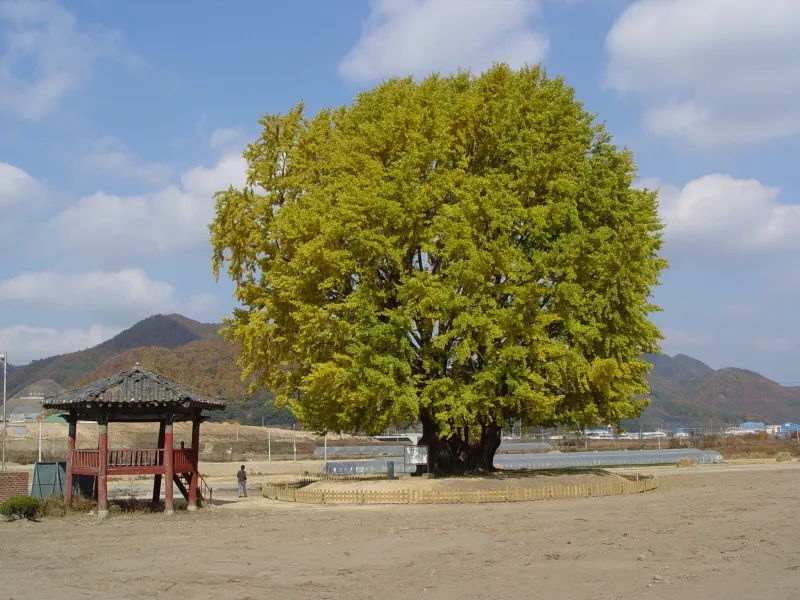
Ginkgo Tree of Yogwang-ri, Geumsan
錦山 要光里 銀杏나무
충청남도 금산군
Basic information
- Designation
- Natural Monument No.84
- Category
- 동식물
- Designated year
- 1962
- Location
- 금산군, 충청남도— 충남 금산군 추부면 요광리 329-8번지
- Coordinates
- 36.212235, 127.492548
AI Docent
Coming soonAn AI-generated, friendly retelling of this heritage site is available in Korean. An English version is on our roadmap — for now, please see the official description below.
Description
A ginkgo tree can be as old as a fossil. Found in Japan, China and Korea, the Ginko tree was introduced to Korea along with Confucianism and Buddhism from China. In fall it produces beautiful leaves which are resistant to insect damage. As ginkgo trees provide broad leafy shade, they are often planted in arbors or by roadsides. The ginkgo tree of Yogwang-ri in Geumsan is about 1,000 years old. It is about 24m in height, and has a girth of about 12.93m. It is hollow like a cave as its trunk has rotted. Although the tree spread nicely, the branches on its south and east sides were broken, and the villagers used them to make tables and 37 coffins over a three-year period. About 500 years ago, an ancestor of the O family (apparently a governor of Jeolla-do) built a pavilion under the ginkgo tree and named it Haengjeong, meaning “the ginkgo tree arbor". The arbor is no longer there, but the hexagonal Haengjeongheon Pavilion was built on the site. According to a local legend, if a dull child stands under this ginkgo tree at night, he will become intelligent; if an old man eats the boiled leaves of this tree, he will stop coughing; and if a woman who wants a baby prays to this ginkgo tree, she will give birth to a son. Furthermore, the tree is said to inform the village whenever misfortunes are about happen in the village or the country by making certain sounds. Local people who believe these things pray to the tree for good luck at midnight on January 3 on the lunar calendar. The ginkgo tree in Geumsan has been well preserved for many years, making it an important material for biology research. It has been designated as Natural Monument (No. 84) for its protection.
Location
지도를 불러오는 중…
Have you visited this place?
Log in and verify your visit on-site via GPS to record a stamp in My Journey. (QR verification coming later.)
Images: KOGL (khs.go.kr) · Data source: Korea Heritage Service Open API (khs.go.kr)