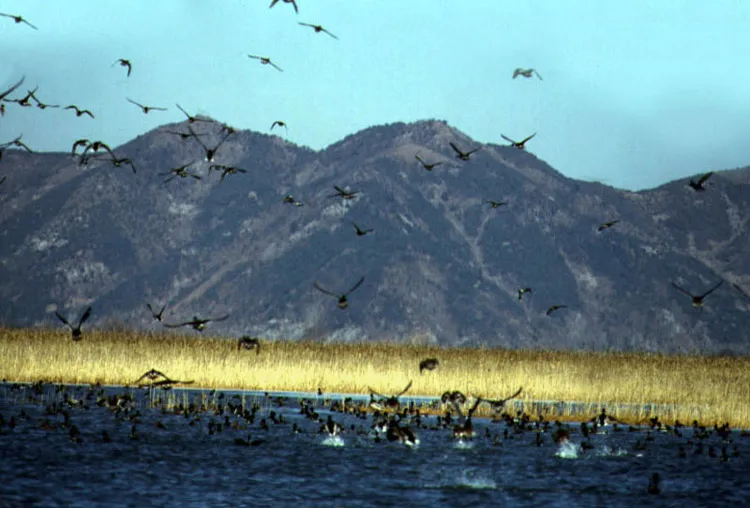
Sanctuary of Migratory Birds at Nakdonggang River Estuary
洛東江 下流 철새 渡來地
부산광역시 (특정 불가)
Basic information
- Designation
- Natural Monument No.179
- Category
- 동식물
- Designated year
- 1966
- Location
- (특정 불가), 부산광역시— 부산광역시 강서구, 사상구, 사하구 일원
- Coordinates
- 35.085611, 128.908108
AI Docent
Coming soonAn AI-generated, friendly retelling of this heritage site is available in Korean. An English version is on our roadmap — for now, please see the official description below.
Description
Migrant birds move their breeding grounds or living sites according to season. The winter birds breed in the north regions and winter in Korea. The summer birds live from spring until fall in Korea, and then fly to southern regions. The representative migrant birds of Korea are Egrets, Cinereous Vulture, and Red-crowned Cran. The migrant habitat in the estuary of Nakdonggang River is between the Busan and Gimhae fields. Deltas are formed here. In the upper estuary are Ilungdo Island and Eulsukdo Island. The large delta is formed between the main stream of Nakdonggang River and Jungnipgang River. In the front part of the estuary are sand dunes that become large silt at low tide or estuary at high tide. Sand dunes are moved or removed by the overflowing waters of Nakdonggang River or typhoons. There are lots of animals and plants living in water at this site, which is a resting place for sea birds because it has not yet been developed. Therefore, the Snipe bird and species of Plover migrate through this site during spring and summer. The delta in the downstream area of Nakdonggang River does not freeze. The winter migrants flock regularly from November until March. Sometimes, the White-naped Crane, the Black-faced spoonbill, and the Oriental Pratincole can be found. The species and the number of migrants have been decreasing because of pollution. The migrant habitat in the downstream area of Nakdonggang River has biological and educational value because it is the largest one in Korea. This site is also important for studies on the development of ecosystems. Therefore, it is designated as a Natural Monument.
Location
지도를 불러오는 중…
Have you visited this place?
Log in and verify your visit on-site via GPS to record a stamp in My Journey. (QR verification coming later.)
Images: KOGL (khs.go.kr) · Data source: Korea Heritage Service Open API (khs.go.kr)