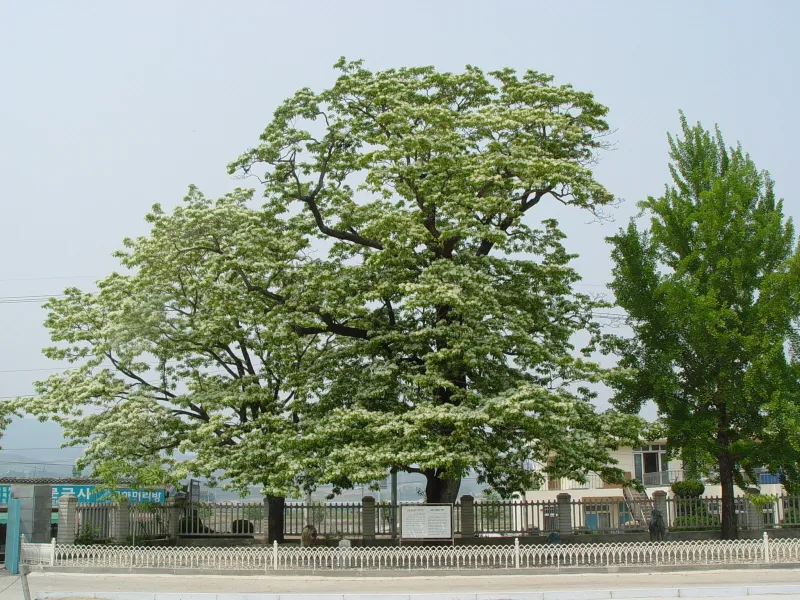
Population of Retusa Fringe Trees in Pyeongji-ri, Jinan
鎭安 平地里 이팝나무 群
전북특별자치도 진안군
Basic information
- Designation
- Natural Monument No.214
- Category
- 동식물
- Designated year
- 1968
- Location
- 진안군, 전북특별자치도— 전북 진안군 마령면 임진로 2122 (평지리)
- Coordinates
- 35.735030, 127.369020
AI Docent
Coming soonAn AI-generated, friendly retelling of this heritage site is available in Korean. An English version is on our roadmap — for now, please see the official description below.
Description
Retusa fringe tree is named “Ipamnamu” in Korean. There are two folk origins about the name of the tree. Some say, the name “Ibap,” literally meaning "rice," stemmed from the fact that its white blossoms resemble cooked rice. Others say, it once had the name “Iphamok” in Korean (a tree growing in early summer), since this tree blossoms when summer starts. This name was changed to “Ipamnamu”. In some places, there is a saying that, when this tree is in full blossom, there will be a good harvest. The ages of retusa fringe trees in Pyeongji-ri are not known. They have height of about 13m and girth ranging from 118cm to 2.52m. They stand beside the walls of the playground of Maryeong Elementary School. There are 7 female and male trees. Villagers in this town call them Iamnamu or Ppeonnamu. Originally, these trees were protected by the town; since the elementary school was built, the trees had to be included in the school yard. The place where there are retusa fringe trees has been called “Agisari,” meaning a place where children are buried. Now, the forest of retus fringe tree provides children with good shade. During the monsoon season, however, the ground is not well-drained, and the roots of the trees are getting weak. Since the retusa fringe trees in Pyeongji-ri, Jinan have been under our ancestors' care and protection and are also biologically valuable, they are designated and protected as a natural monument.
Location
지도를 불러오는 중…
Have you visited this place?
Log in and verify your visit on-site via GPS to record a stamp in My Journey. (QR verification coming later.)
Images: KOGL (khs.go.kr) · Data source: Korea Heritage Service Open API (khs.go.kr)