Jangsuhaneulso
將帥하늘소
기타 .
Basic information
- Designation
- Natural Monument No.218
- Category
- 자연지형
- Designated year
- 1968
- Location
- ., 기타— 기타 전국일원
- Coordinates
- 37.573815, 126.985589Kakao address conversion
AI Docent
Coming soonAn AI-generated, friendly retelling of this heritage site is available in Korean. An English version is on our roadmap — for now, please see the official description below.
Description
Machine-translatedThis English description was machine-translated and may contain inaccuracies. Refer to the original Korean text for details.
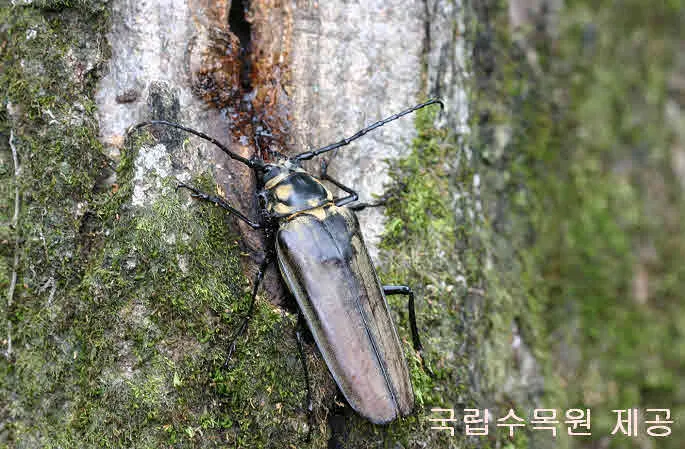
The Callipogon longhorn beetle (Callipogon relictus) is the largest among beetle-type insects and is distributed in Manchuria, northeast China, the Ussuri region of Siberia, and areas such as the Gwangneung region of Gyeonggi Province in Korea. The Callipogon longhorn beetle's body length is approximately 12 centimeters for males and 7-8 centimeters for females. The body is black or dark brown with strong luster, while the back is densely covered with tan-colored fine hair. The wing covers are reddish-brown. The large mandibles, developed scissor-like, curve upward with a projecting tooth on each outer side. The antennae are slightly shorter than body length with segments becoming finer toward the front. The pronotum displays yellow hair tufts forming a figure-eight pattern, with saw-like projections along the lateral margins. It inhabits forests where old, large trees such as hop hornbeam, sawtooth oak, and ash grow. When females bore holes in tree trunks to lay eggs, larvae consume the solid fibrous portions of wood. Adult beetles feed on sap from protruding knots on trunks, appearing from June to September. Based on its primitive form, the Callipogon longhorn beetle appears to be the oldest among longhorn beetles to appear on Earth, and similar insects inhabit Central and South America, serving as living evidence that Asia and that continent were once connected by land. The Callipogon longhorn beetle possesses significant value in biological taxonomy and biogeography, making it a rare insect worthy of designation and protection as a natural monument.
Location
지도를 불러오는 중…
Have you visited this place?
Log in and verify your visit on-site via GPS to record a stamp in My Journey. (QR verification coming later.)
Images: KOGL (khs.go.kr) · Data source: Korea Heritage Service Open API (khs.go.kr)