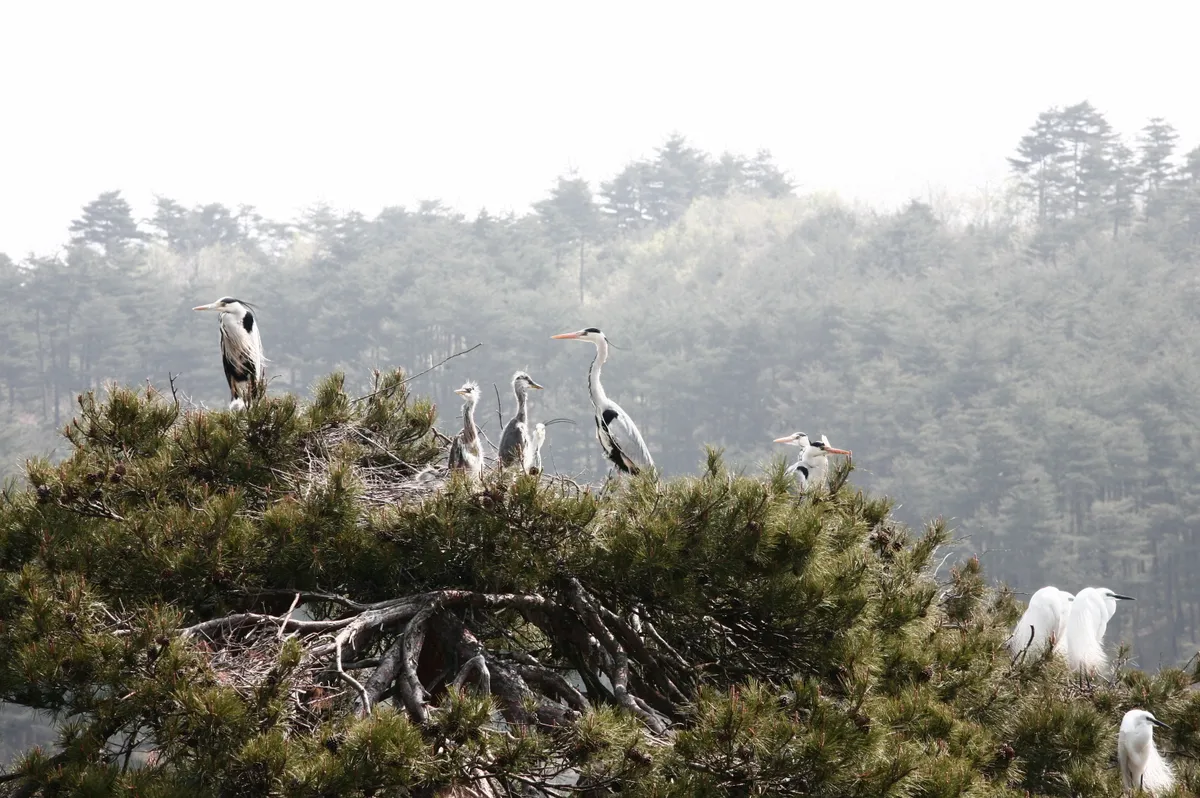
Breeding Ground of Egrets and Grey Herons in Pomae-ri, Yangyang
襄陽 浦梅里 白鷺와 왜가리 繁息地
강원특별자치도 양양군
Basic information
- Designation
- Natural Monument No.229
- Category
- 동식물
- Designated year
- 1970
- Location
- 양양군, 강원특별자치도— 강원도 양양군 개매길 215-33 (현남면)
- Coordinates
- 37.950062, 128.770826
AI Docent
Coming soonAn AI-generated, friendly retelling of this heritage site is available in Korean. An English version is on our roadmap — for now, please see the official description below.
Description
An egret (white heron) lives widely in the tropical and temperate regions and in all areas in Korea except the highland in Baekdusan Mountain. It reproduces in Korea from early spring to late autumn, and it can be seen in streams, lakes, and tidelands. It reproduces mainly in a pine tree and a ginkgo tree. The waegari (heron) is the biggest bird in the white heron family, reproducing in all areas in Korea in summer. A small group of herons spend winter in the southern region and island region. It lives in a rice field, a stream, a coast, and a tideland and feeds on frogs, fish, and snakes. There are about 500 pine trees in the egret and Waegari habitat in Pomae-ri, Yangyang, and they are about 70-150 years old and 20-25 meters high. Egret and Waegari have reproduced on about 250 of those 500 pine trees. They have also built 3 nests each on the Big Cone Pine, black oak, and chestnut tree. The egret and Waegari habitat in Pomae-ri, Yangyang was the biggest breeding place in the east coast. Note, however, that their habitat is shrinking due to environmental pollution and their droppings. As a result, the number of white herons and Waegari is decreasing. Therefore, it is designated and protected as a Natural Monument.
Location
지도를 불러오는 중…
Have you visited this place?
Log in and verify your visit on-site via GPS to record a stamp in My Journey. (QR verification coming later.)
Images: KOGL (khs.go.kr) · Data source: Korea Heritage Service Open API (khs.go.kr)