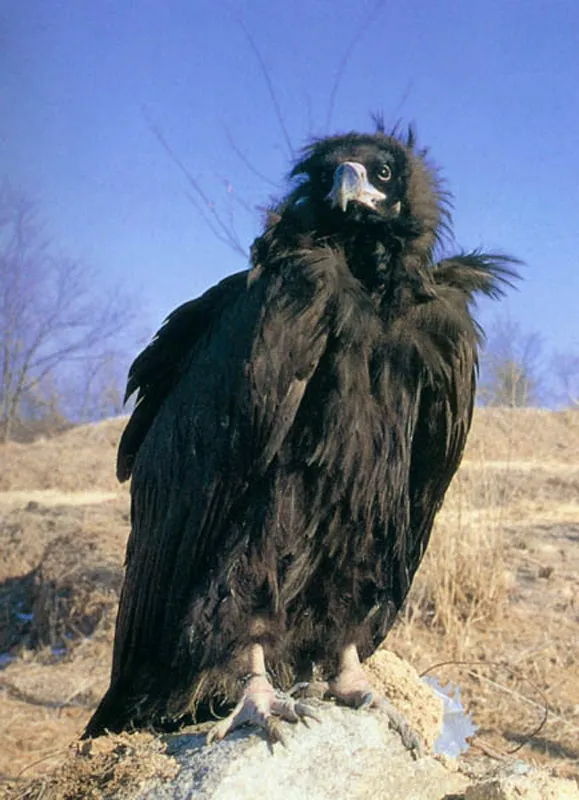
Doksuri
기타 .
Basic information
- Designation
- Natural Monument No.243-1
- Category
- 동식물
- Designated year
- 1973
- Location
- ., 기타— 기타 전국일원
- Coordinates
- 37.558782, 126.937231Kakao address conversion
AI Docent
Coming soonAn AI-generated, friendly retelling of this heritage site is available in Korean. An English version is on our roadmap — for now, please see the official description below.
Description
Machine-translatedThis English description was machine-translated and may contain inaccuracies. Refer to the original Korean text for details.
It is a migratory bird of prey that winters in Korea, not only very rare but also critically endangered, requiring international protection; therefore, it is designated and protected as a Natural Monument. The Cinereous Vulture (Aegypius monachus) is distributed across Europe, Iran, Tibet, Mongolia, India, China, Korea, Japan, Taiwan, and other regions. Its entire body is dark brown with a blackish tinge, and unlike the Steller's Sea-Eagle and White-tailed Eagle, its tail matches the body color. It has distinctive feathering around the neck and a very large bill. It nests on trees or high rocky outcrops. It is known as a 'scavenger' because it primarily feeds on dead animals. As it gradually declines and its survival is threatened, it is a rare avian species requiring international protection. It was once a common winter bird that could be seen throughout Korea; however, it has become a very rare winter bird today. Particularly in the Han River estuary, Nakdong River estuary, and Jeju Island regions, it was always observable as a winter bird until the 1960s. Currently, in the DMZ (particularly near reservoirs in Daseong-dong, Gunae-myeon, Paju-si, Gyeonggi Province), wintering flocks of 3-7 individuals can still be regularly observed, with as many as approximately 150 birds recorded in December 1999.
Location
지도를 불러오는 중…
Have you visited this place?
Log in and verify your visit on-site via GPS to record a stamp in My Journey. (QR verification coming later.)
Images: KOGL (khs.go.kr) · Data source: Korea Heritage Service Open API (khs.go.kr)