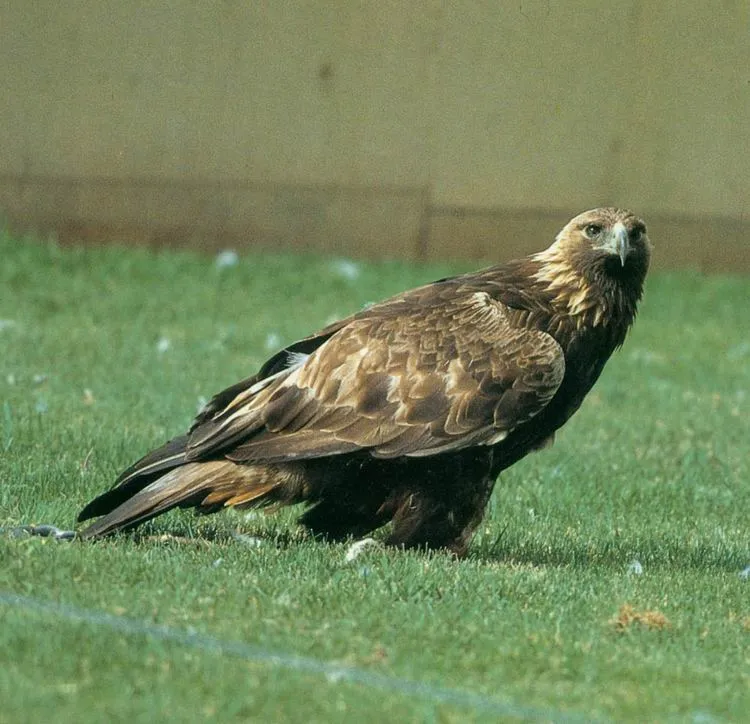
Geomdoksuri
기타 .
Basic information
- Designation
- Natural Monument No.243-2
- Category
- 동식물
- Designated year
- 1973
- Location
- ., 기타— 기타 전국일원
- Coordinates
- No precise coordinates are available, so this item is not shown as a map marker. To be added later.
AI Docent
Coming soonAn AI-generated, friendly retelling of this heritage site is available in Korean. An English version is on our roadmap — for now, please see the official description below.
Description
Machine-translatedThis English description was machine-translated and may contain inaccuracies. Refer to the original Korean text for details.
It is a very rare species in Korea and, due to requiring international protection as a critically endangered species, is designated and protected as a Natural Monument. The Golden Eagle (Aquila chrysaetos) is distributed across North America and the Eurasian continent. Its body color is uniformly dark brown; compared to other eagles it appears darker, hence the Korean name '검독수리' (geomdoksuri, meaning 'dark eagle'). It nests on high rocky outcrops in mountainous areas. It hunts and feeds on small animals and medium-sized birds. Distribution: North America and the Eurasian continent. Morphology: Body length 76-89 cm. The entire body is uniformly dark brown, but the crown and upper head are pale-colored. Juveniles have white bases on the primary wing feathers and broad dark bands at the tip of white tails. The White-tailed Eagle and Steller's Sea-Eagle have white tails without such dark bands. Ecology: It nests on rocky cliffs in mountainous areas. It builds nests by stacking branches and lines them with plant leaves and stems or straw and green leafy branches. It lays 2 eggs (rarely 3-4). Eggs have a grayish-white ground with small reddish-brown spots or are unmarked. It inhabits plains and mountainous regions. Its call is 'fyuui' or 'poiyoo'; during alarm, mating, or breeding season, it produces sharp, intense calls of 'ppi-it, ppi-it, ppi-it'. It is a resident bird that rarely breeds in mountainous areas but also occasionally winters near reclaimed lands and river areas. As a species gradually disappearing, active protection of artificial breeding and wild populations is requested. Post-WWII breeding records include: April 1, 1948—one nest at 15 m depth in a rock cavity 25 m up a 25 m cliff at Yebongsan, 56 km northeast of Seoul; April 16, 1948—two nests in rock pockets 25 m up a 33 m cliff at Cheonmasan, Gyeonggi Province (Wolfe, 1950); and August 3, 1974—observation of a breeding pair at Dojipbong Peak (elevation 600 m) near Naejangsan (Won Byeong-o, 1974). Additionally, breeding appears to occur near Yanggu, Gangwon Special Autonomous Region, and near Dutayeon (areas adjacent to the DMZ).
Have you visited this place?
Log in and verify your visit on-site via GPS to record a stamp in My Journey. (QR verification coming later.)
Images: KOGL (khs.go.kr) · Data source: Korea Heritage Service Open API (khs.go.kr)