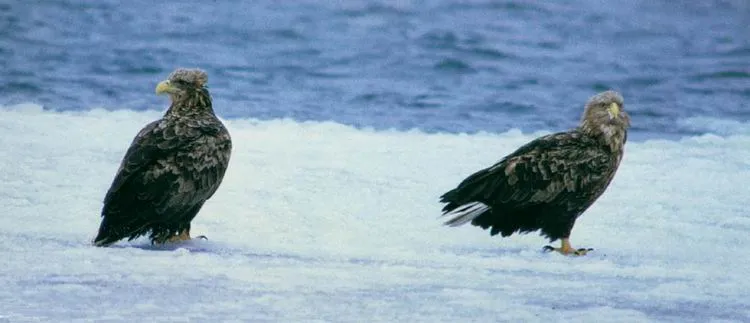
Huinkkorisuri
기타 .
Basic information
- Designation
- Natural Monument No.243-4
- Category
- 동식물
- Designated year
- 1973
- Location
- ., 기타— 기타 전국일원
- Coordinates
- No precise coordinates are available, so this item is not shown as a map marker. To be added later.
AI Docent
Coming soonAn AI-generated, friendly retelling of this heritage site is available in Korean. An English version is on our roadmap — for now, please see the official description below.
Description
Machine-translatedThis English description was machine-translated and may contain inaccuracies. Refer to the original Korean text for details.
The White-tailed Eagle is a very rare species uncommon to see in Korea and, as it is disappearing globally and requires international protection, is designated and protected as a Natural Monument. The White-tailed Eagle is widely distributed across the Eurasian continent. Except for its white tail, yellow bill, and yellow feet, it is entirely brown. It inhabits rocky coasts and mudflats. It feeds on fish, small animals, and birds. Distribution of the White-tailed Eagle: Widely distributed across the Eurasian continent. From the west coast of South Greenland, Iceland, Scandinavia, Western Europe, Asia Minor, to Siberia in the east (Kamchatka, Kuril Islands, Sakhalin, Amur, Ussuri, Manchuria, Mongolia, Russian Pakistan, and other regions). Morphology: Total length 69-94 cm. It is a large and robust eagle. Adult plumage ranges from pale yellowish-brown to pale yellowish-brown on the head and neck, with uniformly brown plumage elsewhere, except for the white tail. Juvenile plumage lacks the pale neck coloration and is mottled brown overall; the white tail varies with age. It is distinguished from the juvenile Golden Eagle by its wedge-shaped (V-shaped) tail. Ecology: It builds flat, dish-shaped nests by stacking thick branches and lines the nest site with dry grass and animal fur. It lays 1-4 (usually 2) white or grayish-white eggs. It inhabits coasts, wetlands, lakes, large river valleys, etc. Its call is sharp 'kwuit, kwuit, kwuit' or 'ki-it, ki-it, ki-it'; it sometimes produces loud 'ka-at, ka-at, ka-at' sounds. Its breeding population is declining and is an uncommon winter bird of worldwide conservation concern. Decline factors include overhunting and environmental degradation from development. In Korea, it winters throughout the country along the Seomjin River, Daseong-dong, Gunae-myeon, Paju-si, Gyeonggi Province, the Han River, Nakdong River, large rivers and estuaries, and the east and west coasts and island coastal areas of the southern sea. As a globally distributed species, it exhibits some variation in behavior and ecological requirements as well as wide variation in feather coloration and color patterns.
Have you visited this place?
Log in and verify your visit on-site via GPS to record a stamp in My Journey. (QR verification coming later.)
Images: KOGL (khs.go.kr) · Data source: Korea Heritage Service Open API (khs.go.kr)