Gaeri
기타 .
Basic information
- Designation
- Natural Monument No.325-1
- Category
- 동식물
- Designated year
- 1982
- Location
- ., 기타— 기타 전국일원
- Coordinates
- 35.162022, 129.159034Kakao address conversion
AI Docent
Coming soonAn AI-generated, friendly retelling of this heritage site is available in Korean. An English version is on our roadmap — for now, please see the official description below.
Description
Machine-translatedThis English description was machine-translated and may contain inaccuracies. Refer to the original Korean text for details.
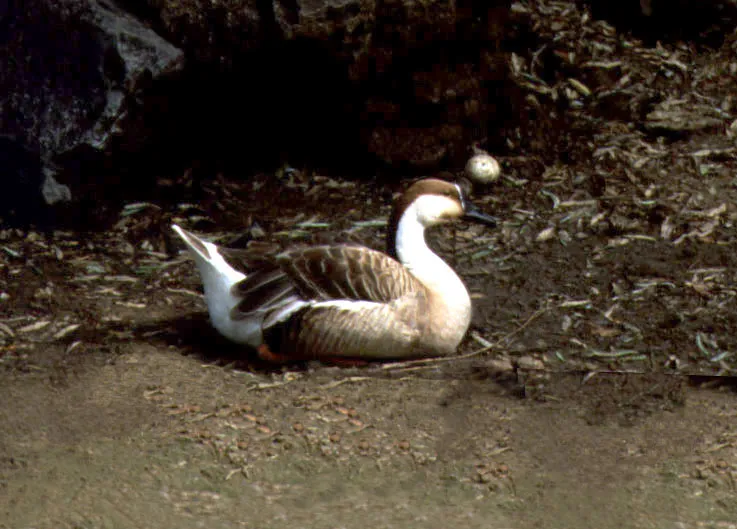
The Swan Goose (Anser cygnoides) is increasingly rare and designated as a natural monument for protection. The Swan Goose (Anser cygnoides) is a relatively uncommon winter bird with body length of approximately 81-94cm, making it difficult to distinguish between males and females. It is characterized by a long neck; the area in front of the eyes to the back of the head is dark brown, while the back and wings are dark brown with white stripes. The chest is grayish-brown, and the sides of the neck and belly are white. It lives in flocks in lakes, swamps, rice paddies, wetlands, coastal areas, and reclaimed land, feeding on aquatic plants, rice, barley, wheat, mollusks, and shellfish. As of November 16, 1982, its habitat is near rivers and lakes where it always dwells, and it can occasionally be found in wetland grasslands and forests around estuaries and streams with fresh and brackish water, even in mountainous regions. Korea formerly hosted common wintering flocks throughout the country, but has become extremely rare in recent years. Distribution: from the Ob and Tobol River basins in south-central Siberia, eastward to Kamchatka and the Commander Islands, and southward to central Asia and northern Mongolia. In winter, it winters in northern China, Korea, and Japan. As of March 17, 2005, the designation numbers have been adjusted because the current single designation number included 2-8 species of natural monument birds. The Swan Goose (Anser cygnoides) is a rare species of geese with a small surviving population that is disappearing. In Korea, it has become an extremely rare winter bird. The first observation in Korea was of a small flock of 7 birds resting in rice fields on February 10, 1967 in Sinjeong-ri, Muan County, South Jeolla Province. Subsequently, on February 20, 1988, 2 birds were observed mixed in flocks of greater and lesser white-fronted geese at Junam Reservoir in Changwon County, South Gyeongsang Province. In November 1989, 2 birds were observed in Jeju Island. Small flocks of 4-5 individuals would regularly pass through or winter in coastal areas. In North Korea, small groups of about 10 birds are observed at the Yongam Port area along the Yalu River in North Pyongan, and at the mouth of the Cheon River in South Pyongan, as well as coastal wetland areas. However, unexpectedly, during the winter of 1992-1993, as many as 667 birds (maximum count) wintered in the lower Han River. The global surviving population is estimated at approximately 100,000 birds. Winter survey results conducted from 1999-2000 showed that approximately 1,000 birds wintered in the riverbanks and tidal flats around Haengju Fortress and Odosan in the lower Han River, and approximately 60 birds wintered in the Geum River estuary.
Location
지도를 불러오는 중…
Have you visited this place?
Log in and verify your visit on-site via GPS to record a stamp in My Journey. (QR verification coming later.)
Images: KOGL (khs.go.kr) · Data source: Korea Heritage Service Open API (khs.go.kr)