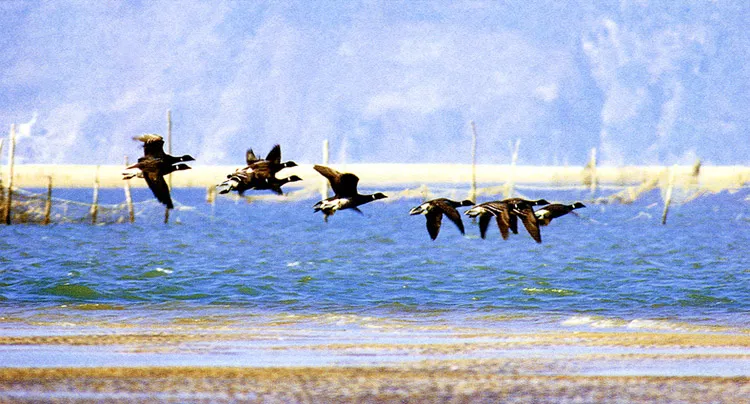
Heukgireogi
黑기러기
기타 .
Basic information
- Designation
- Natural Monument No.325-2
- Category
- 동식물
- Designated year
- 1982
- Location
- ., 기타— 기타 전국일원
- Coordinates
- 35.806865, 128.741246Kakao address conversion
AI Docent
Coming soonAn AI-generated, friendly retelling of this heritage site is available in Korean. An English version is on our roadmap — for now, please see the official description below.
Description
Machine-translatedThis English description was machine-translated and may contain inaccuracies. Refer to the original Korean text for details.
Among seven species of geese that come to Korea to overwinter, the Black Brant is increasingly rare and designated as a natural monument for protection. The Black Brant has a body length of approximately 58-66cm, with difficulty in distinguishing between males and females. Its head, chest, and back are black, with a crescent-shaped white marking on the neck, and a white belly. It lives in flocks, breeding in tundra lakes covered with moist moss and mudflats. It feeds on seaweeds and mollusks. Distribution: distributed in the tundra regions from the Arctic in eastern Siberia to western Canada, wintering in Japan, China, northern coasts, and western North America. As of March 17, 2005, the designation numbers have been adjusted to prevent public confusion by providing independent sub-designations for birds previously listed under a single designation number covering 2-8 species. The Black Brant is a rare species. Three subspecies widely distributed across Eurasia and North America were once large populations of 42,000 to 140,000 birds each, but are declining. The subspecies breeding in the Arctic Siberia along the Lena River basin to the Anadyr basin and adjacent Arctic islands primarily winters along Korea's southern coast and Chinese coasts. The total population size is unknown, but this subspecies is estimated to be the smallest surviving population. In Japan, it winters in Hokkaido, Honshu, Sado, Shikoku, Kyushu, and Tsushima, but in Korea, it is an uncommon winter bird that regularly arrives on the southern coast annually. During migration, it is also observed on the eastern and western coasts. Flocks of 10 to 37 birds are primarily visible around the sea cucumber farming areas off Yeosu, South Jeolla Province and Bogil Island in Wando County. However, small flocks are also observed on the sea off Dadaepo near Busan to areas around Geoje Island and Jinhae, and on January 22, 1984, 700 birds were observed from Mokpo to Yongwon-ri in Jinhae, and on February 5, 1987, 118 birds were observed near Dadaepo in Busan and around the Nakdong River estuary, with flocks of around 1,000 birds regularly arriving and wintering on the southern coast. The global surviving population is estimated at approximately 200,000 birds.
Location
지도를 불러오는 중…
Have you visited this place?
Log in and verify your visit on-site via GPS to record a stamp in My Journey. (QR verification coming later.)
Images: KOGL (khs.go.kr) · Data source: Korea Heritage Service Open API (khs.go.kr)