Wonang
鴛鴦
기타 .
Basic information
- Designation
- Natural Monument No.327
- Category
- 동식물
- Designated year
- 1982
- Location
- ., 기타— 기타 전국일원
- Coordinates
- 33.300177, 126.581330Kakao address conversion
AI Docent
Coming soonAn AI-generated, friendly retelling of this heritage site is available in Korean. An English version is on our roadmap — for now, please see the official description below.
Description
Machine-translatedThis English description was machine-translated and may contain inaccuracies. Refer to the original Korean text for details.
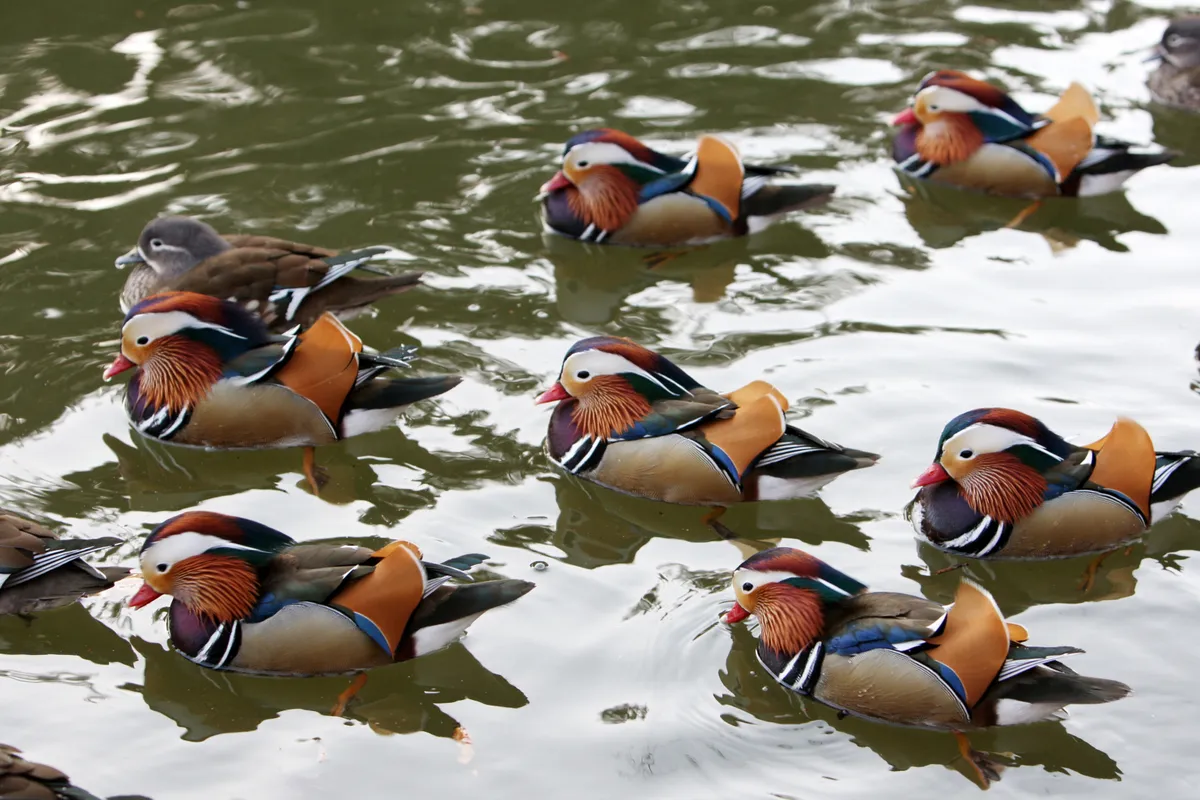
The Mandarin Duck is distributed in Korea, China, Russia, the Ussuri region, Japan, and Taiwan. It is called Mandarin Duck because males and females are said to always travel together, and the term is used figuratively to describe harmonious couples that are always together. The Mandarin Duck typically has a body length of about 43cm. The male is extremely beautiful with white around the eyes, chestnut on the crown and upper chest, greenish-blue on the back, and two vertical stripes on the chest. It also has yellow sides and distinctive fan-shaped orange wings that curve upward. The female has a grayish-brown body throughout with white spotted markings and a whitish belly. It lives in densely forested mountain valleys and gorges, wintering in flocks at reservoirs, lakes, swamps, beaches, and streams. It primarily breeds in tree cavities of deciduous trees, being the only duck species in Asia to breed in tree cavities like the Chinese Merganser. It lays 7-12 light yellowish-brown eggs per clutch, which hatch in 28-30 days. It feeds on grass seeds, tree fruits, snails, and freshwater fish. The Mandarin Duck is extremely rare with only 20,000-30,000 individuals remaining worldwide, and having been beloved by Korean ancestors for its beautiful appearance, it is designated and protected as a natural monument.
Location
지도를 불러오는 중…
Have you visited this place?
Log in and verify your visit on-site via GPS to record a stamp in My Journey. (QR verification coming later.)
Images: KOGL (khs.go.kr) · Data source: Korea Heritage Service Open API (khs.go.kr)