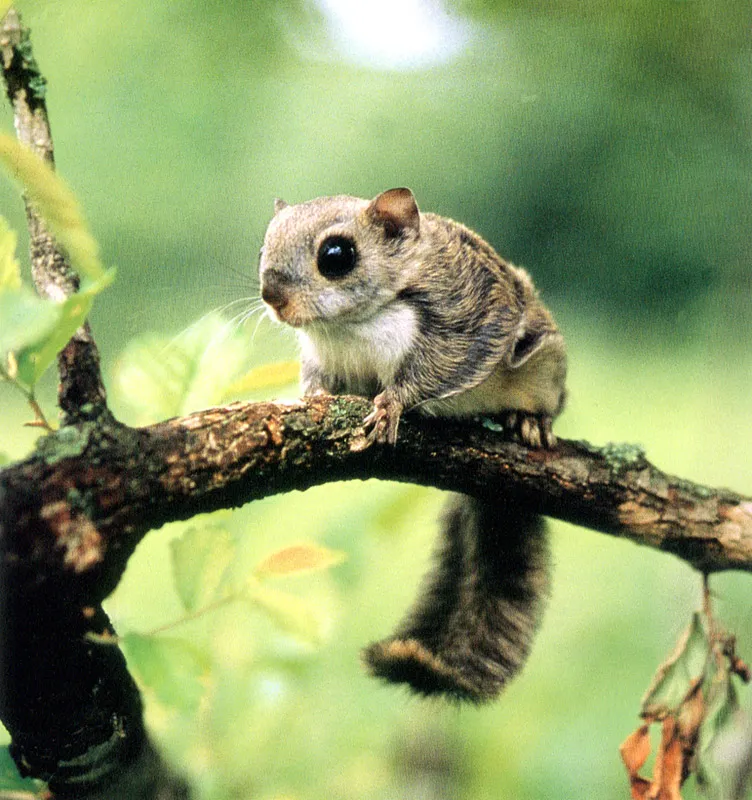
Haneuldaramjwi
기타 .
Basic information
- Designation
- Natural Monument No.328
- Category
- 동식물
- Designated year
- 1982
- Location
- ., 기타— 기타 전국일원
- Coordinates
- 37.776762, 127.509277Kakao address conversion
AI Docent
Coming soonAn AI-generated, friendly retelling of this heritage site is available in Korean. An English version is on our roadmap — for now, please see the official description below.
Description
Machine-translatedThis English description was machine-translated and may contain inaccuracies. Refer to the original Korean text for details.
The Siberian Flying Squirrel (Pteromys volans) belongs to the squirrel family and is distributed in Siberia, Lake Baikal, Manchuria, and central-north regions of Korea. With a body length of 15-20cm, it has a round head, small ears, and very large eyes. Its body size is smaller than the Japanese flying squirrel (Pteromys momonga) but larger than the northern subspecies. Its body color is light grayish-brown, the surfaces of the front and hind limbs are gray, and the underside is white. Its tail is long-haired, with many lateral hairs but few vertical ones, making it flattened, with length of 9.5-14cm. Between the front and hind limbs, it possesses a patagium (membrane) covered with fur similar to wings, which enables it to glide accurately over long distances, typically 7-8 meters and up to 30 meters. It primarily inhabits areas with mixed oak and Korean pine, pure coniferous forests, especially Korean pine forests, typically occurring alone or in pairs. Its nest is constructed in tree hollows using tree bark, grass leaves, and twigs in a rounded shape. It is nocturnal, sleeping curled up with its flat tail covering its entire body during the day and becoming active from dusk. In winter, it hibernates in its nest. Although the Siberian Flying Squirrel is commonly found in the Baekdudaegan region, it is extremely rare in central Korea and is an endemic subspecies to Korea, therefore designated and protected as a natural monument.
Location
지도를 불러오는 중…
Have you visited this place?
Log in and verify your visit on-site via GPS to record a stamp in My Journey. (QR verification coming later.)
Images: KOGL (khs.go.kr) · Data source: Korea Heritage Service Open API (khs.go.kr)