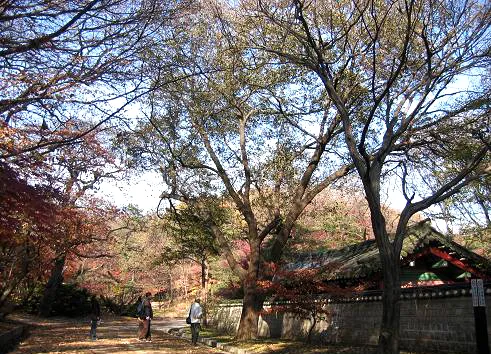
White Mulberry of Changdeokgung Palace
昌德宮 뽕나무
서울특별시 종로구
Basic information
- Designation
- Natural Monument No.471
- Category
- 동식물
- Era
- 400여년 추정(수령)
- Designated year
- 2006
- Location
- 종로구, 서울특별시— 서울 종로구 율곡로 99, (창덕궁 내) (와룡동)
- Coordinates
- 37.583237, 126.993385
AI Docent
Coming soonAn AI-generated, friendly retelling of this heritage site is available in Korean. An English version is on our roadmap — for now, please see the official description below.
Description
The White Mulberry of Changdeokgung Palace is located near the wall forming the boundary with Changgyeonggung Palace. It stands 12m high and has girth of 239.5cm. This old mulberry tree is very unique as it is the biggest and handsomest one in the palace grounds. Traditionally, agriculture and sericulture were the two most important fields in Joseon industry. Growing mulberry trees, raising silkworms, and making silk were widely encouraged to the people by the Government. To emphasize the importance of sericulture, mulberry trees were planted and taken care of in the palace. The first record of mulberry tree planted in the palace appears in Taejong sillok (Annals of King Taejong). It states that Taejong, under the influence of China’s public sericulture system, ordered mulberry trees to be planted in the palace garden. Seongjong sillok (Annals of King Seongjong) also mentions that the king emphasized the importance of sericulture to Seungjeongwon, the royal secretariat, and ordered to plant mulberry trees in the back garden. According to records, the queen herself looked after the silkworms in the garden, and a rite called Chinjamnye was dedicated to the god Seoreung, who first taught sericulture skills to human. As sericulture was one of the most important industries in the past, the royal family considered mulberry trees to be very important as well. In 1911, the Japanese government-general created a sericulture center inside Seohyanggak Pavilion, the western annex of the royal library, Gyujanggak, with records stating that Chinjamnye was held at Juhamnu Pavilion (Gyujanggak building) on June 17, 1925, June 15, 1929, and June 26, 1939. As seen above, the white mulberry of Changdeokgung Palace is an important tree, showing an interesting aspect of the history of the palace
Location
지도를 불러오는 중…
Have you visited this place?
Log in and verify your visit on-site via GPS to record a stamp in My Journey. (QR verification coming later.)
Images: KOGL (khs.go.kr) · Data source: Korea Heritage Service Open API (khs.go.kr)