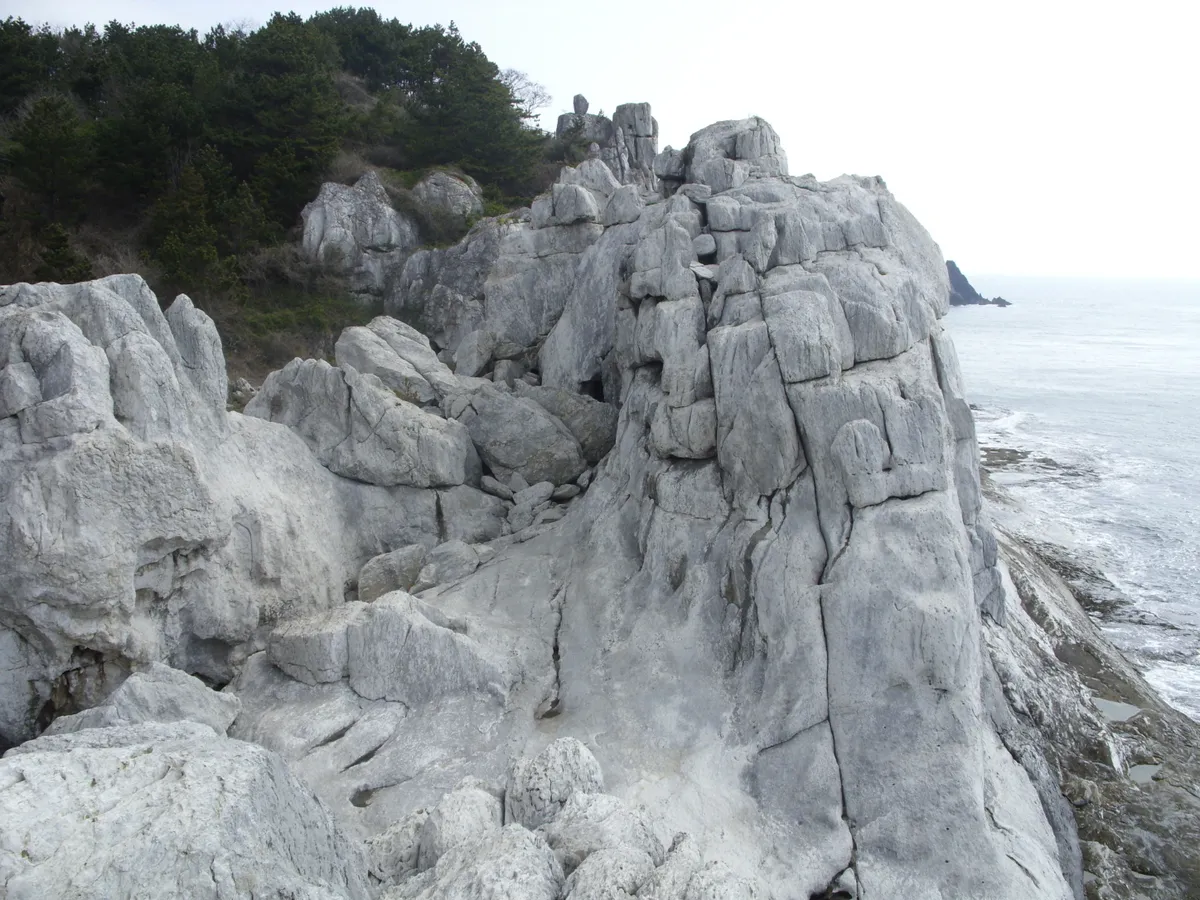
Stromatolite and Bunbawi Rock on Socheongdo Island, Ongjin
甕津 小靑島 스트로마톨라이트와 분바위
인천광역시 옹진군
Basic information
- Designation
- Natural Monument No.508
- Category
- 자연지형
- Designated year
- 2009
- Location
- 옹진군, 인천광역시— 인천광역시 옹진군 대청면 소청리 산 55-3 등
- Coordinates
- 37.767457, 124.768670
AI Docent
Coming soonAn AI-generated, friendly retelling of this heritage site is available in Korean. An English version is on our roadmap — for now, please see the official description below.
Description
Stromatolites are organo-sedimentary structures formed by the trapping and binding of cyanophyta and cyanobacteria living in the sea or lakes, having well-developed lamination. The occurrence of stromatolites, a type of limestone, has been observed throughout the entire geological era, from the beginning of life on earth. Stromatolites are particularly essential for unraveling the mystery of how life began within the paleo-environment during the Precambrian Eon. Their scientific and educational value is, therefore, immeasurable. The only stromatolites dating from the Precambrian Eon that were reported in South Korea are found inside limestone masses in Socheongdo Island. In North Korea, they are found in the environs of Pyeongyang. Inside the stromatolites of Socheongdo Island, the first bacteria fossil ever discovered in Korea, has been identified. This fossil is the oldest fossil in Korea, dated to the late Proterozoic Era (six hundred million to one billion years ago). Limestone in Socheongdo Island was quarried extensively since the colonial period, up until several decades ago, for use in construction. Only a small amount remains today. The designation of the stromatolites of Socheongdo as a Natural Monument is all the more meaningful due to the threat of indiscriminate quarrying faced by the limestone formation which also merits conservation attention for its beauty. Meanwhile, the white crystalline limestone (marble) outcrop located nearby, known as “Bunbawi Rock,” adds to the scenic beauty of this shoreline section.
Location
지도를 불러오는 중…
Have you visited this place?
Log in and verify your visit on-site via GPS to record a stamp in My Journey. (QR verification coming later.)
Images: KOGL (khs.go.kr) · Data source: Korea Heritage Service Open API (khs.go.kr)