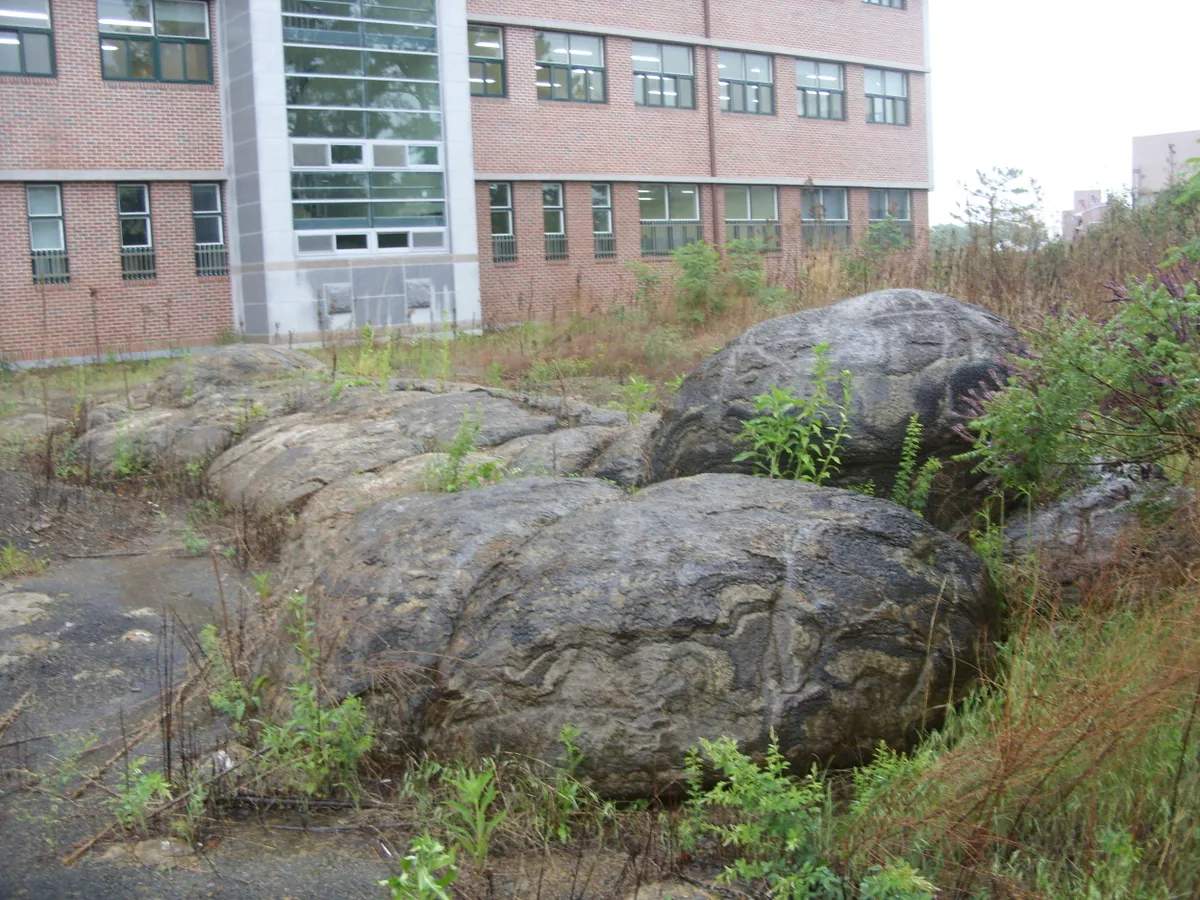
Stromatolite at the Catholic University of Daegu, Gyeongsan
慶山 大邱가톨릭大學校 스트로마톨라이트
경상북도 경산시
Basic information
- Designation
- Natural Monument No.512
- Category
- 자연지형
- Designated year
- 2009
- Location
- 경산시, 경상북도— 경상북도 경산시 하양읍 금락리 300-1
- Coordinates
- 35.914661, 128.808537
AI Docent
Coming soonAn AI-generated, friendly retelling of this heritage site is available in Korean. An English version is on our roadmap — for now, please see the official description below.
Description
Stromatolites are sedimentary fossils formed by living organisms (bacteria). These intriguing geobiological structures were formed since the beginning of life on earth and are continuously being formed even today, in both seawater and freshwater. Studying stromatolites can, therefore, offer clues about how Earth’s early lifeforms came about and also provide answers to the question how Earth was formed. Stromatolites are also treasure troves of information about how bacteria and microalgae have evolved since early Earth. Further, stromatolites, being attractive fossils that are highly varied morphologically, can be of interest not just for the scientific community, but also for the general public. Fossil tourism, for example, is one of the ways through which stromatolites could reach a general audience beyond academic circles. In Korea, stromatolite research began about fifteen years by a group of scientists who were the first to realize their importance. Soon there were reports on various types of stromatolites located in Gyeongsangbuk-do. More stromatolites were reported, thereafter, from places including Daegu, Gunwi, Uiseong and Jinju, and the quantities were quite hefty. The stromatolites identified near the Catholic University of Daegu were especially of high quality as well as large in quantity. The gigantic stromatolite near the campus of the Catholic University of Daegu discovered in October 2004, is presumed to have been formed inside a lake during the Cretaceous Period in the late Mesozoic Era. Stromatolites of such high quality, in terms of amount of bacterial fossils contained, as well as in condition and variety, are rare not just in Korea, but worldwide. This stromatolite is expected to yield light on the emergence and evolution of living organisms in early Earth, as well as provide important pointers toward understanding the size and environment of the lake in which it was formed.
Location
지도를 불러오는 중…
Have you visited this place?
Log in and verify your visit on-site via GPS to record a stamp in My Journey. (QR verification coming later.)
Images: KOGL (khs.go.kr) · Data source: Korea Heritage Service Open API (khs.go.kr)