Geumgwangdongcheung Sinsaengdae Fossil Site, Pohang
浦項 金光洞層 新生代 化石産地
경상북도 포항시
Basic information
- Designation
- Natural Monument No.577
- Category
- 자연지형
- Era
- 신생대
- Designated year
- 2023
- Location
- 포항시, 경상북도— 경상북도 포항시
- Coordinates
- 36.018995, 129.343165
AI Docent
Coming soonAn AI-generated, friendly retelling of this heritage site is available in Korean. An English version is on our roadmap — for now, please see the official description below.
Description
Machine-translatedThis English description was machine-translated and may contain inaccuracies. Refer to the original Korean text for details.
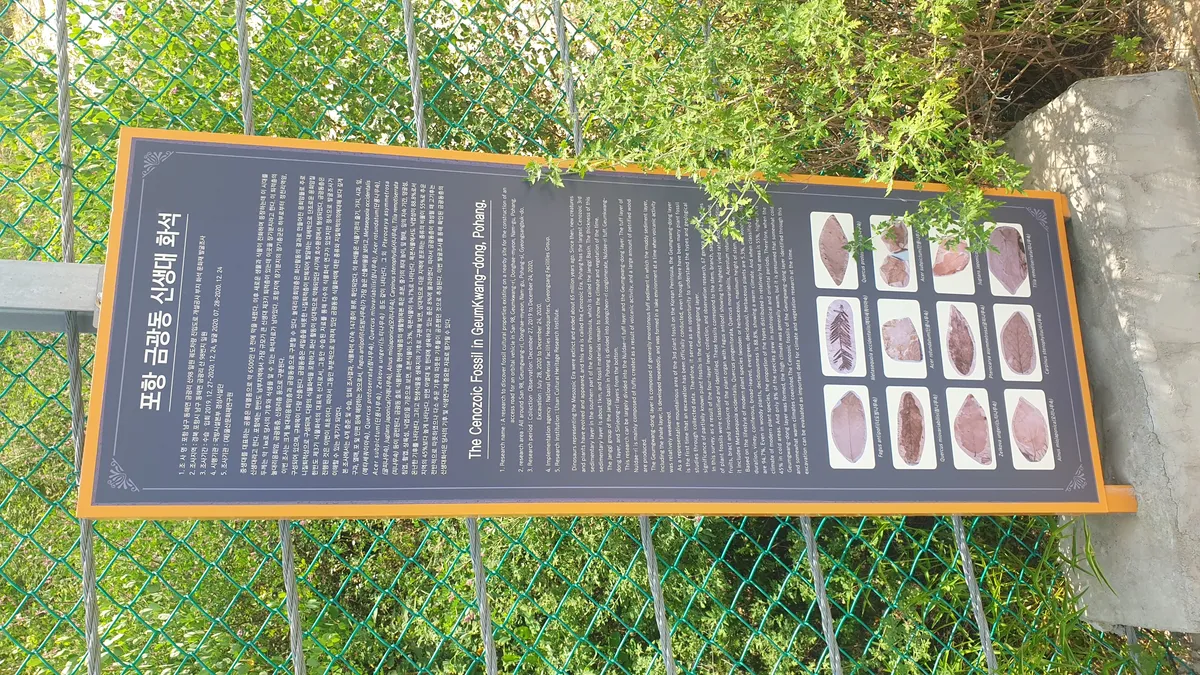
The Cenozoic sedimentary strata associated with the formation and expansion of the East Sea are divided into Early Miocene terrestrial sedimentary layers and volcanic rocks (Hyodong-ri Andesite, Beomgok-ri Formation Group, Janggi Formation Group) and Middle Miocene marine sedimentary layers (Yeonil Formation Group). The Geumgwang-dong Formation is an Early terrestrial sedimentary layer. Deposited conformably above the Nuldae-ri Tuff in a lacustrine setting, the upper part of the Geumgwang-dong Formation is overlain by the Sinjung-ri Formation, composed of tuff and pyroclastic sedimentary rocks. Therefore, the Geumgwang-dong Formation represents sedimentary rocks deposited in a lake during a volcanic quiescent period. Since Tateiwa (1924) conducted geological mapping surveys of the Pohang region, basic stratigraphic classification and paleobiota have been documented. In particular, the Geumgwang-dong Formation of the Janggi Formation Group has yielded diverse plant fossils, which were taxonomically studied by Japanese scholars. Specifically, Huzioka (1972) synthesized the depositional timing and paleovegetation of plant fossils from the Geumgwang-dong Formation, correlating them with the Early Miocene Aniai-type flora of Japan and inferring a relatively cool climatic environment. The Janggi Formation Group represents a small-scale terrestrial depositional basin formed by sinistral strike-slip faults related to the opening of the East Sea, displaying volcanogenic pyroclastic deposits and tectonically deformed structures, distinguishing it from marine layers in the Pohang Basin (including the Duho Formation). The Geumgwang-dong Formation, characterized by tan, yellowish-brown, and gray coloration, is primarily composed of well-laminated shale with abundant leaf fossils distributed across multiple stratigraphic levels. The dominant taxa include Metasequoia, Fagus, Quercus, Acer, Betula, and Zelkova, with rare insect and fish fossils also preserved. Based on overall depositional facies and fossil preservation, plant leaves transported into the lake during a period of relatively weak volcanic activity were slowly deposited with suspended sediment and compacted parallel to the lamination surfaces. The Geumgwang-dong Formation holds significant academic value related to Cenozoic paleoclimate, tectonics, and depositional environments of the Korean peninsula. Moreover, its importance lies in the concentration of diverse plant fossils rarely observed in other Cenozoic sedimentary layers within a narrow area. Additionally, it represents a significant record of paleontological research history extending from the Japanese colonial period to the present.
Location
지도를 불러오는 중…
Have you visited this place?
Log in and verify your visit on-site via GPS to record a stamp in My Journey. (QR verification coming later.)
Images: KOGL (khs.go.kr) · Data source: Korea Heritage Service Open API (khs.go.kr)