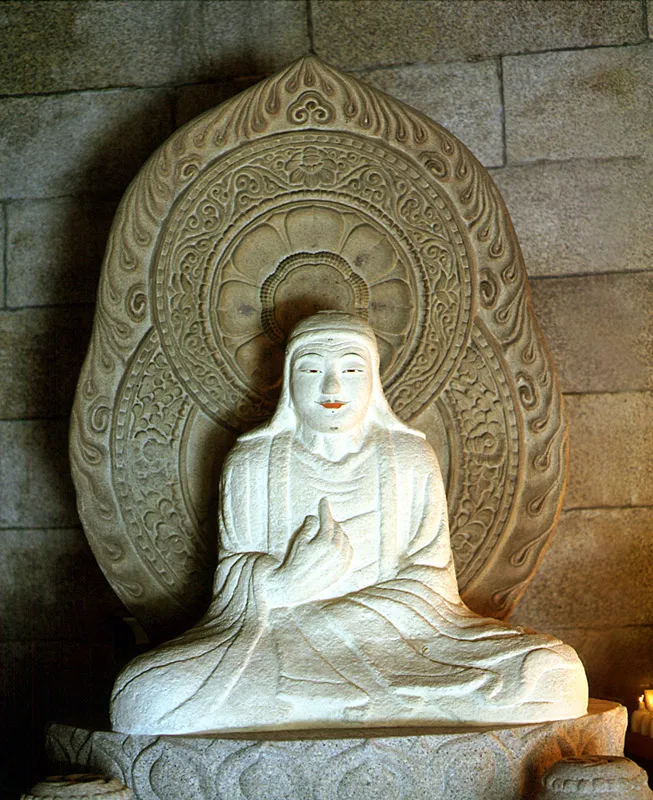
Seunggasa Seokjoseunggadaesa Seated Figure, Seoul
서울 僧伽寺 石造僧伽大師坐像
서울특별시 종로구
Basic information
- Designation
- Treasure No.1000
- Category
- Sculpture
- Era
- 고려 헌종 15년(1024)
- Designated year
- 1989
- Location
- 종로구, 서울특별시— 서울특별시 종로구 비봉4길 213 (구기동, 승가사)
- Coordinates
- 37.626988, 126.959869
AI Docent
Coming soonAn AI-generated, friendly retelling of this heritage site is available in Korean. An English version is on our roadmap — for now, please see the official description below.
Description
This statue was made as a portrait of Buddhist Monk Seungga, an Indian monk who came to the Tang Dynasty of China and devoted himself to religious propagation. He was finally hailed as Avalokitesvara Bodhisattva. This statue is enshrined in Seunggasa Temple, which was established by Buddhist Monk Sutae in 756 (15th year of the reign of King Gyeongdeok during the Silla Period). The statue, which carries a splendid mandorla on the back, is the life-size statue sitting cross-legged. It has a hempen hood on the head and a wide face with protruding cheekbones typical of an old man in a rural area, with strong local color. In addition to the plain shape, these characteristics demonstrate a similarity to the stone monk statue in the early Goryeo Period such as the stone pagoda and statue found from the site of Sajabinsinsa Temple in Hansu-myeon, Jecheon-gun, Chungcheongbuk-do. In addition, the extraordinarily wide knees compared to the long top of the body show characteristics similar to the iron Buddha statues made in the early Goryeo Period, whereas the sacerdotal robe draped over both shoulders has thick and simple lines of pleats as the trend at that time. The mandorla, which represents the brilliance of the head and body, is shaped like a boat and is much larger compared to the statue. The patterns of lotus flower, scroll, and peony are carved on the head mandorla, with the round body mandorla carved with scroll design. The rims of the head and body mandorlas have the flame pattern carved in a detailed, refined manner to show the excellent carving skill. An inscription on the back of the mandorla states that Monk Jigwang helped Gwangyu and others carve the mandorla in 1024 (15th year of the reign of King Hyeonjong of the Goryeo Dynasty). It is a representative portrait sculpture in the early Goryeo, drawing attention together with the stone carving prevalent from the Three Kingdoms’ Period to the Goryeo Period.
Location
지도를 불러오는 중…
Have you visited this place?
Log in and verify your visit on-site via GPS to record a stamp in My Journey. (QR verification coming later.)
Images: KOGL (khs.go.kr) · Data source: Korea Heritage Service Open API (khs.go.kr)