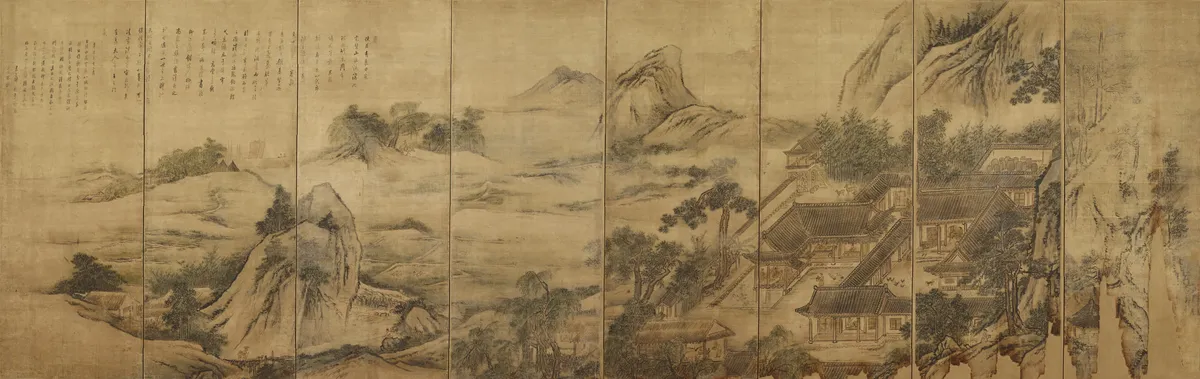
Gimhongdo Pil Samgongbulhwando
金弘道 筆 三公不換圖
서울특별시 용산구
Basic information
- Designation
- Treasure No.2000
- Category
- Painting
- Designated year
- 2018
- Location
- 용산구, 서울특별시— 서울특별시 용산구 이태원로55길 60-16 (한남동)
- Coordinates
- 37.538461, 126.999294Kakao address conversion
AI Docent
Coming soonAn AI-generated, friendly retelling of this heritage site is available in Korean. An English version is on our roadmap — for now, please see the official description below.
Description
The Three Dukes (Samgongbulhwando), a large ink wash painting mounted on an eight-panel folding screen, was produced by Kim Hong-do (1745-after1806), one of the greatest painters of late Joseon, known for his outstanding achievements in landscape, figure, and genre painting, in 1801 when he was 57 years old. As suggested by the title, the painting was inspired by the poem Angler’s Terrace written by the Song poet Dai Fugu (c. 1168-1250), in which he declares that he would not exchange the joy of his peaceful rural life even for the top position in the imperial government. The landscapes and scenes of daily life depicted in the painting were inspired by the Essay on Delighting the Mind, in which the author, the Later Han thinker Zhong Changtong (180-220), praises the peaceful pastoral life. For Kim Hong-do, the joy of the idyllic life could be represented by a large tile-roofed mansion located at the foot of a mountain, with a river flowing before it, farmland, a landlord receiving his guests, who are served by a housemaid, and farmers and anglers busy at their work. The painting presents the artist’s reinterpretation of the classical Chinese text’s praise of the simple, peaceful life in the countryside based on the daily life of his country folk, resulting in the creation of a masterpiece that effectively combines themes from genre and landscape painting. Kim Hong-do adopted a diagonal composition for this painting in order to render the scenes more dynamic, while combining diverse elements from various genres including figure, landscape and flower-and-bird painting, thereby lending refinement and complexity to the final work. The painting is generally regarded as one of the two representative masterpieces - the other being Autumn Sounds Rhapsody (Chuseongbudo, 1805, Treasure No. 1395) - of Kim Hong-do’s great achievement in the final stage of his career as an artist.
Location
지도를 불러오는 중…
Have you visited this place?
Log in and verify your visit on-site via GPS to record a stamp in My Journey. (QR verification coming later.)
Images: KOGL (khs.go.kr) · Data source: Korea Heritage Service Open API (khs.go.kr)