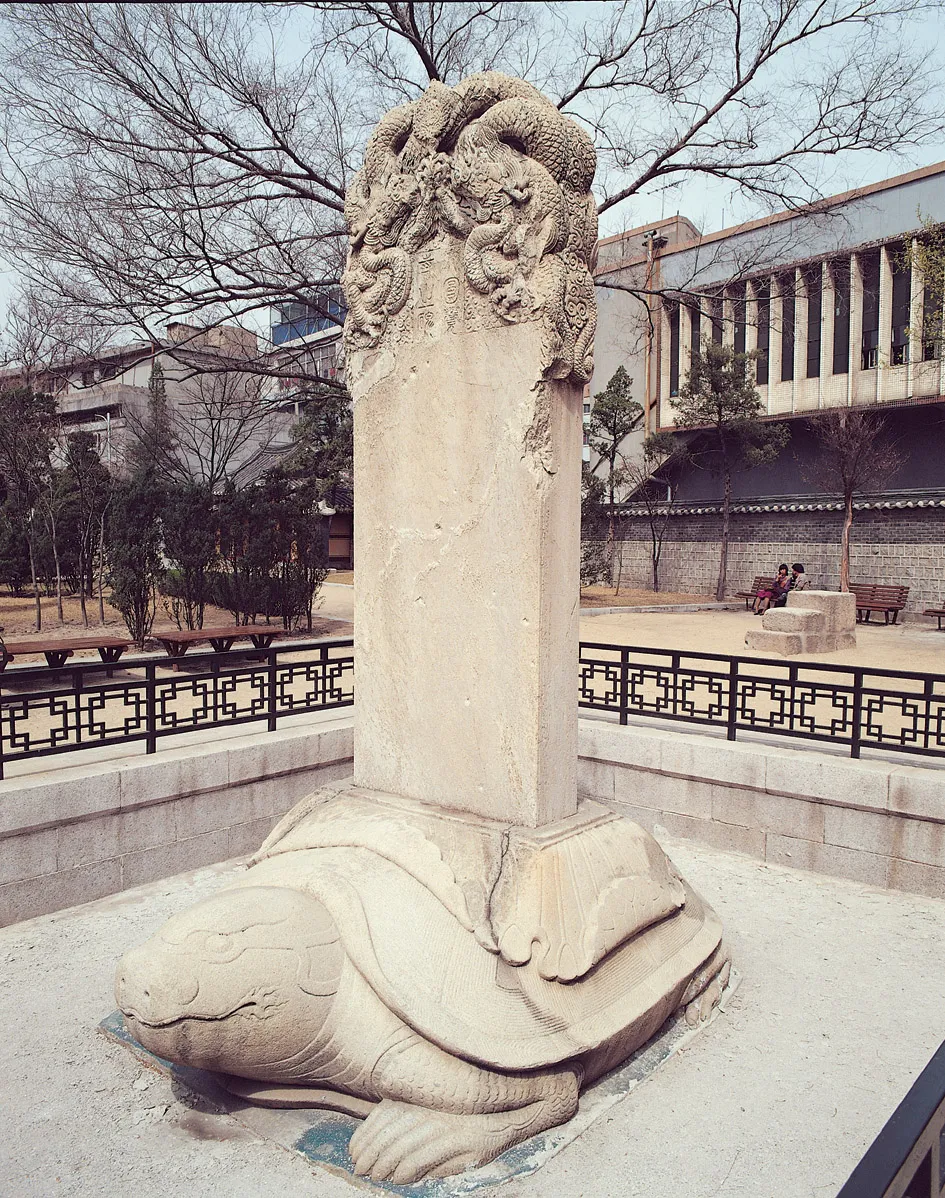
Stele for the Construction of Daewongaksa Temple at Wongaksa Temple Site, Seoul
서울 圓覺寺址 大圓覺寺碑
서울특별시 종로구
Basic information
- Designation
- Treasure No.3
- Category
- Books & Records
- Era
- 조선 성종 2년(1471)
- Designated year
- 1963
- Location
- 종로구, 서울특별시— 서울 종로구 종로2가 38-3번지 탑골공원
- Coordinates
- 37.571069, 126.988635
AI Docent
Coming soonAn AI-generated, friendly retelling of this heritage site is available in Korean. An English version is on our roadmap — for now, please see the official description below.
Description
This stele, inscribed with details concerning the foundation of Wongaksa Temple, was erected in 1471 (the 2nd year of the reign of King Seongjong of the Joseon Dynasty). Originally occupying the site of the present-day Tapgol Park in Seoul, Wongaksa Temple was built as the main temple of the Jogye Order when King Taejo, the founder and first king of the new Joseon Dynasty, decided to use Seoul as his capital. However, following the disappearance of the Jogye Order, the temple building began to be used as a government office. The temple was later rebuilt to commemorate the translation of Mahavaipulya-purnabudha Sutra by the Gangyeongdogam (Directorate of Buddhist Publications) and the acquisition of sarira from the stupa at Hoeamsa Temple. A ten-story stone pagoda was also built at the site around the same time. The stele follows the traditional style, in which the top of the stele (without a roof stone) is decorated with two dragons as if wrapped around its main body. The stone base of the stele resembles a tortoise with a heavy body and protruding head, and features a trapezoidal - rather than the more typical hexagonal - pattern on its back. The lotus leaves engraved on the middle of the back, and the fish scales on the tail and legs exhibit the unique beauty of sculptural works of the Joseon Dynasty. The top of the main stone is carved with an image of two dragons supporting a large lotus bud, beneath which the name of the stele (Daewongaksajibi) is inscribed in the calligraphic style of Gang Hui-maeng, a renowned calligraphic artist of the era. The stele’s inscriptions were composed by famous scholars such as Kim Su-on and Seong Im, who wrote those on the front, and Seo Geo-jeong and Jeong Nan-jong, who wrote those on the back.
Location
지도를 불러오는 중…
Have you visited this place?
Log in and verify your visit on-site via GPS to record a stamp in My Journey. (QR verification coming later.)
Images: KOGL (khs.go.kr) · Data source: Korea Heritage Service Open API (khs.go.kr)