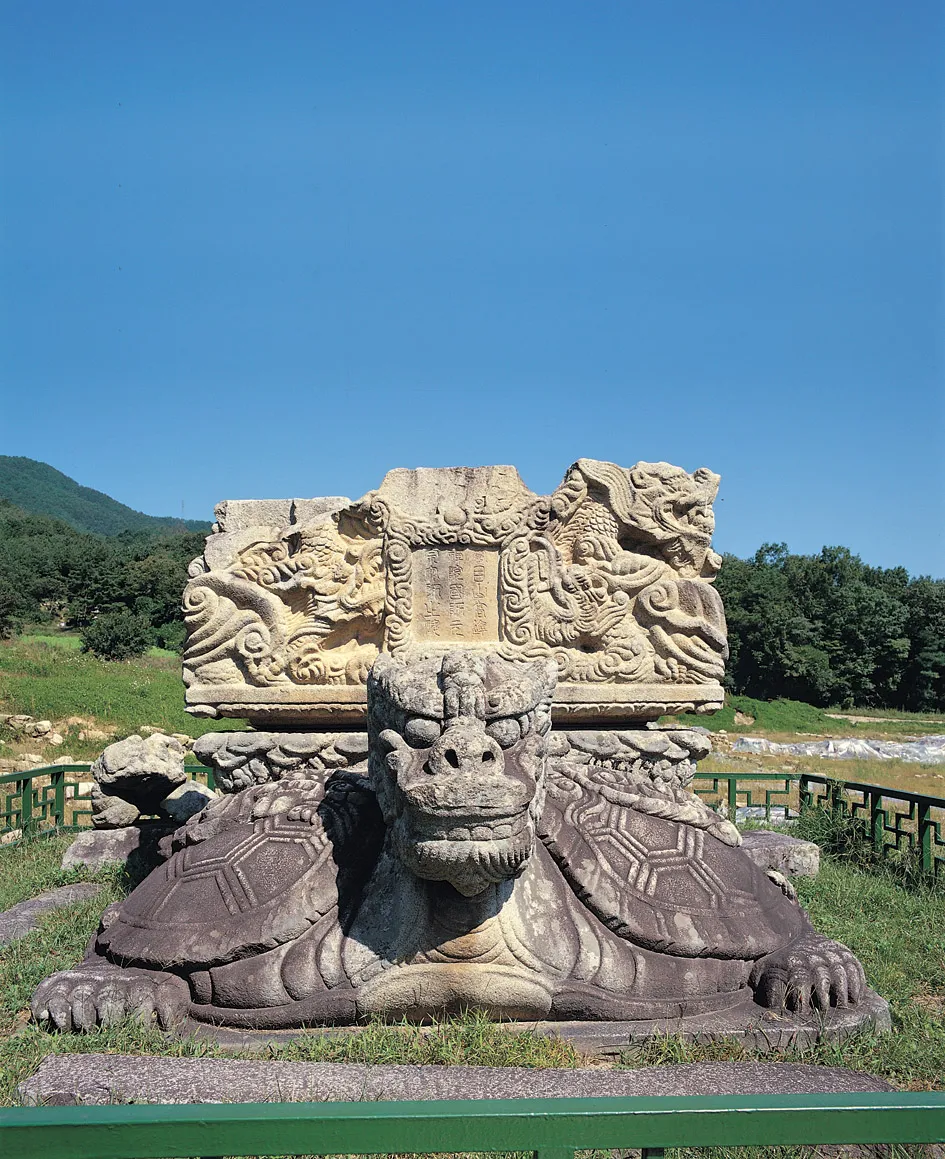
Stele of Buddhist Monk Wonjong at Godalsa Temple Site, Yeoju
驪州 高達寺址 元宗大師塔碑
경기도 여주시
Basic information
- Designation
- Treasure No.6
- Category
- Books & Records
- Era
- 고려 광종 26년( 975)
- Designated year
- 1963
- Location
- 여주시, 경기도— 경기도 여주시 북내면 상교리 419-3번지
- Coordinates
- 37.392791, 127.653908
AI Docent
Coming soonAn AI-generated, friendly retelling of this heritage site is available in Korean. An English version is on our roadmap — for now, please see the official description below.
Description
This stele was erected at the site of Godalsa Temple to commemorate the life and achievements of the Buddhist monk Wonjong, who was born in 869 (the 9th year of the reign of King Gyeongmun of the Silla Dynasty) and died at the age of 90 in 958 (the 9th year of the reign of King Gwangjong of the Goryeo Dynasty). King Gwangjong bestowed the posthumous title of Wonjong upon him and named the monument ‘Hyejin’. The actual stele was destroyed a long time ago, and only the tortoise-shaped pedestal and the ornamental capstone in the form of a hornless dragon remain today. The stele’s broken main stone is displayed in the National Museum of Korea. Its inscription includes details about Wonjong's birth, life, achievements, learning and virtues as a monk. The tortoise pedestal is characterized by glaring eyes that seem to stare directly at the viewer, vividly expressed legs and paws, and a very short neck. The back of the tortoise pedestal is carved with double hexagonal honeycomb patterns, while its middle part, which is one tier higher than the pedestal and is the part to which the main body of the stele is fixed, is adorned with swirling cloud patterns. The ornamental capstone, which features a lively design of clouds and dragons, is almost rectangular; while its base is decorated with a lotus flower design. According to the inscription, the tortoise-shaped pedestal and the ornamental capstone were made in 975. Judging from certain details such as the tortoise's face’s resemblance to a grim dragon, its short neck, glaring eyes, and ornamental stone, and especially the vivid and complex decoration with swirling cloud design, this stele dates from the period of transition from the artistic style of the late Unified Silla Dynasty to that of the early Goryeo Dynasty.
Location
지도를 불러오는 중…
Have you visited this place?
Log in and verify your visit on-site via GPS to record a stamp in My Journey. (QR verification coming later.)
Images: KOGL (khs.go.kr) · Data source: Korea Heritage Service Open API (khs.go.kr)