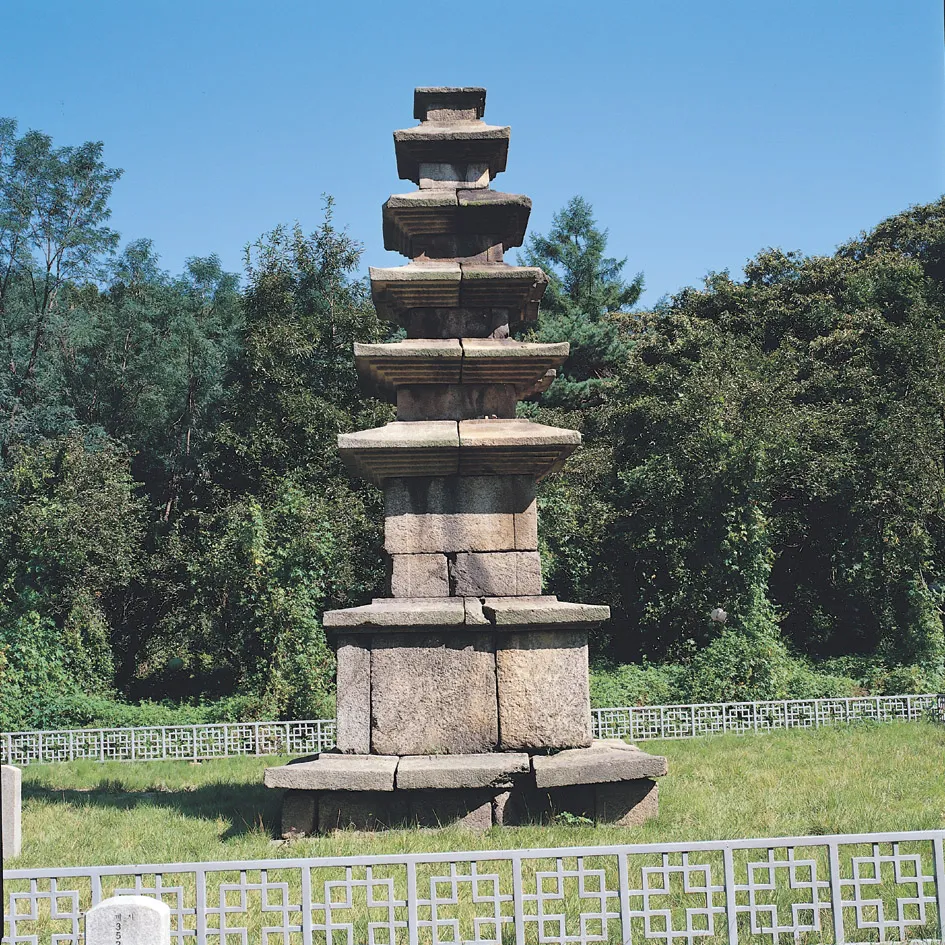
Five-story Stone Pagoda at Dongsa Temple Site, Hanam
河南 桐寺址 五層石塔
경기도 하남시
Basic information
- Designation
- Treasure No.12
- Category
- Sites & Pagodas
- Era
- 고려시대
- Designated year
- 1963
- Location
- 하남시, 경기도— 경기 하남시 춘궁동 466번지
- Coordinates
- 37.516860, 127.185864
AI Docent
Coming soonAn AI-generated, friendly retelling of this heritage site is available in Korean. An English version is on our roadmap — for now, please see the official description below.
Description
This square five-story stone pagoda, atypically consisting of a two-story platform and a five-story main stone body, is located in Chungung-dong, Hannam, Gyeonggi-do. (Generally, pagodas are composed of a platform, a body consisting of a main stone and a roof stone, and a finial.) The platform of this pagoda features carvings of columns on its four corners and the middle of each side. As its south face is broken, the stone column inside the platform can be seen through the break. The unique feature of this pagoda is the structure of its body. The first story of the main stone body has two steps, on the first of which are laid four square stones, with another flat stone laid upon them. This style, introduced during the Goryeo Dynasty, can also be seen in the Five-story Stone Pagoda at Seonggeosa Temple Site in Gwangju (Treasure No.109). As regards the roof stone, there are four steps on the first to third floors, two on the fourth, and one on the fifth. The stone supporting the roof stone also has a decreasing number of steps (falling from five on the first floor to four on the second-fourth floors, and from four to three on the fifth floor). This structure gives the impression of a gradual upward tapering of the body. The lower line of the roof stone is horizontal, while the edge is turned slightly upward. All of the finial, apart from its base, has been lost. Though it displays some structural irregularities, it is a great work characterized by the harmonious proportions of the body. It shows the influence of the style of late Unified Silla in the two-story platform and the degree of lift of the edge of the roof stone. However, the decreasing number of steps on the roof stone and the columns carved on the middle of the platform suggest that it was made in the late 10th century (early Goryeo Period).
Location
지도를 불러오는 중…
Have you visited this place?
Log in and verify your visit on-site via GPS to record a stamp in My Journey. (QR verification coming later.)
Images: KOGL (khs.go.kr) · Data source: Korea Heritage Service Open API (khs.go.kr)