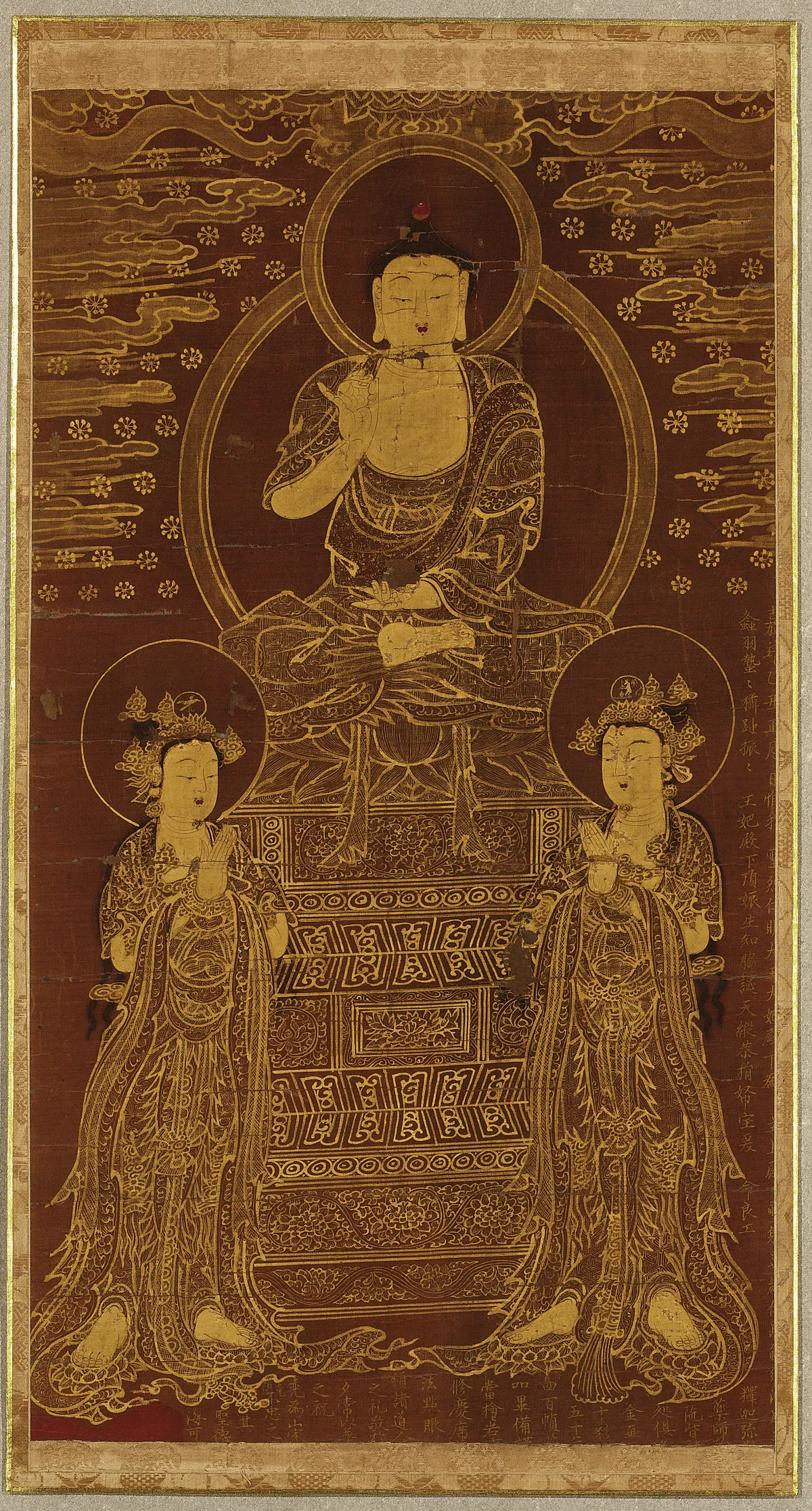
‘hoeamsa’myeong Yaksayeoraesamjondo
‘檜巖寺’銘 藥師如來三尊圖
서울특별시 용산구
Basic information
- Designation
- Treasure No.2012
- Category
- Painting
- Era
- 1565년(명종20)
- Designated year
- 2019
- Location
- 용산구, 서울특별시— 서울특별시 용산구 서빙고로 137 (용산동6가, 국립중앙박물관)
- Coordinates
- 37.523500, 126.980100Museum-based location
AI Docent
Coming soonAn AI-generated, friendly retelling of this heritage site is available in Korean. An English version is on our roadmap — for now, please see the official description below.
Description
The Altar Painting of the Bhaisajyaguru Triad with Inscription of Hoeamsa is one of 400 pieces of Buddhist painting produced in 1565 under the patronage of Queen Munjeong (1501-1565), consort of King Jungjong (r.1506-1544), who wished for the health and longevity of her son, King Myeongjong (r. 1545-1567), and the birth of his male heir. The painting was enshrined in Hoeamsa Temple as soon as it was established in Yangju, Gyeonggi-do. According to the postscript written to the painting by the eminent monk Bou (1509-1565), the painting project produced one hundred altar paintings, fifty in gold and fifty in multiple colors, for each of the four Buddhas, Shakyamuni, Bhaisajyaguru, Maitreya and Amitabha. Queen Munjeong who financed the project was a powerful member of the royal family at the time and a generous patron of Buddhism. Hoeamsa Temple that enshrined the paintings funded by the queen was the largest royal temple during the early Joseon period. One can conclude, therefore, that this painting of the Bhaisajyaguru Triad was created as part of the historic Buddhist event undertaken with the full support from Queen Munjeong and the royal family of early Joseon of which she was the most senior member. The painting features a simple composition with the principal Buddha, Bhaisajyaguru, portrayed at the center with the two attendants, Sunlight (Ilgwang) and Moonlight (Wolgwang) Bodhisattvas, on both sides, all illustrated with gold lines against the background of reddish brown silk. The arrangement of the divinities stressing the strict hierarchy between the Buddha and his attendants shows an influence from the tradition of the Buddhist iconography of Goryeo but the slender bodies and small features on the face reflect the characrteristic elements of the Buddhist paintings funded by the royal family of Joseon, represented by the delicate brushstrokes and dignified appearances that only top-class court painters were able to deliver. Most of the original 400 paintings have disappeared except for seven of which six are outside Korea, mostly in the US and Japan. As the only one of the original paintings remaining in Korea, and accompanied by the detailed record of its background, the patron, purpose, and locations related with the painting, the Bhaisajyaguru Triad of Hoeamsa Temple is regarded as a priceless source for the study of the Buddhist paintings of Joseon in the 16th century, promotion of Buddhism by royal patrons, and the activities of thecourt painters of Joseon.
Location
지도를 불러오는 중…
Have you visited this place?
Log in and verify your visit on-site via GPS to record a stamp in My Journey. (QR verification coming later.)
Images: KOGL (khs.go.kr) · Data source: Korea Heritage Service Open API (khs.go.kr)