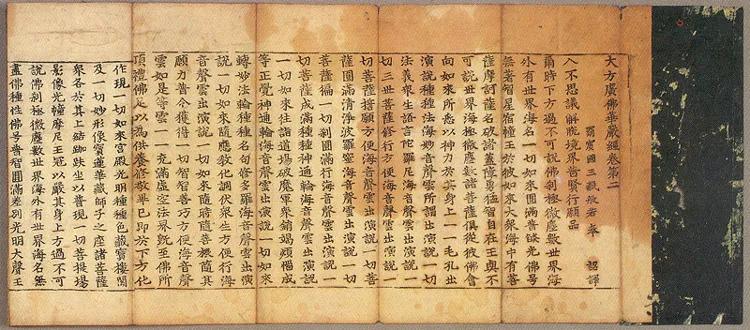
Daebanggwangbulhwaeomgyeong Jinbon Gwon15, Jubon Gwon38, Jeongwonbon Gwon2, 38
大方廣佛華嚴經 晋本 卷十五, 周本 卷三十八, 貞元本 卷二, 三十八
충청북도 단양군
Basic information
- Designation
- Treasure No.1017
- Category
- Books & Records
- Era
- 12∼13세기
- Designated year
- 1989
- Location
- 단양군, 충청북도— 충청북도 단양군
- Coordinates
- 36.984658, 128.365546
AI Docent
Coming soonAn AI-generated, friendly retelling of this heritage site is available in Korean. An English version is on our roadmap — for now, please see the official description below.
Description
The main idea of Hwaeomgyeong (Avatamsaka Sutra) is that Buddha and ordinary people are one rather than separate entities. In Korea, this sutra has served as a fundamental sutra for the Huayan Sect (Avata-saka Sect). This sutra, along with the Lotus Sutra, was one that wielded crucial influence on the establishment of Buddhist philosophy in Korea. These books include Vols. 2 and 38 of the edition translated by Sanzangbanruo of the Tang Dynasty of China, Vol. 15 of the East Chin, China edition translated by Buddhabhadra, and Vol. 38 of the edition translated by Sik ananda of the Tang Dynasty of China. The 40-volume edition translated by Sanzangbanruo was printed on mulberry paper out of the wood block. Each volume is in the form of a folding screen. It is presumed to have been printed in the 12th or 13th Century based on the edition re-made at Haeinsa Temple -- referring to the original -- during the reign of King Sukjong (r. 1096-1105) of Goryeo. The East Chin, China edition is part of the 60-volume edition printed out of the wood block. Also in the form of a folding screen, it is presumed to have been printed out of the same wood block and during the same period as the edition translated by Sanzangbanruo. The edition translated by Sik ananda 60 years later than the 60-volume East Chin, China edition is also called the newly translated Mahavajpulya-Buddha-Avatamsaka-Sutra. It was printed on mulberry paper out of the wood block and is in the form of a folding screen. The main text system and the technique are as outstanding as Vol. 36 of Mahavajpulya-Buddha-Avatamsaka-Sutra (National Treasure No. 204). The wood block is presumed to have been made during the reign of King Sukjong (r. 1096-1105) of Goryeo.
Location
지도를 불러오는 중…
Have you visited this place?
Log in and verify your visit on-site via GPS to record a stamp in My Journey. (QR verification coming later.)
Images: KOGL (khs.go.kr) · Data source: Korea Heritage Service Open API (khs.go.kr)