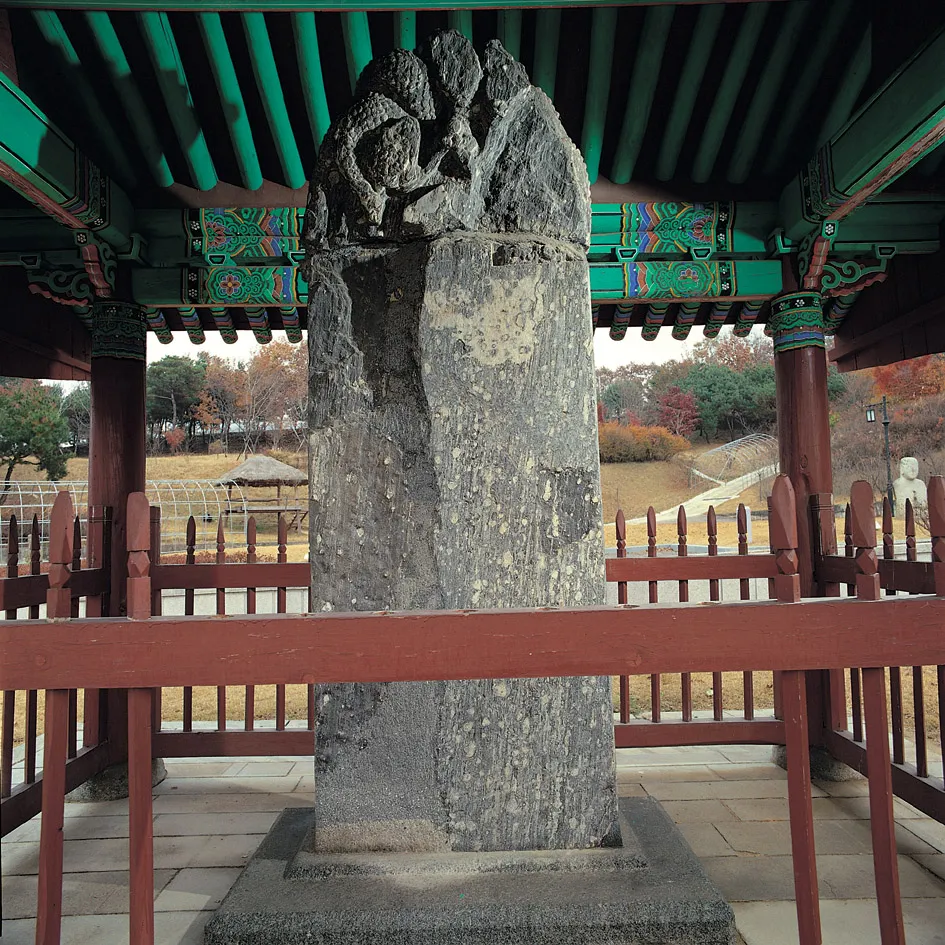
Monument for Liu Renyuan of Tang China, Buyeo
扶餘 唐 劉仁願 紀功碑
충청남도 부여군
Basic information
- Designation
- Treasure No.21
- Category
- Books & Records
- Era
- 신라시대
- Designated year
- 1963
- Location
- 부여군, 충청남도— 충남 부여군 부여읍 금성로 5, 국립부여박물관 (동남리)
- Coordinates
- 36.275668, 126.917897
AI Docent
Coming soonAn AI-generated, friendly retelling of this heritage site is available in Korean. An English version is on our roadmap — for now, please see the official description below.
Description
This monument was built to commemorate the contribution of Liu Ren-yuan, a commander of Tang China. It was found broken into three pieces lying scattered on Busosan Mountain. Upon its restoration, a small structure was erected over the monument, and it was moved to the Buyeo National Museum after Korea’s liberation from Japan in 1945. The front parts of the main stone have been chipped or hewn off, and the roof stone is also damaged in places. The inscriptions on both sides of the monument are barely legible due to the defacement. The main and roof stones were each made with a single block of stone. The roof is rounded without any angles. The roof stone features carvings of six dragons (three rising upwards on each side of the roof), all of which appear to be coiling around themselves in a struggle to seize the magic stone depicted at the center of the roof stone. This type of image was inspired by the splendid style of the early Tang period. The inscription consists of two parts: one concerns the family background of Liu Ren-yuan, the other his life and achievements, including his activities after being selected by King Taejong of Tang. He made an important contribution to King Taejong’s invasion of Goryeo, attacking and destroying the Baekje Dynasty in alliance with Su Ding-fang in 660 and subjugating the Baekje restoration movement carried out by its displaced subjects. However, the description of his activities has been partially erased by the defacement. According to Daedong geumseokseo (On the Monument of the Great East), the inscription was written by Liu Ren-yuan, but this cannot be confirmed. The monument was erected in 663 (the 3rd year of the reign of King Munmu of the Silla Dynasty), three years after the inscription was made on the Five-Story Stone Pagoda at the Jeongnimsa Temple Site. Even though it is a monument to a commander of the Tang Dynasty, it is of great historical significance for Korea. It records that King Uija of Baekje, the crown prince, and more than 700 of their subjects were taken as hostages to Tang. It also tells the story of the Baekje restoration movement and the ruined capital.
Location
지도를 불러오는 중…
Have you visited this place?
Log in and verify your visit on-site via GPS to record a stamp in My Journey. (QR verification coming later.)
Images: KOGL (khs.go.kr) · Data source: Korea Heritage Service Open API (khs.go.kr)