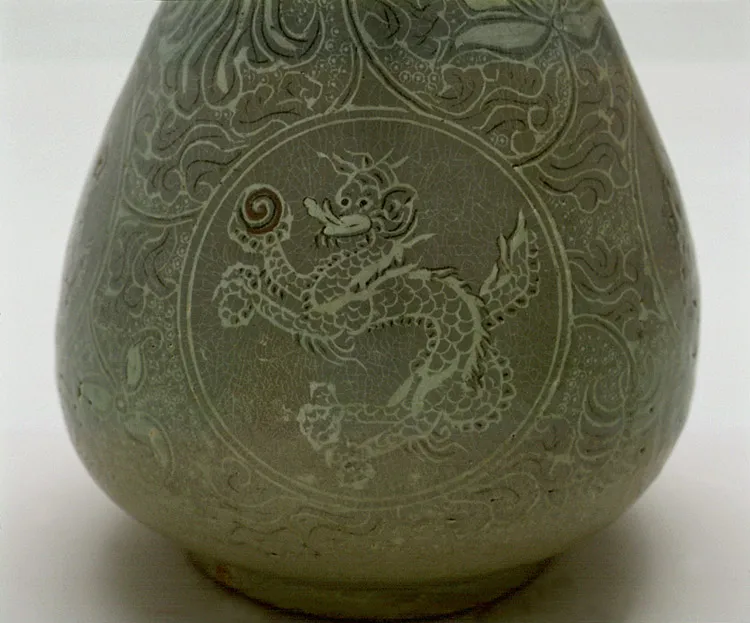
Celadon Sanggamdongchaeyeonhwadangchoyongmun Bottle
靑磁 象嵌銅彩蓮花唐草龍文 甁
서울특별시 관악구
Basic information
- Designation
- Treasure No.1022
- Category
- Craft
- Era
- 고려 14세기중반
- Designated year
- 1990
- Location
- 관악구, 서울특별시— 서울 관악구 남부순환로152길 53, 호림박물관 (신림동,호림박물관)
- Coordinates
- 37.481072, 126.918352
AI Docent
Coming soonAn AI-generated, friendly retelling of this heritage site is available in Korean. An English version is on our roadmap — for now, please see the official description below.
Description
This celadon bottle, dating back to the Goryeo Dynasty, has a long neck that is erected upright and a slightly open mouth. It is a rather big bottle, which widens gradually from the shoulder, and then expands fully at the bottom part of the bottle and narrows again. It has height of 38.3 cm, mouth diameter of 6.9 cm, and base diameter of 12 cm. It continues with a curved line that looks close to a straight line until it reaches the waist, where it has maximum circumference. Although the lower part of the body narrows drastically, it still maintains overall stability since the heel is short and wide. The glaze used on the bottle is grayish blue and transparent, and there are thin cracks all over the surface. The upper part of the bottle shows a light brown color due to partial oxidation, and the condition of glaze coating is not good. The neck area has six sectors, three of which contain designs of lightning and lotus flowers inlaid in white; the other sectors beneath contain designs of lotus flowers, chrysanthemums, clouds, and cranes inlaid in black and white. Around the shoulder are flower designs in white color, with three dots made with oxidized copper paint put inside the flower band. There are four big circles around the body of the bottle, and a portrayal of a dragon holding a cintamani -- or a wish-granting jewel -- is found in each of these circles. The cintamani appears in red because it is colored with oxidized copper. The background is filled with lotus scrolls, and the blank space has the design of sequenced beads. This is a very rare piece made from a creative technique of combining the decoration effect of the splendor created by filling the surface of the bottle with large designs and brilliance of oxidized copper. It is presumed to have been produced around the 14th century.
Location
지도를 불러오는 중…
Have you visited this place?
Log in and verify your visit on-site via GPS to record a stamp in My Journey. (QR verification coming later.)
Images: KOGL (khs.go.kr) · Data source: Korea Heritage Service Open API (khs.go.kr)