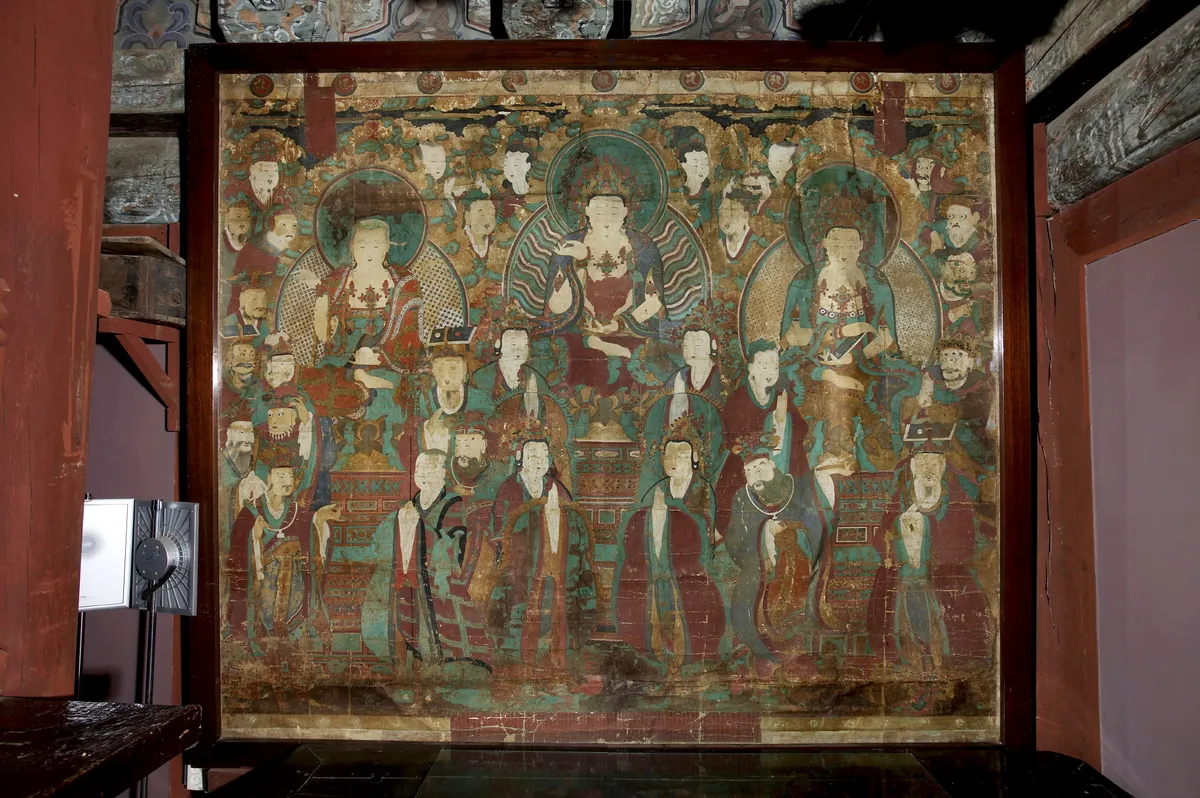
Daedunsa Samjangbosaldo, Gumi
龜尾 大芚寺 三藏菩薩圖
경상북도 구미시
Basic information
- Designation
- Treasure No.2025
- Category
- Painting
- Era
- 1740년(영조 16)
- Designated year
- 2019
- Location
- 구미시, 경상북도— 경상북도 구미시 산촌옥관로 691-78 (옥성면, 대둔사)
- Coordinates
- 36.335337, 128.242152Kakao address conversion
AI Docent
Coming soonAn AI-generated, friendly retelling of this heritage site is available in Korean. An English version is on our roadmap — for now, please see the official description below.
Description
The Altar Painting of the Tripitaka Bodhisattvas in Daedungsa Temple was produced in 1740 together with the paintings of the Vulture Peak Assembly, Indra, Yama, and Amitabha and enshrined in Daedunsa Temple although all the rest have never survived. The production of the paintings was participated by the monk-painters, such as Wollyun, Chiheum and Upyeong, who were active in and around the Gyeongsangbuk-do area. The painting portrays on a large ground, 238cm by 279cm, three bodhisattvas, of Heaven, Earth, and Underground, seated in lotus position with the Bodhisattva of Heaven at the center of the Sumeru altar. They are surrounded by other members of the assembly arranged in a well-organized formation. The painting is regarded significant in the history of Korean Buddhist painting as it created a new example for the iconography of the Tripitaka Bodhisattvas of the 18th century based on Essentials of the Brahman’s Voices on the Rite of Heaven and Earth, Darkness and Brightness, and Water and Land published in 1661. Now that the paintings of Tripitaka Bodhisattvas created before the 17th century are all outside Korea and that those of Seoktapsa Temple in Andong and Pagyesa Temple in Daegu, produced in 1699 and 1707 respectively, have been stolen, this painting is regarded as particularly important as the oldest material of its kind remaining in Korea. The use of refined brushstrokes, stable composition, and the harmony between red and green makes the painting a fine example of the Korean Buddhist painting in the first half of the 18th century and, together with the painting of the same subject enshrined in Namjangsa Temple in Sangju, which was completed in 1741, provides criteria for the paintings of the Tripitaka Bodhisattvas produced in the Gyeongsangbuk-do area in the first half of the 18th century.
Location
지도를 불러오는 중…
Have you visited this place?
Log in and verify your visit on-site via GPS to record a stamp in My Journey. (QR verification coming later.)
Images: KOGL (khs.go.kr) · Data source: Korea Heritage Service Open API (khs.go.kr)