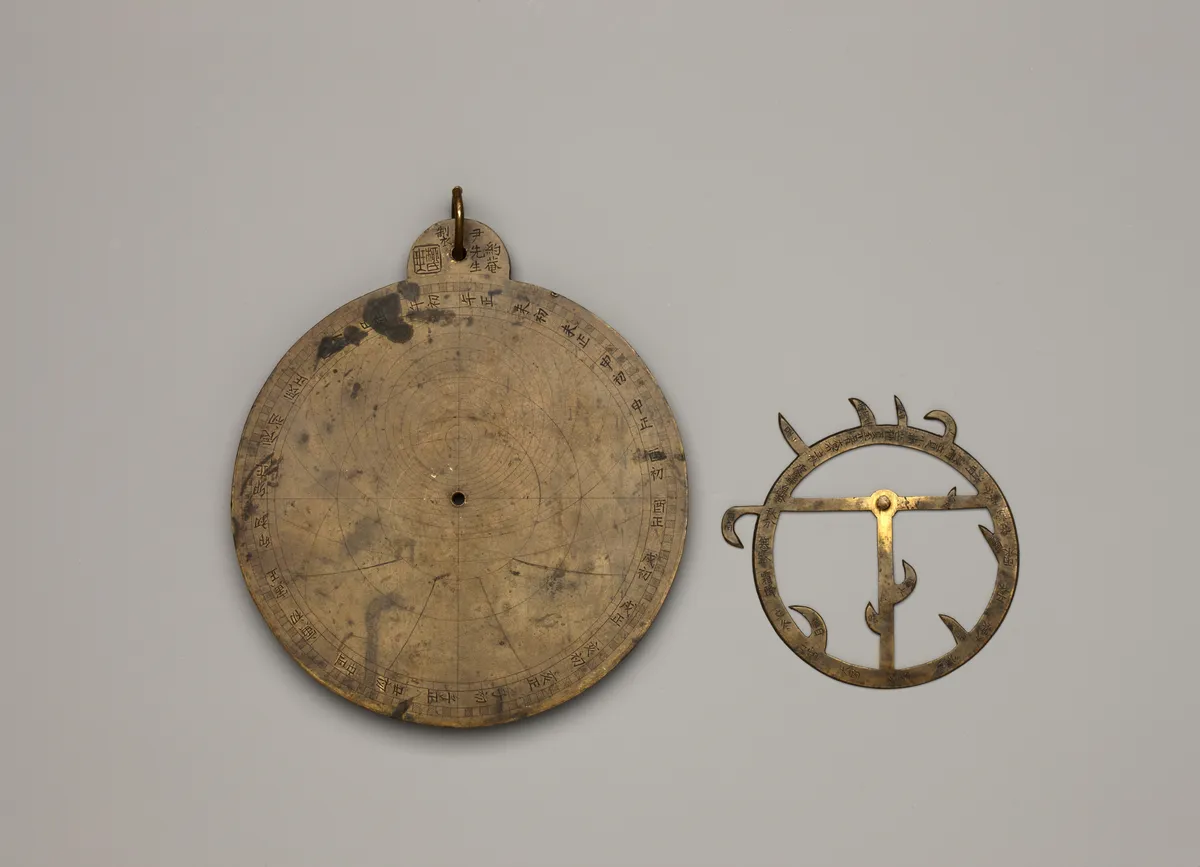
Hongaetongheonui
渾蓋通憲儀
경기도 남양주시
Basic information
- Designation
- Treasure No.2032
- Category
- Craft
- Era
- 1787년(정조 11)
- Designated year
- 2019
- Location
- 남양주시, 경기도— 경기도 남양주시 다산로747번길 16 (조안면, 문화재관리용건축물) 실학박물관
- Coordinates
- 37.516000, 127.300635Kakao address conversion
AI Docent
Coming soonAn AI-generated, friendly retelling of this heritage site is available in Korean. An English version is on our roadmap — for now, please see the official description below.
Description
Hongaetongheonui (Celestial Globe) is an astronomic timepiece that was designed on the basis of traditional oriental cosmology. It was made by Yu Geum (1741-1788), a Silhak scholar of the Joseon Period, in 1787 (the 11th year of the reign of King Jeongjo) based on a Western astrolabe introduced to the country via China. The round rotating constellation plate is fitted by a pin into the hole in the center, which represents the North Pole, of the round main board. The circumference of the main board is divided into 24 sections, in which the daily hours are engraved clockwise, along with the Tropic of Capricorn, the Equator, the concentric circles of the Tropic of Cancer, and horizontal coordinates. The “T”-shaped form links the North Pole and the points of the vernal equinox and winter solstice on the ecliptic on the constellation plate. Both axis and ecliptic are portrayed on one plate. It also features eleven indicators distinguished from specific stars. The constellation on the main board and the plate are essentially based on 渾蓋通憲圖說 (Hungaitongxiantushuo) of China, but it includes original stars which were observed for the country’s situation. It shows that Yu Geum fully understood the contents of the Chinese book c and was well versed in geometry. Hongaetongheonui shows how a leading intellectual of Joseon understood western astronomy and geometry and adapted them to his own purposes. The principles and level of precision of its production attest to the advanced nature of mathematics and astronomy in late Joseon. It is also the only known astronomical apparatus to have been made in East Asia around that time, and features the twelve ecliptics and twenty-four subdivisions of the seasons neatly engraved on the bronze plate in Chinese characters, displaying Koreans’ esthetic sensibility and metalworking skills with the characteristic emphasis on simplicity and restraint.
Location
지도를 불러오는 중…
Have you visited this place?
Log in and verify your visit on-site via GPS to record a stamp in My Journey. (QR verification coming later.)
Images: KOGL (khs.go.kr) · Data source: Korea Heritage Service Open API (khs.go.kr)