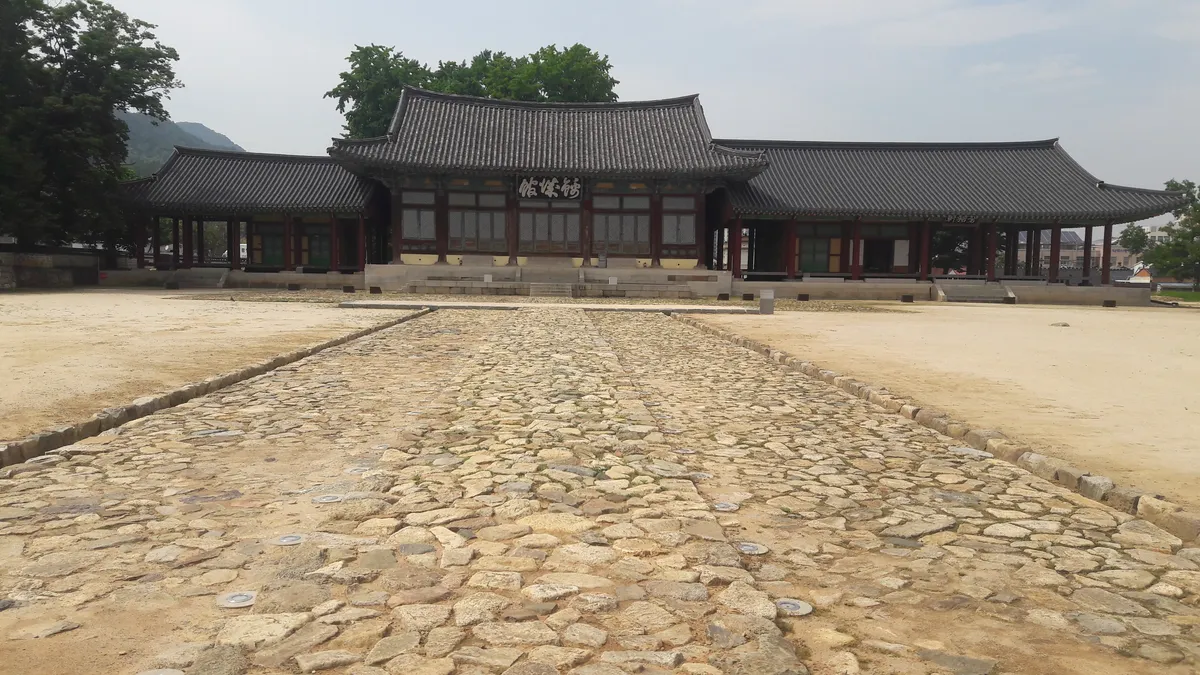
Geumseonggwan, Naju
羅州 錦城館
전라남도 나주시
Basic information
- Designation
- Treasure No.2037
- Category
- Architecture
- Era
- 조선시대
- Designated year
- 2019
- Location
- 나주시, 전라남도— 전라남도 나주시 금성관길 8 (과원동, 나주금성관)
- Coordinates
- 35.033329, 126.716482
AI Docent
Coming soonAn AI-generated, friendly retelling of this heritage site is available in Korean. An English version is on our roadmap — for now, please see the official description below.
Description
The Geumseonggwan Guesthouse is a Gaeksa, a type of guesthouse where foreign envoys used to stay during the Joseon Period and where wooden plaques containing the Chinese characters “殿” and “闕”, symbols of the king, were kept so that local government administrators could pay their respects there. Based on ancient records and its structural pattern, it is assumed that the overall structure is more or less the same as it was after being renovated in 1617. Indeed, the overall wooden structure and the details of the roof-supporting bracket system display the techniques used at the time of the building’s renovation in 1775 and 1885. The structure of its bird wing-shaped bracket supporting eaves that adopts a system using brackets only on columns looks particularly conspicuous. The use of a roof-supporting bracket system with three bird wing-shaped brackets supporting the eaves with only one arm appears to have been chosen to embellish the hall with limited resources. Its platform, plane, elevation, and ceiling resemble those of the main hall of a royal palace rather than those of an ordinary gaeksa. As for the main hall, it is larger than any other gaeksa structures of the Joseon Period and has a hip-and-gable roof, rather than a gable roof (“八”-shaped from the side) like those of other main halls. Given that the nearby Naju Hyanggyo Daeseongjeon Hall (where sacrificial rites were performed for Confucius and the great Confucian scholars) also has a hip-and-gable roof, it appears that this kind of roof was a local development.
Location
지도를 불러오는 중…
Have you visited this place?
Log in and verify your visit on-site via GPS to record a stamp in My Journey. (QR verification coming later.)
Images: KOGL (khs.go.kr) · Data source: Korea Heritage Service Open API (khs.go.kr)