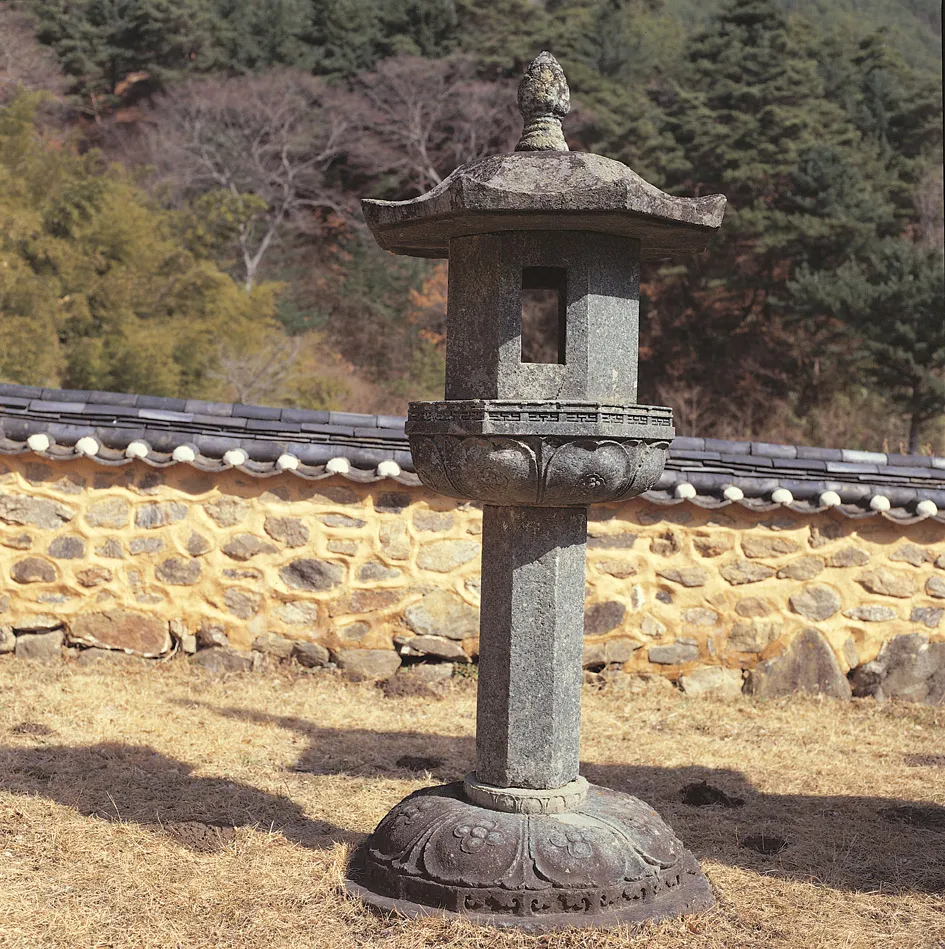
Stone Lantern at Baekjangam Hermitage of Silsangsa Temple, Namwon
南原 實相寺 百丈庵 石燈
전북특별자치도 남원시
Basic information
- Designation
- Treasure No.40
- Category
- Sites & Pagodas
- Era
- 통일신라시대
- Designated year
- 1963
- Location
- 남원시, 전북특별자치도— 전북 남원시 산내면 대정리 975번지 실상사 백장암
- Coordinates
- 35.442561, 127.619955
AI Docent
Coming soonAn AI-generated, friendly retelling of this heritage site is available in Korean. An English version is on our roadmap — for now, please see the official description below.
Description
Silsangsa Temple, located to the west of Cheonwangbong Peak, was constructed in 828 (the third year of the reign of King Heungdeok of the Silla Dynasty) when Hong Cheok (later granted the posthumous title of called National Priest Jeunggak) established the Buddhist sect of Silsangsan Mountain as one of the nine mountains of the Zen Order. Several important relics are preserved within the enclosure situated to the south of Baekjangam Hermitage, including the stone lantern and the Three-story Stone Pagoda at Baekjangam Hermitage of Silsangsa Temple, Namwon (National Treasure No. 10). This stone structure, located at Baekjangam Hermitage of Silsangsa Temple, consists of a three-layer base at the bottom, an octagonal stone lantern with a window in each of its eight faces at the center, and a roof with ornamentation at the top. In terms of its overall ornamentation, the base of the stone lantern is carved with an octagonal pillar at the center; the upper and lower layers are carved with eight symmetrically arranged lotus petals; and the finial is decorated with a large lotus bud. As the foundation of the lantern is buried under solid ground, the nature of the lower part of the structure cannot be determined. In general, the lantern displays the basic octagonal structure of stone lanterns of the Unified Silla Period. Judging by the engraving techniques applied to each part, the lantern is estimated to have been built in the ninth century, during the late the Unified Silla Period.
Location
지도를 불러오는 중…
Have you visited this place?
Log in and verify your visit on-site via GPS to record a stamp in My Journey. (QR verification coming later.)
Images: KOGL (khs.go.kr) · Data source: Korea Heritage Service Open API (khs.go.kr)