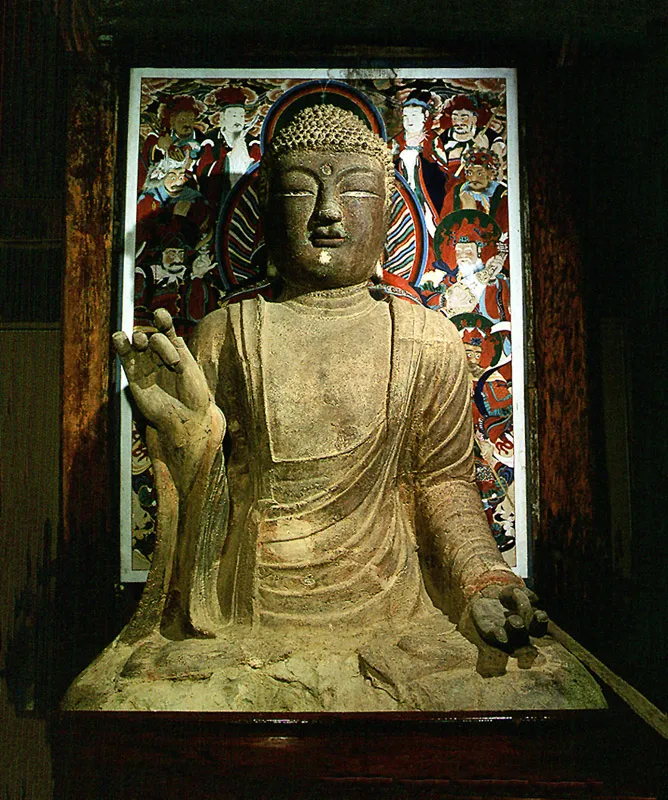
Iron Seated Buddha of Silsangsa Temple, Namwon
南原 實相寺 鐵造如來坐像
전북특별자치도 남원시
Basic information
- Designation
- Treasure No.41
- Category
- Sculpture
- Era
- 통일신라시대
- Designated year
- 1963
- Location
- 남원시, 전북특별자치도— 전북특별자치도 남원시 실상사길 265(산내면, 실상사)
- Coordinates
- 35.416933, 127.635332
AI Docent
Coming soonAn AI-generated, friendly retelling of this heritage site is available in Korean. An English version is on our roadmap — for now, please see the official description below.
Description
A representative artwork of the late Unified Silla period, this iron statue of a seated Buddha has been preserved since the foundation of Silsangsa Temple in the early ninth century and is justly very famous. During the late Unified Silla Period, iron statues of Buddha were made by many Zen Buddhist temples around the country, and this particular example clearly exhibits the style of Buddha statues of that time. The Buddha’s hair is expressed in the curly nabal style (i.e. twirled up and around in a seashell-shaped fashion), and a small usnisa (a protuberance symbolizing supreme wisdom) can be seen on top of his head. The Buddha’s ears are reasonably long, while the samdo, i.e. the three wrinkles on the neck, can hardly be seen. The low brow, crescent-shaped eyes, and closed mouth convey a serious expression unlike the lively, gentle image of the Buddha statues of the previous period. Although the Buddha’s shoulders are smooth and his chest curved, the overall impression is of a dull clumsiness, while the Buddha’s beobui (sacerdotal robe), draped over both shoulders, gives off a heavy feeling. The wrinkles in the garments are shaped like short "U"s, a popular technique of the time. The iron seated Buddha at Silsangsa Temple was one of many iron statues made during the period of transition from the tense and vital works of the eighth century to the more subdued style of the ninth century.
Location
지도를 불러오는 중…
Have you visited this place?
Log in and verify your visit on-site via GPS to record a stamp in My Journey. (QR verification coming later.)
Images: KOGL (khs.go.kr) · Data source: Korea Heritage Service Open API (khs.go.kr)