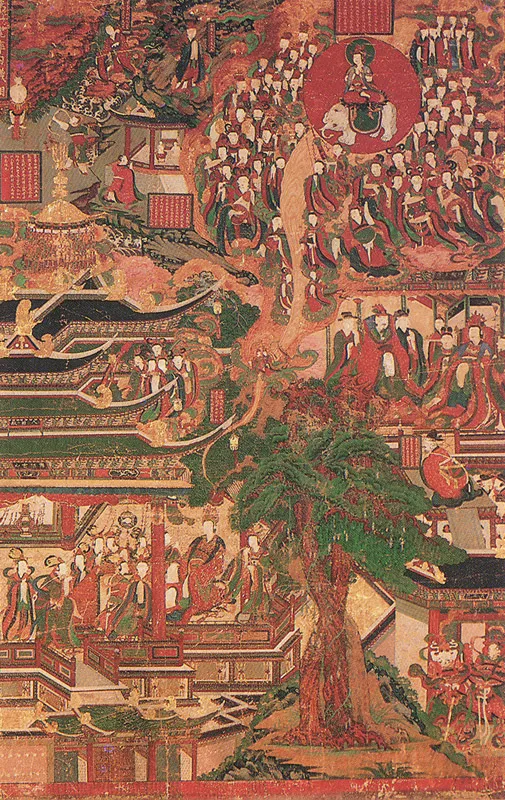
Tongdosa Yeongsanjeon Palsangdo
通度寺 靈山殿 八相圖
경상남도 양산시
Basic information
- Designation
- Treasure No.1041
- Category
- Painting
- Era
- 영조 51, 1775년
- Designated year
- 1990
- Location
- 양산시, 경상남도— 경남 양산시 하북면 통도사로 108, 통도사성보박물관 (지산리)
- Coordinates
- 35.487956, 129.064387
AI Docent
Coming soonAn AI-generated, friendly retelling of this heritage site is available in Korean. An English version is on our roadmap — for now, please see the official description below.
Description
This type of painting is called palsangdo, meaning “painting of the eight great events”; it depicts the eight significant scenes of the life of Buddha from birth to his entering nirvana after cultivating his spiritual sense. Measuring 233.5 cm long and 151 cm wide, this painting was painted by several artists in 1775 (51st year of the reign of King Yeongjo of the Joseon Dynasty) and is now set in a frame and hung on the wall of Yeongsanjeon Hall. The first section of this painting depicts Sakyamuni Buddha riding a white elephant to come to the world of suffering from Tushita Heaven; the second section depicts Queen Maya giving birth to Sakyamuni through her side in a garden at Lumbini. In the third section, Sakyamuni realizes the frailty of life after seeing the hard and painful life of ordinary people living outside the castle; thus, he leaves the palace despite his parents’ objection in the fourth section. The fifth and sixth sections deal with his spiritual exercise. He disciplines himself on a snowy mountain with the wise hermits, overcoming all temptations and threats. The seventh section depicts his first sermon at Deer Park, whereas the eighth section is about his entering Nirvana under the twin sala tree. Each section portrays the long and epic story of Sakyamuni Buddha very concisely and skillfully. Since this painting has been preserved very well, and its exact production date is known, it is regarded as a very important material for the research on the Buddhist paintings made in the Joseon Period.
Location
지도를 불러오는 중…
Have you visited this place?
Log in and verify your visit on-site via GPS to record a stamp in My Journey. (QR verification coming later.)
Images: KOGL (khs.go.kr) · Data source: Korea Heritage Service Open API (khs.go.kr)