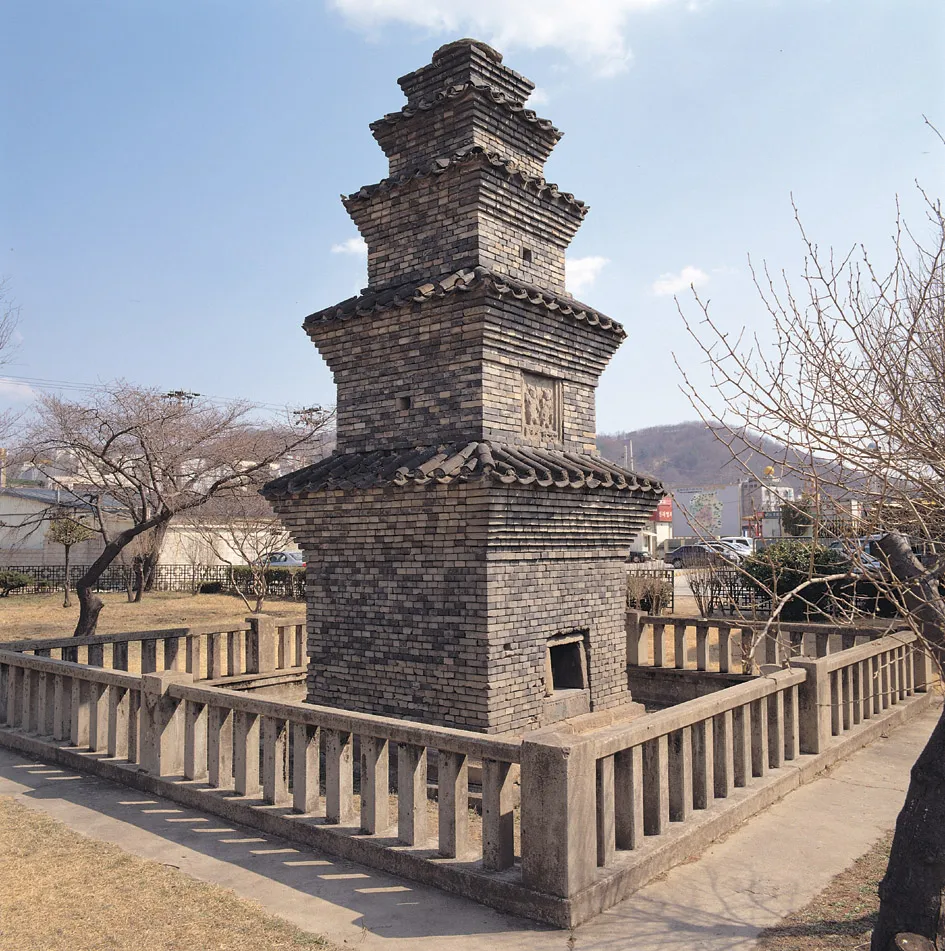
Five-story Brick Pagoda in Unheung-dong, Andong
安東 雲興洞 五層塼塔
경상북도 안동시
Basic information
- Designation
- Treasure No.56
- Category
- Sites & Pagodas
- Era
- 통일신라시대
- Designated year
- 1963
- Location
- 안동시, 경상북도— 경북 안동시 운흥동 231번지
- Coordinates
- 36.562549, 128.731387
AI Docent
Coming soonAn AI-generated, friendly retelling of this heritage site is available in Korean. An English version is on our roadmap — for now, please see the official description below.
Description
This five-story brick pagoda is located in the vicinity of Andong Station. Andong province contains a number of unique brick pagodas (built with the earthen bricks) of a kind rarely found in other areas. The main body of this five-story pagoda was built with pattern-less bricks. Every story has a niche for housing a statue of the Buddha, with the southern side of the second story housing two temple guardians. The width of the eaves is much shorter than that of stone pagodas due to the use of bricks. The number of base plates for the roof falls from ten in the first story, to eight, six, four and finally three in the other stories. The supporting tiles along the edge of eaves are made of wood. The fourth story has a tiled roof. This sort of roof design complete with niches originates from wooden pagodas. On the top, only a stone shaped like an over-turned bowl to support the top ornament remains. This brick pagoda, believed to be the one at Beomnimsa Temple mentioned in the record written in Dongguk yeoji seungnam (Augumented Survey of the Geography of Korea, 1481) and Yeonggaji (Record of the Andong Region, 1608), was erected in the Unified Silla Period (668-935). Historians presume that the actual pagoda differs greatly from the original one, as Yeonggaji records that the brick pagoda at Beomnimsa Temple was a seven-story structure, and because it underwent major repair work during the Joseon Dynasty (1392-1910). The record also states that its gilt bronze finial, like the top ornament of Beopheungsa Temple, was stolen by soldiers of the Ming Dynasty right after the Japanese invasion of Korea of 1592-98.
Location
지도를 불러오는 중…
Have you visited this place?
Log in and verify your visit on-site via GPS to record a stamp in My Journey. (QR verification coming later.)
Images: KOGL (khs.go.kr) · Data source: Korea Heritage Service Open API (khs.go.kr)