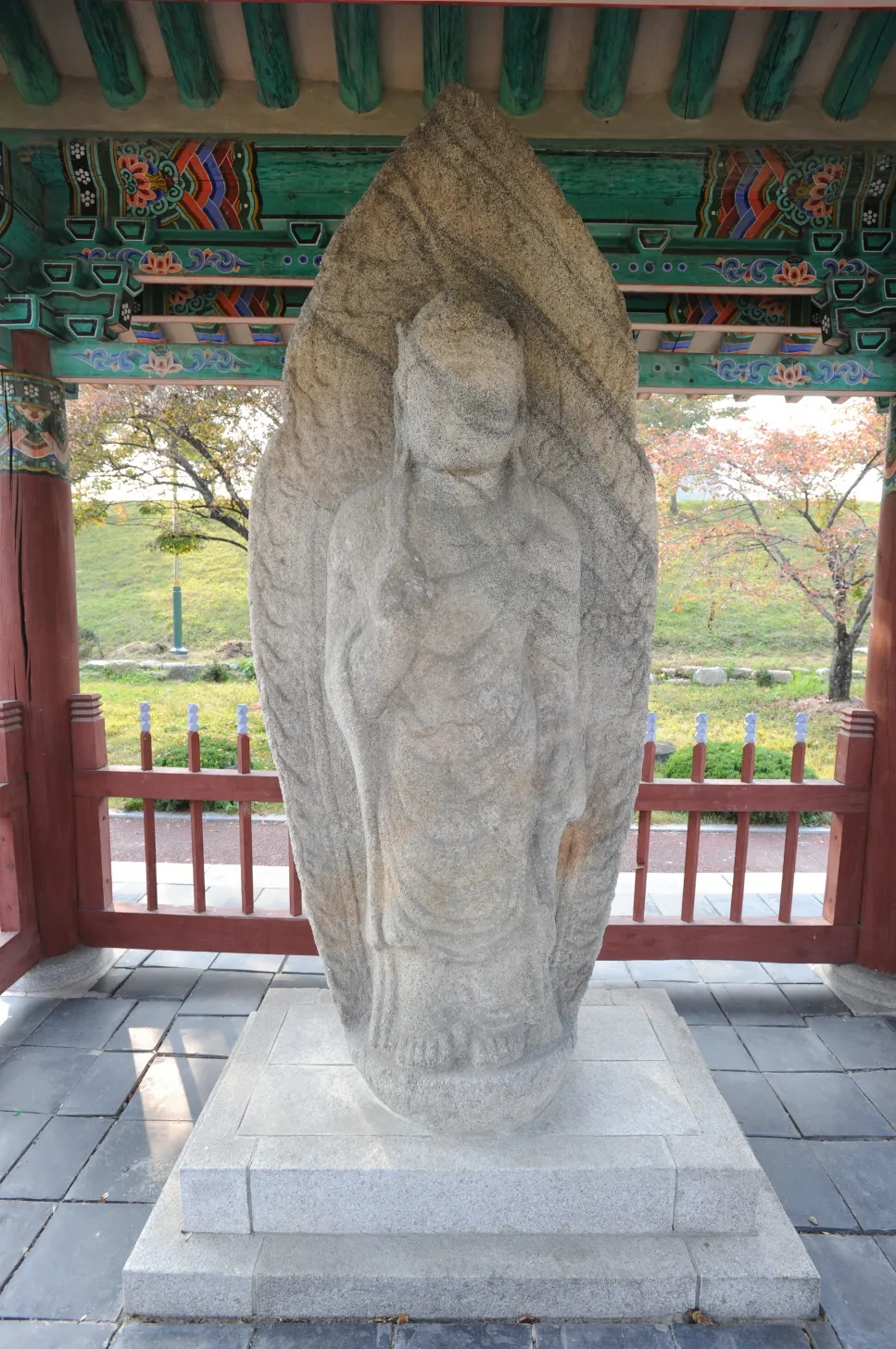
Stone Standing Buddha in Yeongju-dong, Yeongju
榮州 榮州洞 石造如來立像
경상북도 영주시
Basic information
- Designation
- Treasure No.60
- Category
- Sculpture
- Era
- 통일신라시대
- Designated year
- 1963
- Location
- 영주시, 경상북도— 경상북도 영주시 중앙로 7 (가흥동)
- Coordinates
- 36.819147, 128.617110
AI Docent
Coming soonAn AI-generated, friendly retelling of this heritage site is available in Korean. An English version is on our roadmap — for now, please see the official description below.
Description
This almost complete statue of a Bodhisattva was originally located at the temple site in Yeongju City, and was only recently moved to its current location in Yeongju-dong, Yeongju. Both the mandorla (Buddhist halo of light) and Bodhisattva are carved out of one single piece of stone. Its thick neck and broad round shoulders create a powerful, solid impression, while the thick arms and legs, rough hands and feet, and other parts of the body exhibit a powerful manly appearance overall. The flat square face and the thick lips in particular are similar to those of the Rock-carved Buddha Triad and Seated Buddha in Gaheung-dong, Yeongju (Treasure No. 221), Stone Standing Buddha in Seokgyo-ri, Yeongju (Treasure No. 116), and other Buddha statues in the region. A unique characteristic of the Buddha’s clothing is the knot at the left armpit, the hem of which is zigzagged on top of the arm. This is a very rare feature in Korea, as the only another example can be seen on the Gilt-bronze Standing Bhaisajyaguru Buddha (Treasure No. 328) that is now kept at the National Museum of Korea. The mandorla, which expresses the light emanating from the body, has sharp edges. The line dividing the dugwang (light radiating from the head) and the singwang (light emanating from the body) is unmistakable. The clearly defined contours of this work reveal that it was made before the construction of the Stone Standing Amitabha Buddha of Gamsansa Temple, Gyeongju (National Treasure No. 82), which was built in 720. This wonderful Bodhisattva statue with its robust body and compelling energy is a powerful, informal piece, although its overall expression is neither refined nor brilliant. Judging from the characteristics of the body and mandorla, it was probably made during late Unified Silla.
Location
지도를 불러오는 중…
Have you visited this place?
Log in and verify your visit on-site via GPS to record a stamp in My Journey. (QR verification coming later.)
Images: KOGL (khs.go.kr) · Data source: Korea Heritage Service Open API (khs.go.kr)