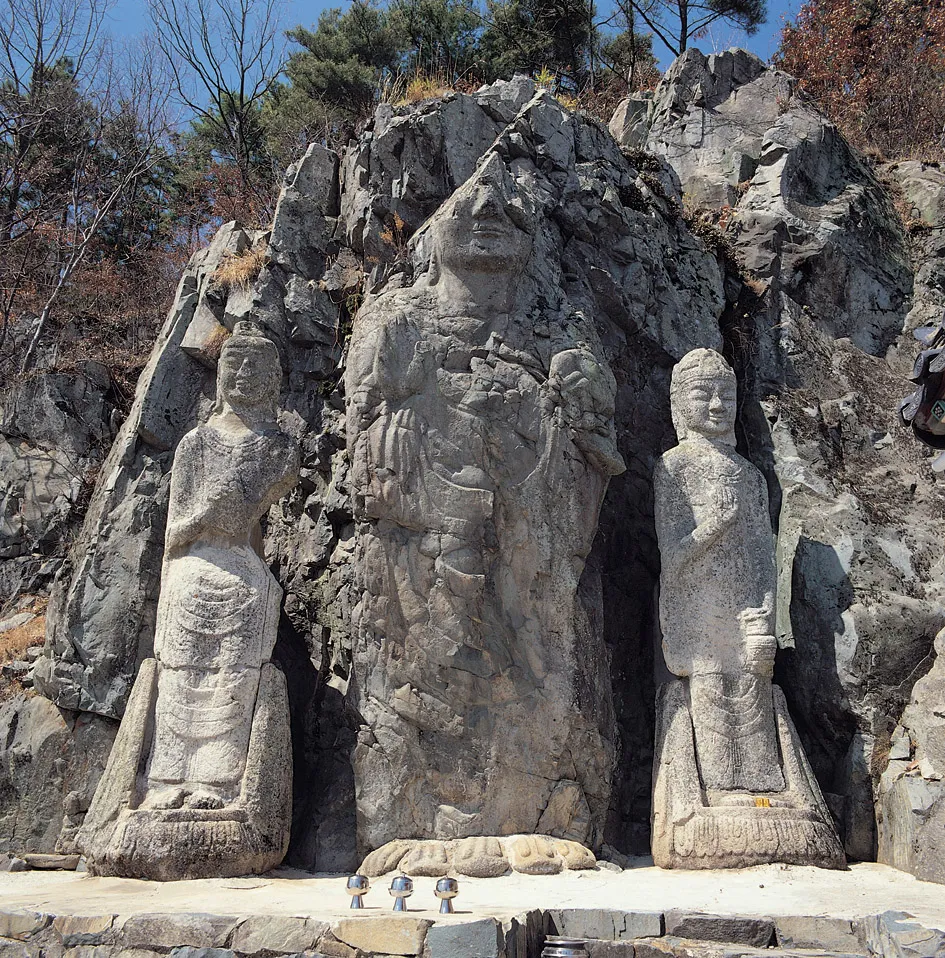
Rock-carved Standing Buddha Triad in Seoak-dong, Gyeongju
慶州 西岳洞 磨崖如來三尊立像
경상북도 경주시
Basic information
- Designation
- Treasure No.62
- Category
- Sculpture
- Era
- 통일신라시대
- Designated year
- 1963
- Location
- 경주시, 경상북도— 경상북도 경주시 서악동 산 92-1
- Coordinates
- 35.833525, 129.175897
AI Docent
Coming soonAn AI-generated, friendly retelling of this heritage site is available in Korean. An English version is on our roadmap — for now, please see the official description below.
Description
This Buddha triad, made during the mid-seventh century, consists of a huge standing statue of Amitabha Buddha carved on a seven-meter-high rock cliff near the top of Seondosan Mountain, flanked by a statue of Avalokitesvara Bodhisattva on the left and one of the Mahasthamaprapta Bodhisattva on the right. The standing Amitabha Buddha statue, which presides over the ‘Pure Land’ in the west of the universe, has been severely damaged. Part of the head is missing and the face is damaged around the eyes. However, the remaining features such as the cheeks, chin, and curled lips realistically express Buddha's mercy and willpower. The broad shoulders and majestic-looking body give an impression of inviolable power and dignity. The beobui (sacerdotal robe) looks rather heavy, exhibiting a simple "U" shaped pattern on its front. The statue of Avalokitesvara, the Buddhist Goddess of mercy who saved the world, displays an elegant smile of religious exultation. Every single detail of the statue exhibits exquisite workmanship, and its delicately expressed body has more curves than the principal statue. The Mahasthamaprapta, who is supposed to eliminate mankind's foolishness, is identical to the Avalokitesvara statue, except for its square face with wide open eyes, which gives off a manly aura of strength, and its hands. This Buddha triad is a masterpiece originating from the period of transition from the Three Kingdoms Period to the Unified Silla Period. The principal Amitabha Buddha statue is 7 meters tall, the Avalokitesvara statue, 4.55 meters tall, and the Mahasthamaprapta, 4.62 meters tall.
Location
지도를 불러오는 중…
Have you visited this place?
Log in and verify your visit on-site via GPS to record a stamp in My Journey. (QR verification coming later.)
Images: KOGL (khs.go.kr) · Data source: Korea Heritage Service Open API (khs.go.kr)