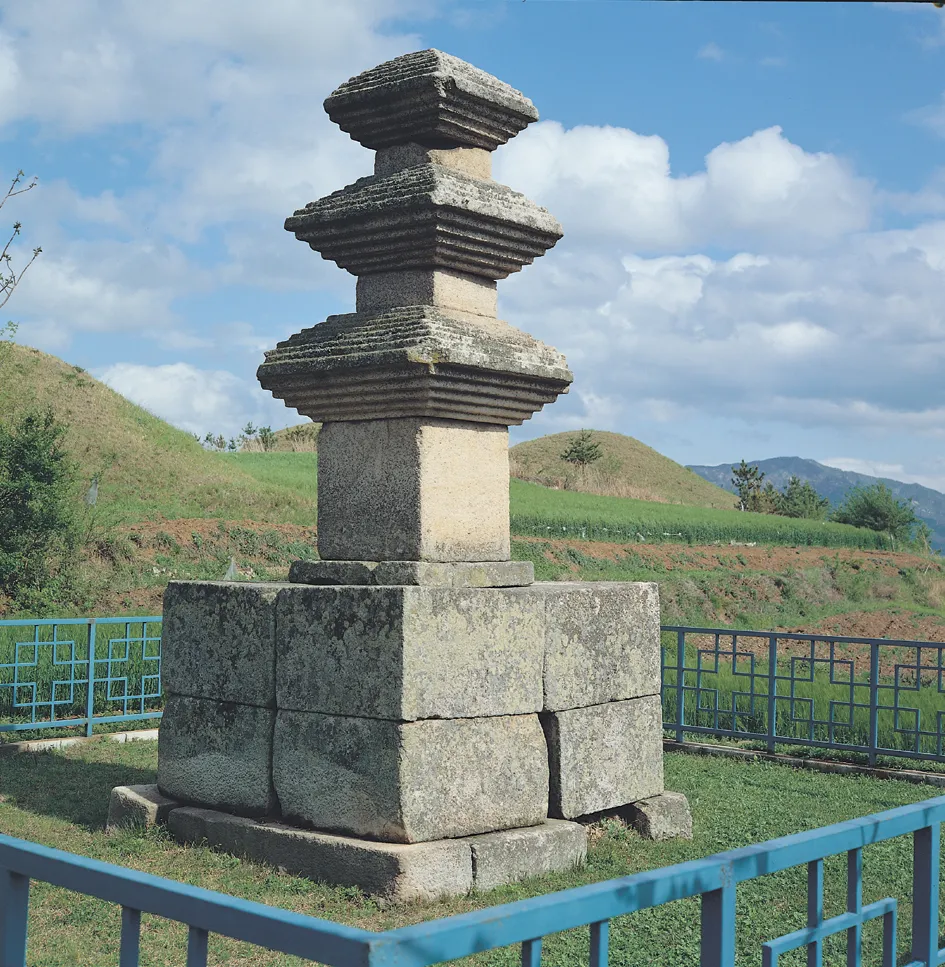
Three-story Stone Pagoda in Seoak-dong, Gyeongju
慶州 西岳洞 三層石塔
경상북도 경주시
Basic information
- Designation
- Treasure No.65
- Category
- Sites & Pagodas
- Era
- 통일신라시대
- Designated year
- 1963
- Location
- 경주시, 경상북도— 경북 경주시 서악동 705-1번지
- Coordinates
- 35.827960, 129.184827
AI Docent
Coming soonAn AI-generated, friendly retelling of this heritage site is available in Korean. An English version is on our roadmap — for now, please see the official description below.
Description
This pagoda, one of many Unified Silla stone pagodas built with stone bricks, stands on gentle hill to the northeast of the Tomb of King Muyeol. In general, stone brick pagodas were made with stones trimmed into bricks, in the style of earthen-brick pagodas. The pagoda stands on an irregularly-shaped base made of eight cubic stone blocks on a stylobate composed of four long, thick stone plates. To support the body stone, a flat stone is inserted into the upper part of the stylobate, which is much simpler than that of the third story of the Namsanri stone pagoda. Both the main stone and the roof stone of the body were hewn from one piece of stone. The core stone of the first story has a big square niche (holding a Buddha statue) carved with the design of a door, on each side of which is carved one of the temple’s guardian deities (Vajradhara) are sculpted on both sides. Each roof stone is hewn from one block of stone, and its cornice and upper part are engraved with a ‘step’ design. The eaves are horizontal. Judging from the distinctive style of the stylobate, this pagoda is a replica of the East and West Three-story Stone Pagodas in Namsan-dong, Gyeongju (Treasure No. 124). However, the three-story stone pagodas in Namsa-dong have a three-tiered stylobate, while the stone pogoda in Seoak-dong has a stylobate made from one piece of stone. As such, it is estimated that the three-story stone pagoda in Seoak-dong was built in the late Unified Silla Period when the kingdom was in decline. The roof of each story is proportionately larger than its core stone, creating an unbalanced and rather heavy impression.
Location
지도를 불러오는 중…
Have you visited this place?
Log in and verify your visit on-site via GPS to record a stamp in My Journey. (QR verification coming later.)
Images: KOGL (khs.go.kr) · Data source: Korea Heritage Service Open API (khs.go.kr)