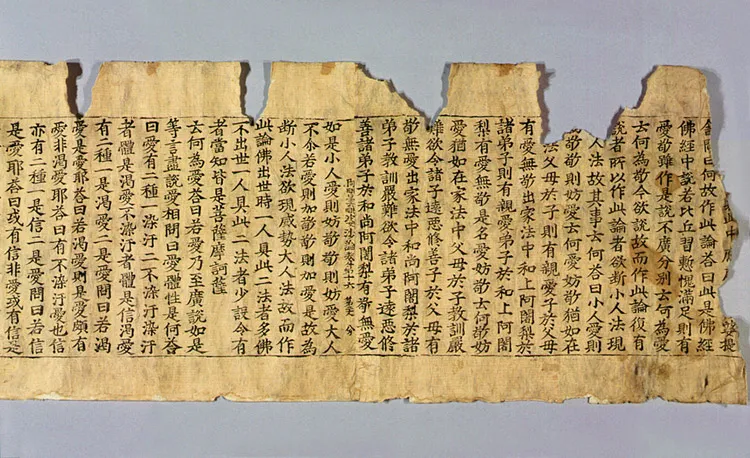
Chojobon Abidambibasaron Gwon16
初雕本 阿毗曇毗婆沙論 卷十六
서울특별시 관악구
Basic information
- Designation
- Treasure No.1075
- Category
- Books & Records
- Era
- 고려시대
- Designated year
- 1991
- Location
- 관악구, 서울특별시— 서울 관악구 남부순환로152길 53, 호림박물관 (신림동,호림박물관)
- Coordinates
- 37.481072, 126.918352
AI Docent
Coming soonAn AI-generated, friendly retelling of this heritage site is available in Korean. An English version is on our roadmap — for now, please see the official description below.
Description
Buddhist texts can be largely divided into three types: gyeong (scripture), yul (law), and non (annotation). The word sastra is used to indicate an “annotation”-type text, which is a commentary written to explain a Buddhist scripture or sutra. In particular, this Abhidharma vibhasa Sastra is a book that systematically describes the wisdom of Buddha for the attainment of Buddhahood. Published as the First Tripitaka Koreana Edition to overcome the invasion of Khitan with the help of Buddha during the reign of King Hyeonjong (r. 1011-1031) of the Goryeo Dynasty, it was translated by Buddhavarman and Daotai of the Northern Liang. This book was printed on 26 sheets of mulberry paper using woodblocks and was kept as a scroll, measuring 47.3 cm wide and 30 cm long. There are several differences between the First Tripitaka Koreana Edition and the Second Edition kept at Haeinsa Temple. While the carving of the woodblocks is elaborate, it is different from the Second Tripitaka Koreana Edition in terms of the number of characters; it also has pihwi (to abbreviate or replace with other letters out of respect for the name of the late king) or abbreviation without a record of the publication period. There is a difference in the indication of number of pages between the two editions as well. This book uses the Chinese character “丈 (jang)” or “幅 (pok)” to indicate the number of pages without a record of the publication period, whereas the second edition uses “張 (jang).” Its publication period is estimated to be the 12th century, judging from its printing state and the quality of paper.
Location
지도를 불러오는 중…
Have you visited this place?
Log in and verify your visit on-site via GPS to record a stamp in My Journey. (QR verification coming later.)
Images: KOGL (khs.go.kr) · Data source: Korea Heritage Service Open API (khs.go.kr)