Malmoi Wongo
말모이 原稿
서울특별시 용산구
Basic information
- Designation
- Treasure No.2085
- Category
- Books & Records
- Era
- 1914년 경
- Designated year
- 2020
- Location
- 용산구, 서울특별시— 서울특별시 용산구 서빙고로 139 (용산동6가, 국립한글박물관)
- Coordinates
- 37.521069, 126.980486Kakao address conversion
AI Docent
Coming soonAn AI-generated, friendly retelling of this heritage site is available in Korean. An English version is on our roadmap — for now, please see the official description below.
Description
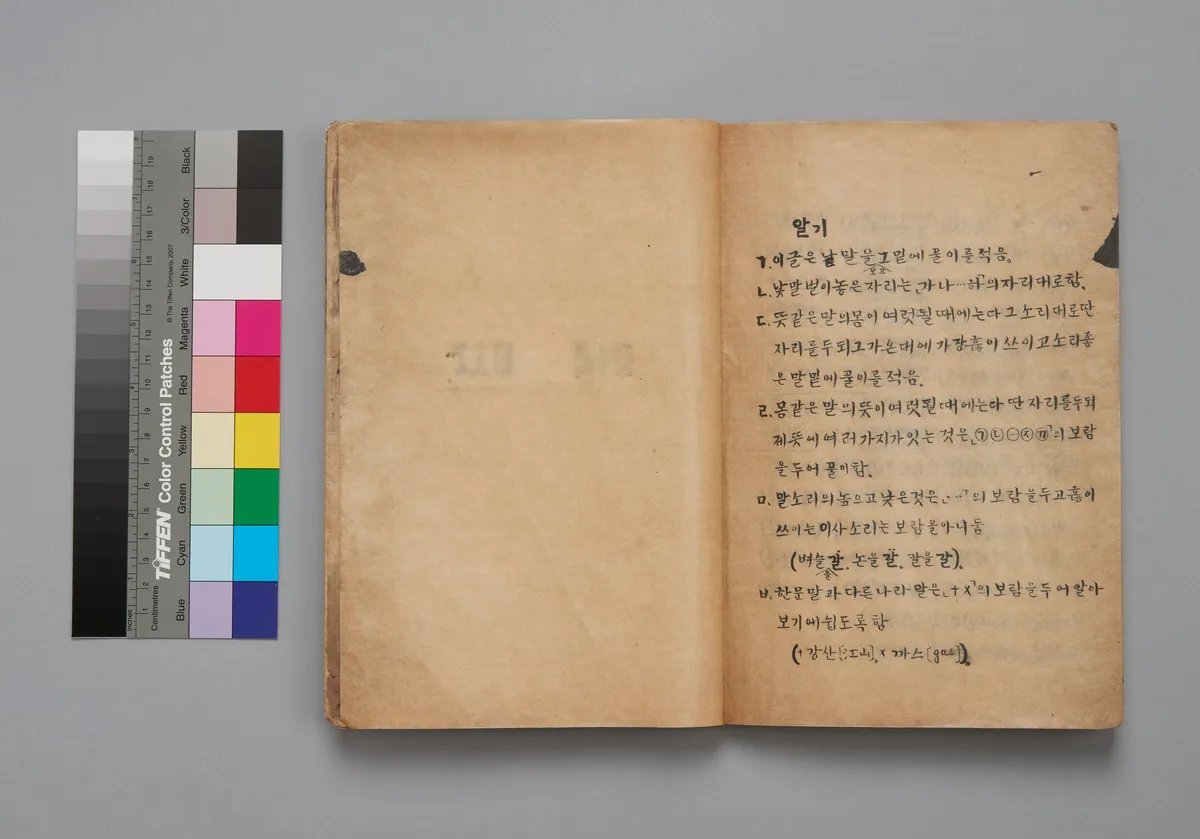
The Manuscript of Malmoi (Treasure No. 2085) is the original manuscript for the country’s first Hangeul (Korean alphabetic script) dictionary, entitled Malmoi, which was compiled by the scholar JU Sigyeong (1876-1914) at the Joseongwangmunhoe, an academic organization , and his students Kim Dubong (1889-?), Yi Gyuyeong (1890-1920), and Kwon Deokgyu (1891-1950). They began compiling the manuscript in 1911 and continued until 1914, when Ju Sigyeong passed away. It is assumed that the manuscript was composed of many volumes, but there is now only one remaining volume, which starts with “ㄱ ”, the first consonant of Hangeul. The manuscript was handwritten in classic brush-style calligraphy on sheets of Korean manuscript paper, each containing 240 letters and composed of four parts, i.e. notes, main text, index, and search by the number of strokes. One of the notable features of the manuscript is the style of the edition, which was specially produced in the form of a handwritten manuscript for the publication of a dictionary that displays the said parts at a glance. Each page of the manuscript provides information on the first and last words on the page and how the consonants, vowels, Chinese characters, and loanwords are marked. In 1916, GIM Dubong, etc. published Joseon Malbon, a Korean grammar book based on the manuscript. The manuscript itself could not be turned into a book as GIM Dubong was compelled to flee to Shanghai, China following the March 1, 1919 Independence Movement and YI Gyuyeong’s death. However, it evetually served as a stepping stone to be publication of Korean dictionaries including Joseonmal Keun Sajeon. The Manuscript of Malmoi is of great value and significance from the historic and academic perspectives, both as a material associated with the early modern history of Hangeul, displaying Koreans’ capability to compile a dictionary, and as a testimony to the Korean people’s struggle to preserve their language and writing system during the Japanese colonial period.
Location
지도를 불러오는 중…
Have you visited this place?
Log in and verify your visit on-site via GPS to record a stamp in My Journey. (QR verification coming later.)
Images: KOGL (khs.go.kr) · Data source: Korea Heritage Service Open API (khs.go.kr)