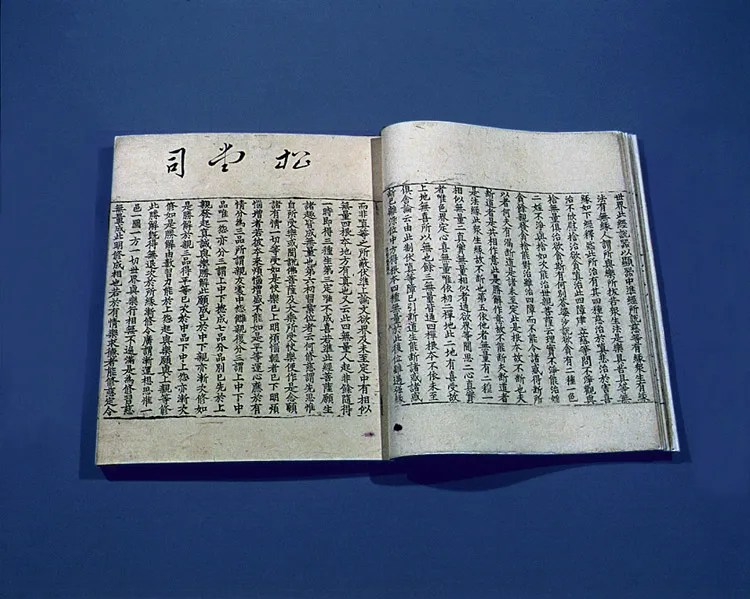
Commentary on the Maha parinirvana Sutra (The Nirvana Sutra), Volumes 9-10
大般涅槃經疏 券九~十
전라남도 순천시
Basic information
- Designation
- Treasure No.90
- Category
- Books & Records
- Era
- 조선 세조 7년(1461년) 중수
- Designated year
- 1963
- Location
- 순천시, 전라남도— 전남 순천시 송광면 송광사안길 100, 송광사 (신평리)
- Coordinates
- 35.002169, 127.275655
AI Docent
Coming soonAn AI-generated, friendly retelling of this heritage site is available in Korean. An English version is on our roadmap — for now, please see the official description below.
Description
The Maha Parinirvana Sutra, also known as the Nirvana Sutra, is intended to teach the meaning of Nirvana from both religious and philosophical perspectives. This bound book (consisting of volumes 9 and 10) printed using woodblock printing types contains additional commentaries by Beopbo of the Tang Dynasty on the Maha Parinirvana Sutra (translated by the Indian Buddhist monk Dam Mucham). The book is printed on mulberry paper and measures 35.5 x 32.7 cm. The original text, Sokjanggyeong, was published in 1099 (the fourth year of the reign of King Sukjong of the Goryeo Dynasty) by Uicheon, the greatest of Goryeo’s Buddhist priests, and was reprinted at the Gangyeongdogam, the governmental office responsible for publishing sutras in Korean, established in 1461 (the 7th year of the reign of King Sejo of the Joseon Dynasty). Judging from its bookbinding type and the quality of the paper, which dates from the early Joseon Dynasty, it is certain that this book is a reprinted version. The Commentary on the Vajracchedika Prajnaparamita Sutra (The Diamond Sutra) (Treasure No. 207) housed in the same temple includes a statement that it was reprinted, thus supporting the possibility of the sutra's reprinting. At the end of the book, the record states that the woodblock letters were written in Gu Yang-sun's calligraphic style by Jang Mo. Since this book was produced by the Gangyeongdogam, it is also regarded as a valuable material for the study of woodblock-printed texts in Korea.
Location
지도를 불러오는 중…
Have you visited this place?
Log in and verify your visit on-site via GPS to record a stamp in My Journey. (QR verification coming later.)
Images: KOGL (khs.go.kr) · Data source: Korea Heritage Service Open API (khs.go.kr)