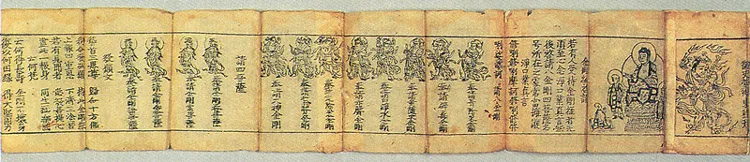
Bongrimsa Mokjoamitabuljwasang Bokjangjeonjeok (Collection), Hwaseong
華城 鳳林寺 木造阿彌陀佛坐像 腹藏典籍 一括
경기도 화성시
Basic information
- Designation
- Treasure No.1095
- Category
- Books & Records
- Designated year
- 1991
- Location
- 화성시, 경기도— 경기 화성시 용주로 136, 용주사 (송산동)
- Coordinates
- 37.199493, 126.831189
AI Docent
Coming soonAn AI-generated, friendly retelling of this heritage site is available in Korean. An English version is on our roadmap — for now, please see the official description below.
Description
The pocket-sized edition of Vajracchedika prajnaparamita Sutra (The Diamond Sutra) is based on Vajracchedika prajnaparamita Sutra, translated by Kumarajiva. The sutra is preceded by a series of images and texts, including a portrait of gods, sermon scene, ‘Geumganggyeong gyecheong,’ ‘Jeonggueop jineon,’ a portrait of eight Vajra Guardians and portrait of four Bodhisattvas, prayer text and ‘Unhabeom’. At the end of the sutra, there is a postscript, followed by six short Dharanis including the Nilakantha dharani (The Great Compassion Mantra), ten bu (符) including a yeouiin (如意印), and the printing information by Kang Geum-gang. The Diamond Sutra used to be the most fundamental scripture in Korean Buddhism. The text from which the philosophy of emptiness derives, the Diamond Sutra emphasizes that the seeker of enlightenment must abandon all attachment to worldly things and the distinction between the self and other in order to comprehend the true essence of being. This pocket-sized edition is meant to be carried for the protective effect of the sutra or used as a memory aid for recitation. According to the postscript, this publishing project was initiated by Gakwon, along with several bhiksus including Dalhyeon and Yeongheung, and upsakas including Yi Gi and Jeon Dae-dong. In Goyeon, they happened onto a small-character edition of the Diamond Sutra, written by a Goryeo monk by the name of Honghoe, and carved printing blocks based on this text, in 1311, according to the same postscript. Meanwhile, in the printing information at the very end of the book, it is said that the printing of the sutra took place in 1339, on the funding of Kang Geum-gang (aka Lord Jinseong). This copy of the pocket-sized sutra, with some worn sheets and frayed edges, appears to have been used for a while before it was placed inside the Buddha statue. The quality of printing, on the other hand, is comparatively good. Although the sutra was printed eighteen years after the printing blocks were carved, as can be deduced from the printing information, there are hardly no blurred characters from defacing of the woodblocks. Meanwhile, the seated wooden Buddha inside which this sutra was found was re-gilded in 1362 (the 11th year of King Gongmin’s reign during the Goryeo Dynasty), according to the record also discovered within. The pocket-sized Diamond Sutra is, therefore, likely to have been placed inside the statue at the time of its re-gilding. As a pocket-sized version of the Diamond Sutra for recitation, this book is informative on the religious practices of Goryeo. Meanwhile, the availability of complete publishing and printing information about this book, printed under the patronage of Kang Geum-gang who was based in Yuan China for a time, adds to its value. Volume 48 of the Avatamsaka Sutra (The Flower Garland Sutra) in Silver on Indigo Paper is one of the 80-volume Zhou Version of the Avatamsaka Sutra. This scroll contains the 34th and 35th of the 39 total chapters of the Avatamsaka Sutra, ‘Yeorae sipsin sanghaepum (Ocean of Physical Marks of the Ten Bodies of Buddha)’ and ‘Yeorae suho gwangmyeong gongdeokpum (Qualities of the Buddha's Embellishments and Lights).’ This copy of the sutra, without illustrations or a prayer text, has a number of other flaws as well. It does not provide, for instance, information about the circumstances of transcription, and the cover page art is rather mediocre while the handwriting is not the most attractive or assured. Displaying the characteristics of a typical hand-copied Goryeo sutra, it appears to date from sometime in late Goryeo. The only surviving portion of a vast Avatamsaka hand-copied in silver, this scroll, nevertheless, provides important glimpses into the practice of hand-copying Buddhist scriptures in late Goryeo. The second volume of the Saddharmapundarika Sutra (The Lotus Sutra) in ink on white paper contains two of the sutra’s twenty-eight chapters: Chapter 3. ‘Biyupum (Simile and Parable)’ and Chapter 4. ‘Sinhaepum (Belief and Understanding).’ Being one of the seven total scrolls making up this sutra, it does not provide information about the circumstances of transcription. Its exact date of transcription is, therefore, unknown. But, it is similar to the Transcription of Saddharmapundarika Sutra (The Lotus Sutra) in Ink on White Paper (Treasure No. 315) of Gwangheungsa Temple, in its general organization. Meanwhile, its cover shows similarities to that of the Lotus Sutra in ink on paper of Naesosa Temple. The dates of these other Lotus Sutras suggest that this one was hand-copied sometime between late Goryeo and early Joseon. The Brahmajala Sutra (The Sutra of Brahma’s Net), also part of this ensemble of scriptures, is written in ink on thick sheets of white paper. The sutra provides no information on the circumstances of transcription, but lists names of those who took part in hand-copying of the sutra including Hyesang, Myowon and Choe Sin-seong, and the name of the donor who funded the project, Yi of the Gyeonghwa House. However, as the birth or death date of none of these people is known, their names do not offer any clue about the date of transcription of the sutra. But, based on the style of decoration of the back cover and the style of handwriting, this hand-copied sutra appears to date from sometime in early Joseon. At any rate, this Sutra of Brahma’s Net is among the better made hand-copied sutras, written with great care and in elegant script. The annotated single-volume Lotus Sutra contains the total seven volumes of the Lotus Sutra by printing on both sides of thin sheets of paper. Annotations are added above the main text on each page, for ease of reading and understanding. This book was not published in Korea, and its date of publication is unknown. But, the sutra appears to have been published sometime in the early Ming dynasty, under the influence of the Dabaoen Temple Tripitaka, published on the order of Ming Taizu. The small-character Prajnaparamita Sutra (The Diamond Sutra), originally consisting of five sheets, is currently missing the second sheet. According to the postscript by Monk Hyesim (1178-1234) added at the end of the book, the publishing of this sutra was a project by Monk Bogwan. This postscript is followed by another postscript by Hyesim, the heir of the State Preceptor Bojo’s movement known as “Jeonghyessangsu” emphasizing the importance of coupling Zen and wisdom, based in Suseonsa in Jogyesan Mountain that the latter made into the base for this movement; something that makes this loose-sheet sutra yet more valuable. The postscript says that although it might be challenging for ordinary people to learn to contemplate Amitabha Buddha and the general surrounding, Yeolga was asked to transcribe the most essential texts for progressively introducing them to the practice of meditation, such as the Diamond Sutra, Universal Gate chapter of the Lotus Sutra and the Universal Worthy’s Conduct and Vows chapter of the Avatamsaka Sutra, while Hyegwi took charge of writing Beomja daejang sinju, included at the end of the volume. The postscript also states that this book was published through joint efforts between Yi Goeng and Monk Mungwang. Meanwhile, the printing of the small-character beomchongjijip ilbu appears to have taken place at the same time as the loose-sheet Diamond Sutra. The three-volume small-character Nilakantha dharani (The Great Compassion Mantra) have a two-line postscript at the end, but the second line is illegible, making it impossible to determine the date of publication. From this postscript, one learns, however, that this book was published to prayer for the happiness and health of Cheonghasangguk. The name “Cheonghasangguk” appears to designate Choe U, the powerful member of King Gojong’s court during the Goryeo Period, considered the de facto ruler of the dynasty at that time. Based on the quality of printing, similar to the quality of printing of the loose-sheet sutra, this book is likely to have been also published during King Gojong’s reign.
Location
지도를 불러오는 중…
Have you visited this place?
Log in and verify your visit on-site via GPS to record a stamp in My Journey. (QR verification coming later.)
Images: KOGL (khs.go.kr) · Data source: Korea Heritage Service Open API (khs.go.kr)