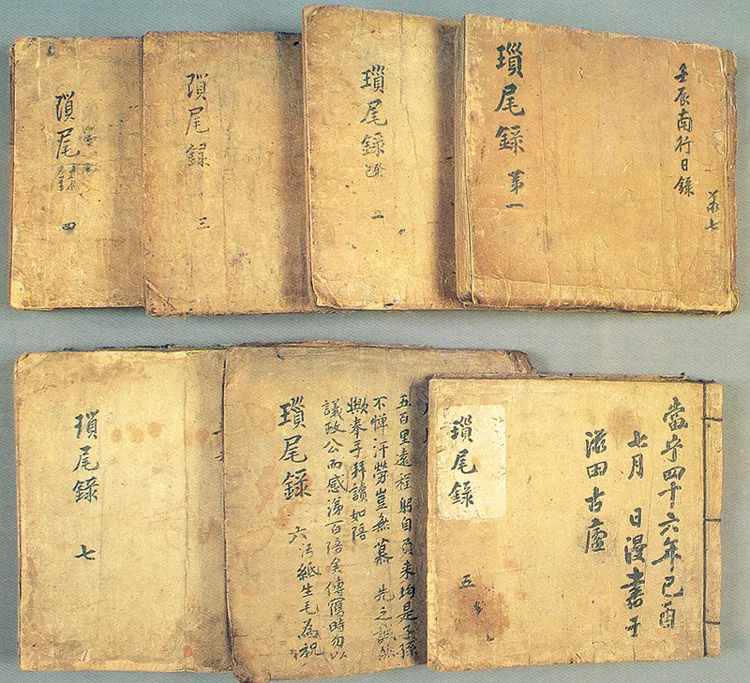
Ohuimun Swaemirok
吳希文 瑣尾錄
경상남도 진주시
Basic information
- Designation
- Treasure No.1096
- Category
- Books & Records
- Designated year
- 1991
- Location
- 진주시, 경상남도— 경남 진주시 남강로 626-35, 국립진주박물관 (남성동,진주성)
- Coordinates
- 35.188778, 128.076941
AI Docent
Coming soonAn AI-generated, friendly retelling of this heritage site is available in Korean. An English version is on our roadmap — for now, please see the official description below.
Description
Swaemirok is a diary written by O Hui-mun (1539-1613) during the period of Japanese invasions in the late 16th century. He kept the diary for about nine years and three months from 1591 (24th year of the reign of King Seonjo of the Joseon Dynasty) to the second lunar month of 1601 (34th year of the reign of the same king). Although an outstanding scholar, O Hui-mun failed to pass a state examination; thus, he never served in any official position. His son O Yun-gyeom was chief state councilor during the reign of King Injo (r. 1623-1649), and his grandson O Dal-je was one of the Three Patriotic Scholars who were taken to the Qing Dynasty to be executed for insisting on fighting the Manchu invasion. The diary consists of seven books. At the end of each book are messages from the king and crown prince, writings by righteous army soldiers, statements by renowned generals, and various official documents, providing detailed information on the situation of the period. It also cites the helplessness of Joseon government troops and delineates the dispatch process of rescue troops by Ming China, the peace conference between Ming and Japan, and its breakdown. In particular, reports from Jangsu-hyeon Prefecture vividly depict the battle situation, distinguished feats by righteous army leaders, cruel carnage and plunder by Japanese invaders, merciless pillage by Ming troops, subsequent impoverished conditions of the grassroots, innumerable refugees, and conscription and requisition for provisions, all of which are rarely seen in other documents. Though he did not hold an official post, he was better able to collect accurate and comprehensive information than anybody else thanks to his close friendship with many local magistrates. Written by a civilian rather than by a governmental official, the diary provides much insight into the living conditions of ordinary people and local administrative systems of the time. It is also a valuable material in the study of the socio-economic history of the period.
Location
지도를 불러오는 중…
Have you visited this place?
Log in and verify your visit on-site via GPS to record a stamp in My Journey. (QR verification coming later.)
Images: KOGL (khs.go.kr) · Data source: Korea Heritage Service Open API (khs.go.kr)