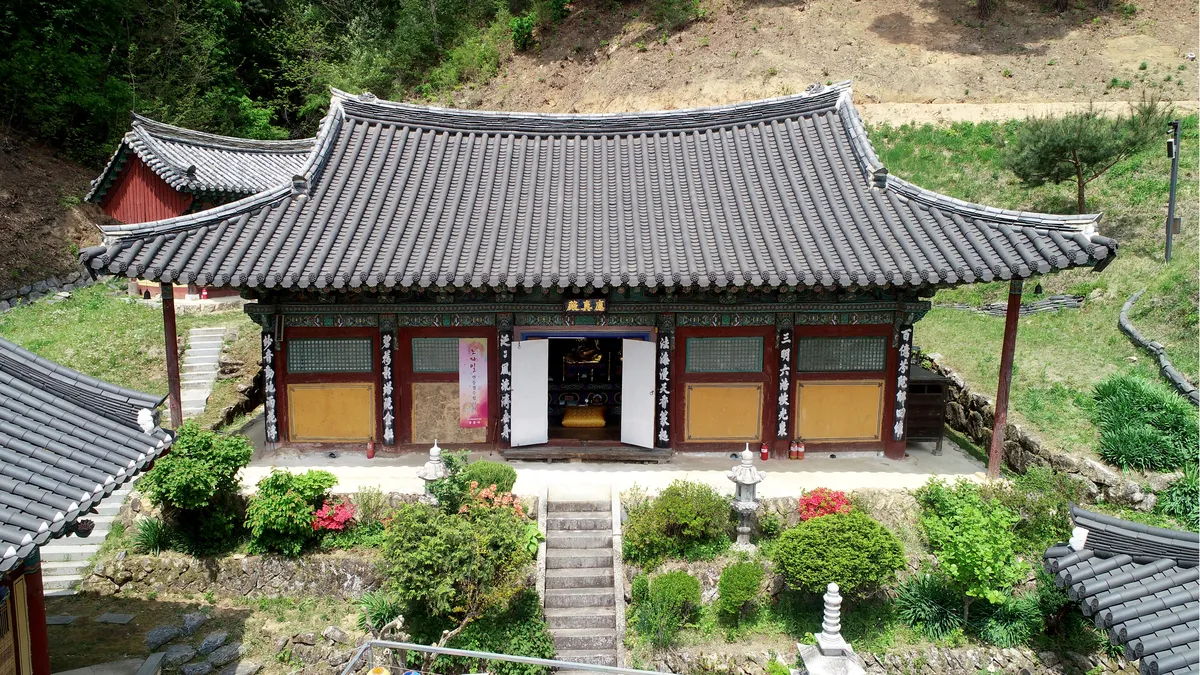
Gwangheungsa Eungjin Hall, Andong
安東 廣興寺 應眞殿
경상북도 안동시
Basic information
- Designation
- Treasure No.2302
- Category
- Architecture
- Era
- 조선시대
- Designated year
- 2025
- Location
- 안동시, 경상북도— 경상북도 안동시 광흥사길 105(서후면)
- Coordinates
- 36.646021, 128.613565Kakao address conversion
AI Docent
Coming soonAn AI-generated, friendly retelling of this heritage site is available in Korean. An English version is on our roadmap — for now, please see the official description below.
Description
Machine-translatedThis English description was machine-translated and may contain inaccuracies. Refer to the original Korean text for details.
Gwanghung Temple in Andong is traditionally believed to have been established by the great monk Uisang during the Unified Silla period. The temple was particularly active in printing Buddhist scriptures during the early Joseon period and possesses well-preserved records including the temple's bronze bell cast in 1573, temple documents from the 17th-18th centuries, and various historical texts such as 'Records of the Reconstruction of Gwanghung Temple,' 'Collected Works of Great Monk Yayun,' and 'Collected Works of Master Hamhong,' establishing it as a historically significant temple in the Andong region. Although the exact date of the Application Hall's construction is unclear, the roof repair document from 1647 (Injo 25) indicates it was built before that time. After major fires in 1827 and 1946 destroyed most temple buildings, the Application Hall, located away from the central area, was spared. As the main hall fell into ruins, the Application Hall assumed the actual central Buddhist function of Gwanghung Temple, a historically significant transformation. The Application Hall features a five-bay front, two-bay depth, and overhanging multiple-bracket style construction on the front, with decorative corbels substituting for middle bracket arms on the sides and rear, emphasizing the front elevation. The brackets employ classical combinations of bracket arms and three-point cap blocks with cloud extensions, while separately-carved lotus-point capitals display stylistic evolution. Decorative cloud corbel supports carved on the lintels, layered ceiling installation, and latticed windows on the side aisles and eaves demonstrate high architectural value through classical techniques. Additionally, the hall enshrines a clay Buddha triad attributed to the 16th century and sixteen Arhat sculptures (Gyeongbuk Provincial Cultural Property), significantly enhancing its artistic value and making Gwanghung Temple's Application Hall a rare example of a subsidiary hall converted to principal hall use, with outstanding historical and architectural worth warranting designation as a National Treasure.
Location
지도를 불러오는 중…
Have you visited this place?
Log in and verify your visit on-site via GPS to record a stamp in My Journey. (QR verification coming later.)
Images: KOGL (khs.go.kr) · Data source: Korea Heritage Service Open API (khs.go.kr)