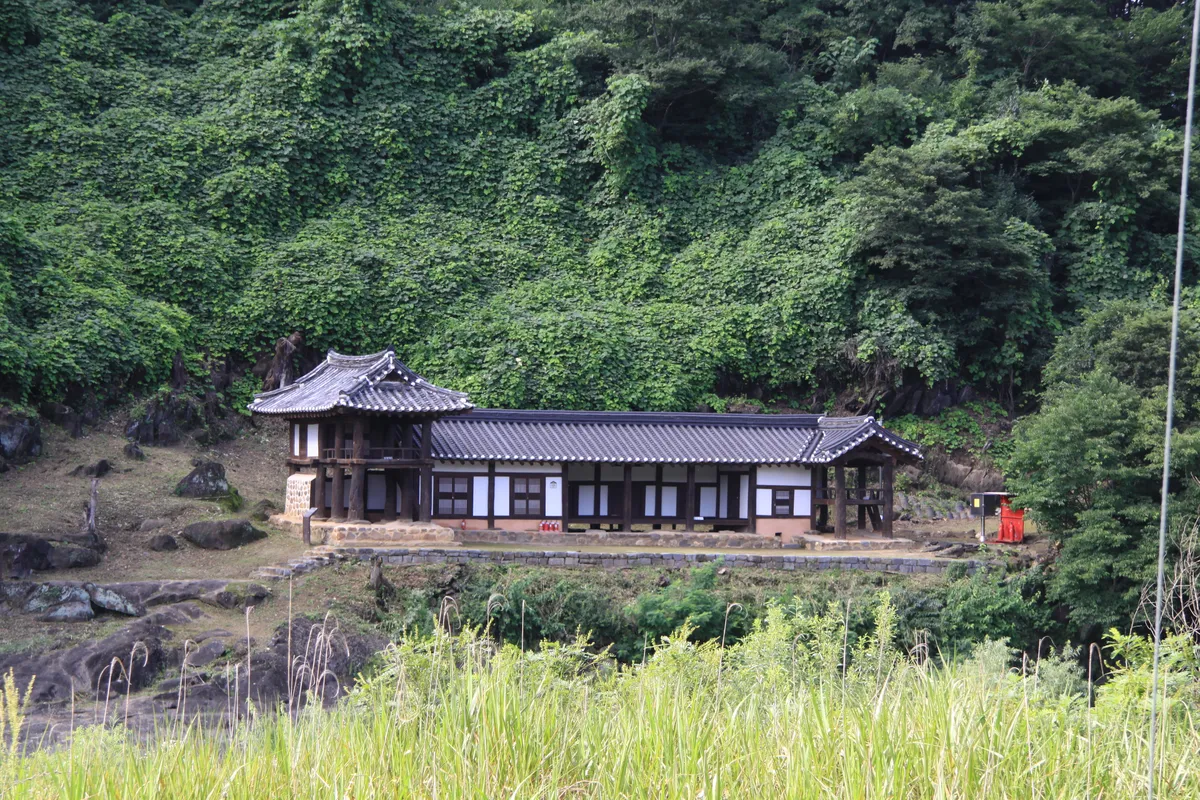
Iji Hall, Okcheon
沃川 二止堂
충청북도 옥천군
Basic information
- Designation
- Treasure No.2107
- Category
- Architecture
- Era
- 조선시대(1674년 건립)
- Designated year
- 2020
- Location
- 옥천군, 충청북도— 충청북도 옥천군 이백6길 126 (군북면, 문화재(옥천이지당))
- Coordinates
- 36.329502, 127.555826
AI Docent
Coming soonAn AI-generated, friendly retelling of this heritage site is available in Korean. An English version is on our roadmap — for now, please see the official description below.
Description
Ijidang House in Okcheon was originally built by Jo Heon (courtesy name: Jungbong, 1544-1592), a renowned Neo-Confucian scholar and a Righteous Army commander of the mid-Joseon period, who was attracted to the outstanding natural beauty of Okcheon. He named the building Gaksinseodang and used it as a school for the education of local youths. In 1674, some eighty years after Jo’s death, the local Confucian community led by Kim Man-gyun renovated the school, adding a lofty pavilion type of structure to the main building. Shortly after the renovation, the building was given its current name, Ijidang, by Song Si-yeonl (1607-1689), a great Neo-Confucian thinker of late Joseon. Jo Heon was closely connected with Kim Man-gyun and Song Si-yeol through their relationship with the town of Okcheon and the Giho School, one of the major groups of Korean Neo-Confucianism. The relationship of the three Neo-Confucian scholars continued to play a key role in the operation and management of Ijidang House as a Confucian educational institution. Ijidang House is located on the slope of a mountain overlooking Seohwacheon, a tributary of the Geumgang River, at the point where a broad flat rock around which the unyielding flow of the river sweeps creates a fantastic scene along with the rocks of fantastic shapes standing behind the house. The building combines the characteristic features of a Confucian academy with the style of pavilion buildings of Joseon, and has a u-shaped layout with double-story wings on both sides, displaying the simple yet elegant architectural style of late Joseon. The lofty wings make the building a rare example of the Confucian architecture built according to the Confucian principle of pursuing “unity between heaven and mankind,” forming a boundary between the building’s outer space and inviting the scenic landscape spreading out in front of it.
Location
지도를 불러오는 중…
Have you visited this place?
Log in and verify your visit on-site via GPS to record a stamp in My Journey. (QR verification coming later.)
Images: KOGL (khs.go.kr) · Data source: Korea Heritage Service Open API (khs.go.kr)