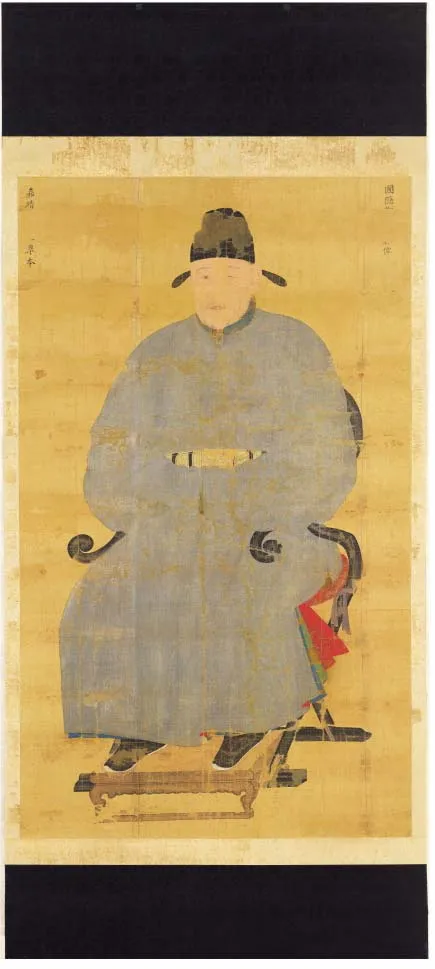
Portrait of Jeongmongju
鄭夢周 肖像(2011)
경기도 용인시
Basic information
- Designation
- Treasure No.1110-2
- Category
- Painting
- Era
- 1555년경
- Designated year
- 2011
- Location
- 용인시, 경기도— 경기도 용인시 기흥구 상갈로 6-0 (상갈동, 경기도박물관 )
- Coordinates
- 37.268330, 127.108756
AI Docent
Coming soonAn AI-generated, friendly retelling of this heritage site is available in Korean. An English version is on our roadmap — for now, please see the official description below.
Description
A distinguished Neo-Chonfucian scholar and civil official of late Goryeo (918-1392), Jeong Mong-ju (pen-name: Poeun, 1337-1392) passed the state examination in 1360, starting a successful career in the government as a mid- and high-ranking posts in the Ministry of Rite (Yejo), State Confucian Academy (Seonggyungwan), Directorate of Education (Bomungak), and the Chancellery (Munhaseong). In 1360, he joined Yi Seong-gye (1335-1408, later King Taejo of Joseon) to enthrone King Gongyang (r. 1389-1392) for reformation of dynasty but, discovering a treasonous plan of Yi and his close aides, such as Jo Jun and Jeong Do-jeon, fiercely confronted them which eventually led to his assassination at Seonjukgyo Bridge. The portrait has postscripts on both sides, suggesting that it was copied from the original in 1555. According to The Collected Writings by Poeun (Poeunjip), his original portrait, which is now missing, was painted in 1390 when he was awarded a title, Jwamyeong Subject of Merit, for his role in the enthronement of King Gongyang. Several imitations have been made from this 1390 portrait to be enshrined and collected in Imgo Seowon, a private Confucian shrine-academy in Yeongcheon of Gyeongbuk, Memorial Shrine for Master Poeun in Yongin of Gyeonggi-do, National Museum of Korea, and Seoul National University Museum in Seoul. Originated from the same original work, titled Portrait of Jwamyeong Subject of Merit, these portraits exhibit the same style. As the official portraits directly copied from the original in 1555 became worn out through turbulent times, the government allowed his memorial shrines across the country to have new portraits which appeared in 1629. One of these copies was designated as Treasure No. 1110 in December 1991. This particular portrait of Jeong Mong-ju currently in the collection of Gyeonggi Provincial Museum is believed to have been one of the copies made in 1555. It had been kept by the head family of the Yeongil Jeong clan until 2006 when they donated to the museum. The support of this portrait is prepared by sewing three pieces of cloth together, displaying an antique style. An examination of the backside of the painting for repair in 2007 revealed that colors were applied not only to the headwear, face, and robe but also to the foot rest. In the portrait, the sitter is in a black satin headwear and round-neck robe, and seated on a chair, facing slightly left. The black official’s headwear is marked by the low, round crown with slender drooped “horns”. The robe is almost gray although the original color should have been blue, and displays characteristic features of those made between late Goryeo and early Joseon with the collar rather tight around the neck and comparatively narrower sleeves. The belt is decorated with gold ornaments. The loyal official depicted in this portrait is also characterized by light peach face with the paint slightly peeling off around the features, particularly the left eye. The artist used brown lines to outline the features and depict wrinkles, and light ink wash to depict the iris in the eyes although eyelashes are not rendered. The lips are rendered with dark red and outlined with ink wash. The outlines and folds of the robe are depicted with fine, and rather sharp, ink wash lines which are applied in a simplistic manner. The sitter is seated on a red seat cushion which is tied to the chair with purple strings, and wears black leather shoes both of which facing the same direction. There is nothing either on or under the footrest. The simple rendering of the face, seat cushion attached with tying strings, black leather shoes facing the same direction, and the sleeveless inner coat worn inside the robe are the elements characterizing the portraits of meritorious subjects produced between late Goryeo and early Joseon as shown by the portraits of Yi Cheon-u (?-1417) and Yi Saek (1328-1396). This portrait is regarded as an important item of Korean artistic heritage not only because it renders Jeong Mong-ju who is widely admired as one of the Korea’s earliest and greatest Neo-Confucian scholars and eminent historic figure symbolizing loyalty but also because it retains the artistic style of the mid Joseon works copied from his original portrait painted in the late Goryeo period. Its value as artistic heritage may be succinctly summed up by that it was made about seventy years before the Treasure No. 1110 which had been wrongly conjectured as his oldest remaining portrait.
Location
지도를 불러오는 중…
Have you visited this place?
Log in and verify your visit on-site via GPS to record a stamp in My Journey. (QR verification coming later.)
Images: KOGL (khs.go.kr) · Data source: Korea Heritage Service Open API (khs.go.kr)