Goryeosa(2021-3)
高麗史(2021-3)
서울특별시 관악구
Basic information
- Designation
- Treasure No.2115-1
- Category
- Books & Records
- Era
- 1613년(광해군 5), 초인(初印)
- Designated year
- 2021
- Location
- 관악구, 서울특별시— 서울특별시 관악구 관악로 1 (신림동, 서울대학교) 규장각한국학연구원
- Coordinates
- 37.466287, 126.948156Kakao address conversion
AI Docent
Coming soonAn AI-generated, friendly retelling of this heritage site is available in Korean. An English version is on our roadmap — for now, please see the official description below.
Description
Machine-translatedThis English description was machine-translated and may contain inaccuracies. Refer to the original Korean text for details.
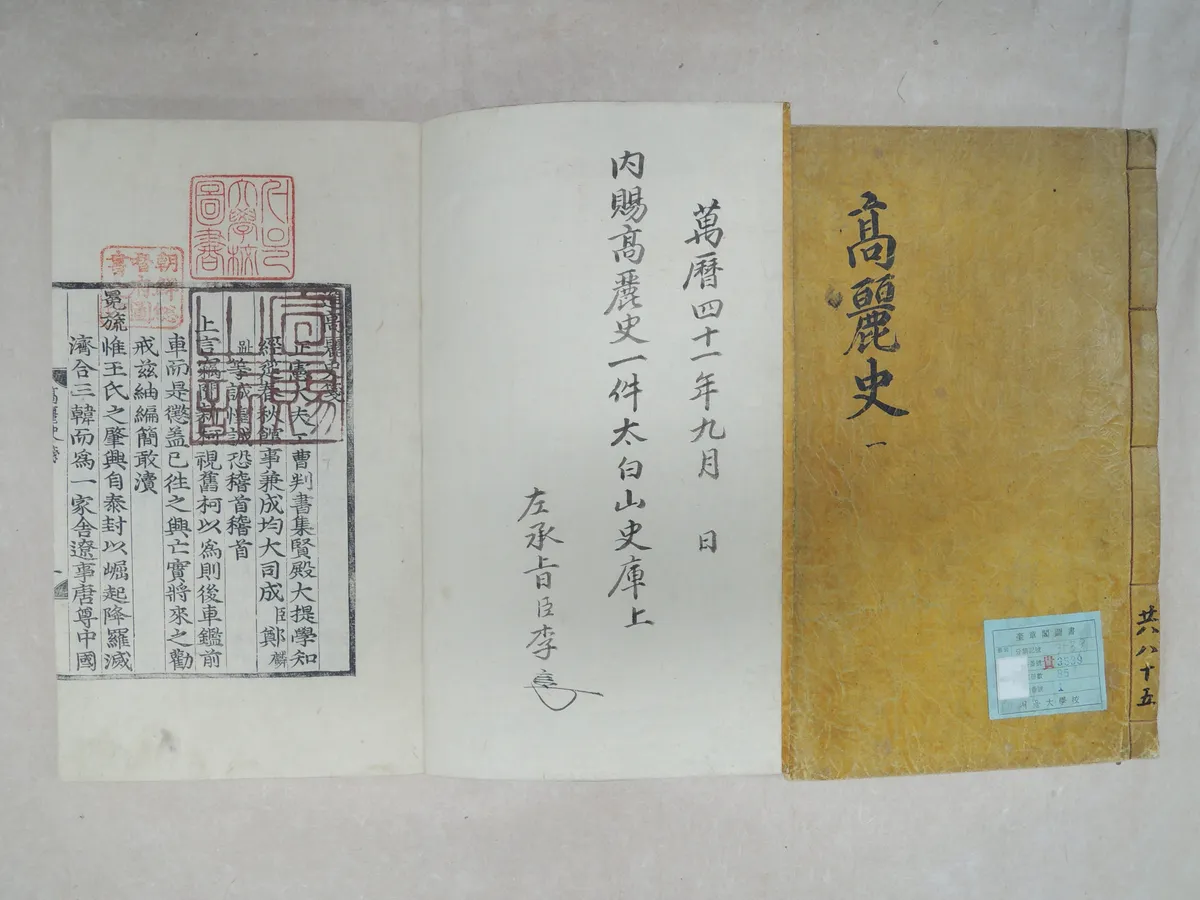
The Goryeosa (History of Goryeo) represents the official Goryeo historical record compiled by scholars including Jeong In-ji (1396-1478) and Jeong Chang-son (1402-1487) in 1451 (first year of King Munjong) in biographic style, standing as one of Korea's two major official histories alongside the Samguksagi. As the most important source material for Goryeo-era research and the most fundamental resource for understanding Goryeo history and culture, the work comprises one hundred thirty-nine volumes total, organized into forty-six volumes of royal lineages, fifty volumes of biographies, thirty-nine volumes of treatises, two volumes of chronological tables, and two volumes of catalogs. While late-Goryeo officials Lee Jae-hyun and An Chuk attempted compilation efforts, these remained incomplete. Following Joseon's founding, King Taejo Yi Seong-gye commissioned the Goryeongunsa compilation, but this survives no longer. In 1414 (fourteenth year of King Taejong), King Taejong ordered revision and recompilation attempts which remained incomplete. King Sejong ultimately ordered new compilation to address errors, undergoing multiple revisions before beginning compilation in 1449 (thirty-first year of King Sejong) and completing the work in 1451 (first year of King Munjong). This represents the Goryeosa transmitted to present times. While metal-type Ulhaeja editions were produced in 1455 (first year of King Sejong), with subsequent middle-period Ulhaeja editions reportedly recarved on woodblocks, currently extant examples include 1482 (thirteenth year of King Seongjong) Ulhaeja printings, 1613 (fifth year of King Gwanghaegun) woodblock revised editions, and subsequent editions from the seventeenth-eighteenth centuries. The Goryeosa possesses exceptional historical, cultural, and bibliographic significance, functioning as official history crucial for understanding Goryeo's past, employing original primary sources ensuring objective accuracy and reliability, and containing abundant information on Goryeo culture and institutions, meriting treasure designation for preservation and scholarly research. Seoul National University's Gyujanggak copy comprises one hundred thirty-nine volumes in eighty-five volumes representing the complete work, printed from woodblock plates recarved from the Ulhaeja edition. Produced from the Taebaeksan Archival version, estimated carving occurred around 1612 (fourth year of King Gwanghaegun) with printing in 1613 (fifth year of King Gwanghaegun), confirmed through internal donation records noting: 'Wangli forty-first year (1613) ninth month, internal gift of one Goryeosa copy to Taebaeksan Archive.' The first volume contains upper and lower catalogs, royal genealogy, and examples; the second volume's beginning contains advance dedication. Content sequences royal lineages beginning with biography sections, treatises, chronological tables, and biographical materials, ending with historical officials' records following volume one hundred thirty-seven. Cover annotations display ink-brush 'goryeosa' titles, with inside cover pages containing internal donation records. Official seal stamps appear on the volume top, with 'Joseon Government-General Library' and 'Seoul National University Library' collection marks printed on upper margins. As Taebaeksan Archive version, both printing condition and binding format preserve original form, maintaining exceptionally high material value.
Location
지도를 불러오는 중…
Have you visited this place?
Log in and verify your visit on-site via GPS to record a stamp in My Journey. (QR verification coming later.)
Images: KOGL (khs.go.kr) · Data source: Korea Heritage Service Open API (khs.go.kr)