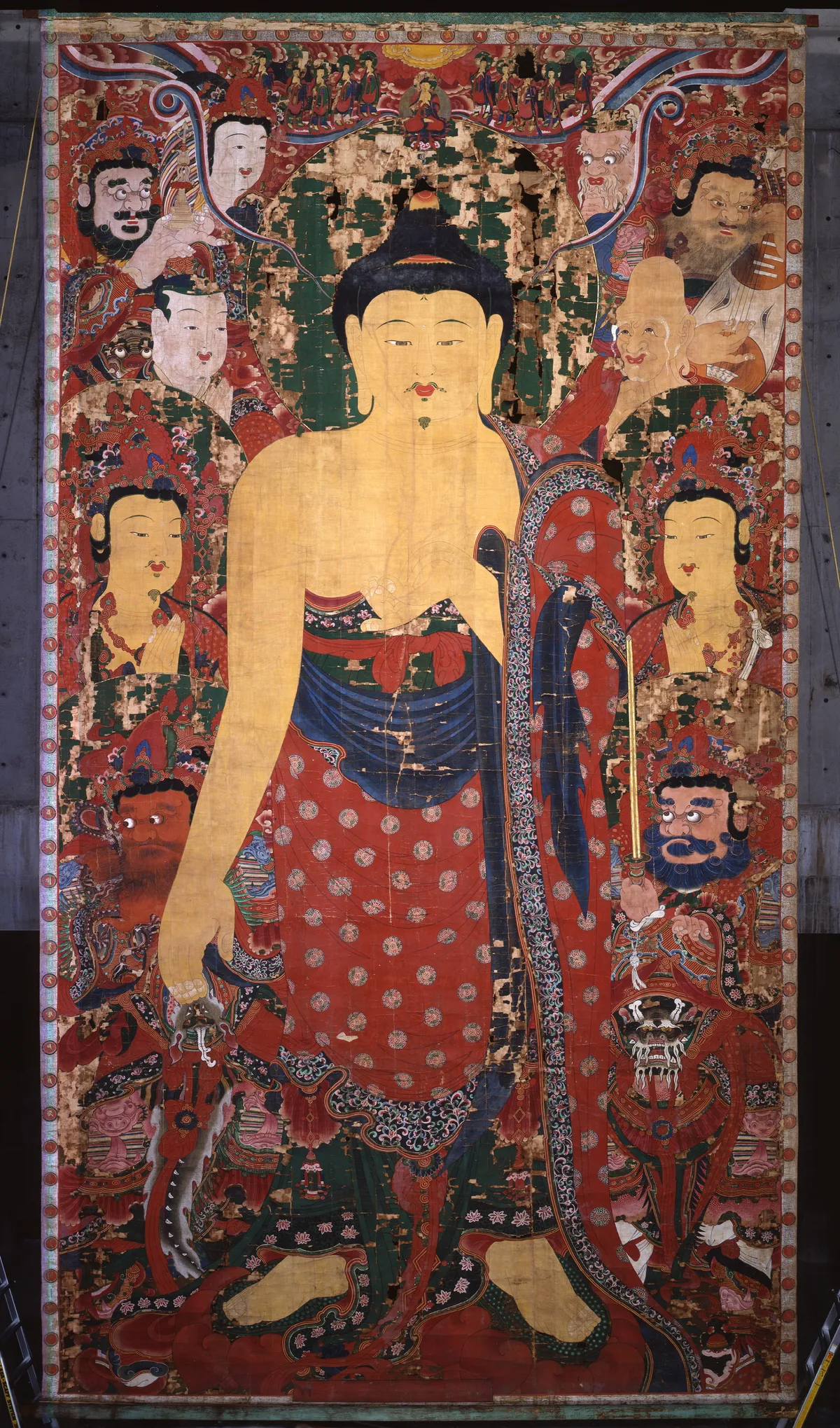
Namjangsa Yeongsanhoe Gwaebuldo Mit Reliquary Objects, Sangju
尙州 南長寺 靈山會 掛佛圖 및 腹藏遺物
경상북도 김천시
Basic information
- Designation
- Treasure No.2116
- Category
- Painting
- Era
- ① 괘불 및 복장낭 : 1776년(정조 1), ②복장낭함 : 1783년(정조 7)
- Designated year
- 2021
- Location
- 김천시, 경상북도— 경상북도 김천시 직지사길 95 (대항면, 직지사성보박물관)
- Coordinates
- 36.118500, 128.117400Museum-based location
AI Docent
Coming soonAn AI-generated, friendly retelling of this heritage site is available in Korean. An English version is on our roadmap — for now, please see the official description below.
Description
Machine-translatedThis English description was machine-translated and may contain inaccuracies. Refer to the original Korean text for details.
The Yeongsan Society Buddhist Painting and Consecration Relics from Namjangsa Temple in Sangju represents a monumental Buddhist painting measuring eleven meters in height, created in 1776 (first year of King Jeongjo) by twenty-three painters from the Gyeongsan Province region under the leadership of master painter Yuseong, representing the standard work for late eighteenth-century Buddhist painting. Though created in 1776, this painting subsequently incurred damage during rain-prayer ceremonies held shortly after production, remaining unusable in its original function until today. Despite significant damage, fortunately, key sections of numerous figures remain well-preserved. This painting's exceptional value derives from preservation of original coloring and mounting without extended usage, distinctly contrasting with eighteenth-century Buddhist paintings that lost original mounting characteristics through multiple repairs following creation. The carefully structured composition positions the figure of Shakyamuni Buddha dominantly at the composition's center with ascending arrangement of attendant bodhisattvas and important attendants, while Four Kings occupy the composition's periphery to conclude the design. The skillfully recessed placement of the principal Buddha figure creates dramatic effect suggesting the Buddha advancing toward the assembly. Through such techniques, the artist's capabilities are evident. The inclusion of dragon-king and dragon-princess as important attendants reveals the Lotus Sutra's fundamental philosophy that all sentient beings achieve Buddhahood; distinctive color differentiation by status reflects controlled artistic strength; and the Four Kings' powerful coloring and shading demonstrate the artist's wit and personal expression. The painting's consecration relics comprise a consecration sack, bronze mirror, and single storage container. Reconstructed in 1788 as the original painting failed functional use during rain-prayer ceremonies, these items subsequently saw reuse in the new painting, representing a large-scale surviving consecration sack with exceptionally good preservation condition. The simultaneous presence of painting and full consecration relics demonstrates completeness making this work exceptionally significant for Joseon Buddhist painting and religious ceremony research.
Location
지도를 불러오는 중…
Have you visited this place?
Log in and verify your visit on-site via GPS to record a stamp in My Journey. (QR verification coming later.)
Images: KOGL (khs.go.kr) · Data source: Korea Heritage Service Open API (khs.go.kr)