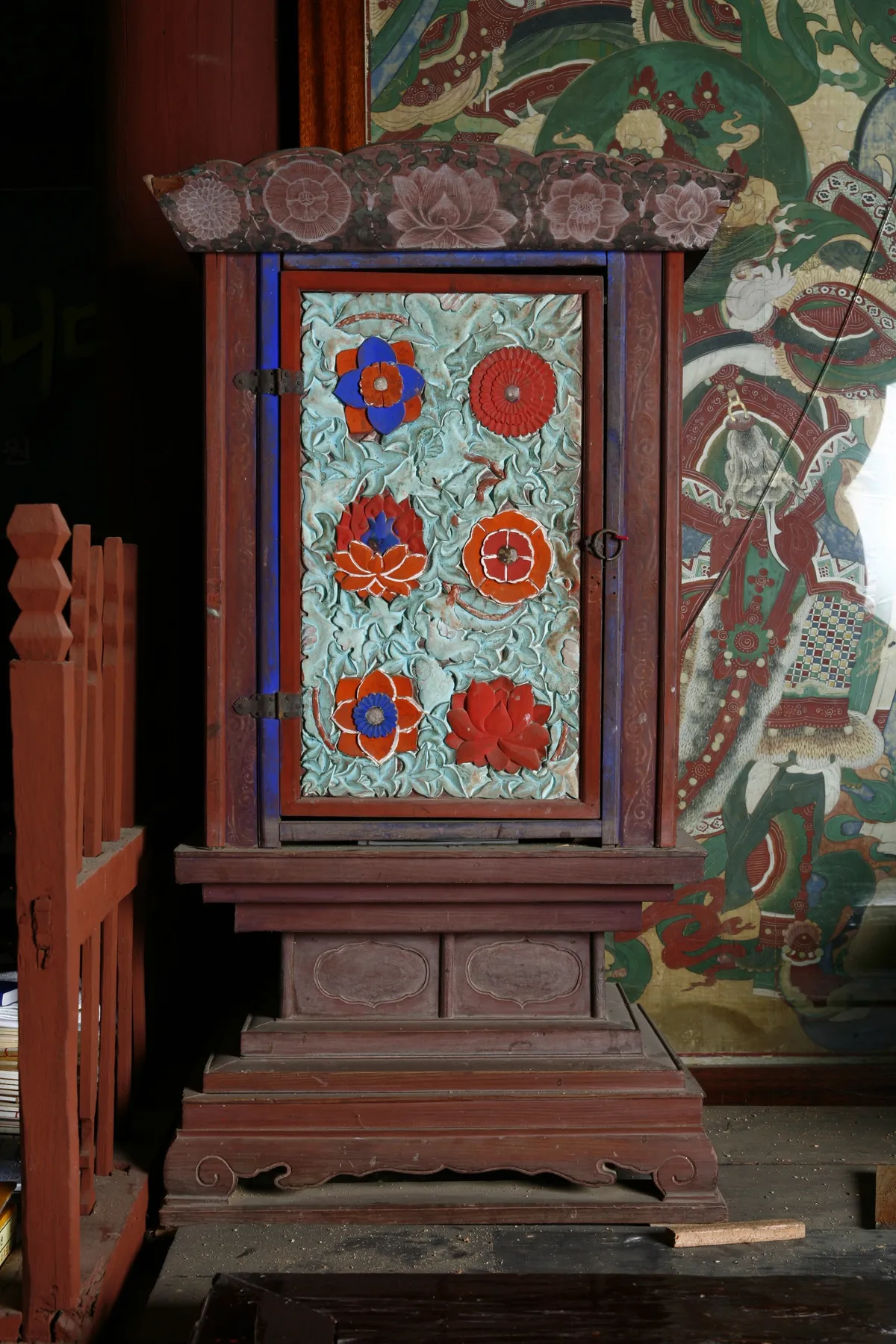
Daedunsa Gyeongjang, Gumi
龜尾 大芚寺 經欌
경상북도 구미시
Basic information
- Designation
- Treasure No.2117
- Category
- Craft
- Era
- 1630년(인조 8)
- Designated year
- 2021
- Location
- 구미시, 경상북도— 경상북도 구미시 산촌옥관로 691-78 (옥성면, 대둔사)
- Coordinates
- 36.335337, 128.242152Kakao address conversion
AI Docent
Coming soonAn AI-generated, friendly retelling of this heritage site is available in Korean. An English version is on our roadmap — for now, please see the official description below.
Description
Machine-translatedThis English description was machine-translated and may contain inaccuracies. Refer to the original Korean text for details.
The Gumi Daedunsa Buddhist Cabinet represents a Buddhist woodcraft item created in 1630 (eighth year of King Injo), with inscription information providing creation timing, 'painter' role, 'drawing-out craftsman,' and 'heating craftsman' designations—crucial examples revealing manufacturing details. Joseon late-period woodcraft production encompassed diverse items including wooden fish, plaques, resonance devices, cabinets, candle-holders, scripture-reading stands, pedestals, altars, and smaller vessels; however, works identifying creation period and craftspeople remain exceptionally rare. In this context, the Gumi Daedunsa Buddhist Cabinet deserves particular attention, with creation timing, craftspeople, and purpose information documented on the left cabinet's rear and bottom surfaces, establishing the work as standard reference material for Joseon late-period woodcraft research. Additionally, the paired cabinets' inner doors contain four individual paintings of the Four Kings (two per door), suggesting original creation as a matched set for placement flanking the main altar in temple assembly halls. While certain sections underwent repair and repainting, the work predominantly preserves original manufacturing patterns and coloring techniques without substantial loss. Notably, the Four Kings paintings represent the sole surviving seventeenth-century linear-drawing Buddhist paintings. This cabinet demonstrates proportional relationships between pedestal and body measuring approximately zero point thirty-five to one, establishing notably stable and harmonious ratios. Both pedestal and body feature exquisite carved corner designs, subtly rendered circular patterns, sensitively carved floral designs, delicately and skillfully executed Four Kings paintings, and floral vine patterns. The thoughtful integration of craft elements, sculpture, and painting creates extraordinary aesthetic coherence. The distinctive placement of Four Kings paintings inside cabinet doors, consecrating the religious treasures, distinguishes this cabinet beyond simple altar-adornment woodcraft function, acquiring profound religious symbolism. This implementation of the traditional Buddhist practice of carving external protector spirits on stupas, towers, and reliquaries onto cabinet doors—unparalleled in documented examples—establishes exceptional significance. The Gumi Daedunsa Buddhist Cabinet warrants treasure designation as a rare example with clearly identifiable creation period and craftspeople through inscriptions, possessing significant art-historical meaning. Furthermore, its substantial scale and superior formal qualities establish this work as reference standard for Joseon late-period Buddhist woodcraft chronology and iconographic research.
Location
지도를 불러오는 중…
Have you visited this place?
Log in and verify your visit on-site via GPS to record a stamp in My Journey. (QR verification coming later.)
Images: KOGL (khs.go.kr) · Data source: Korea Heritage Service Open API (khs.go.kr)