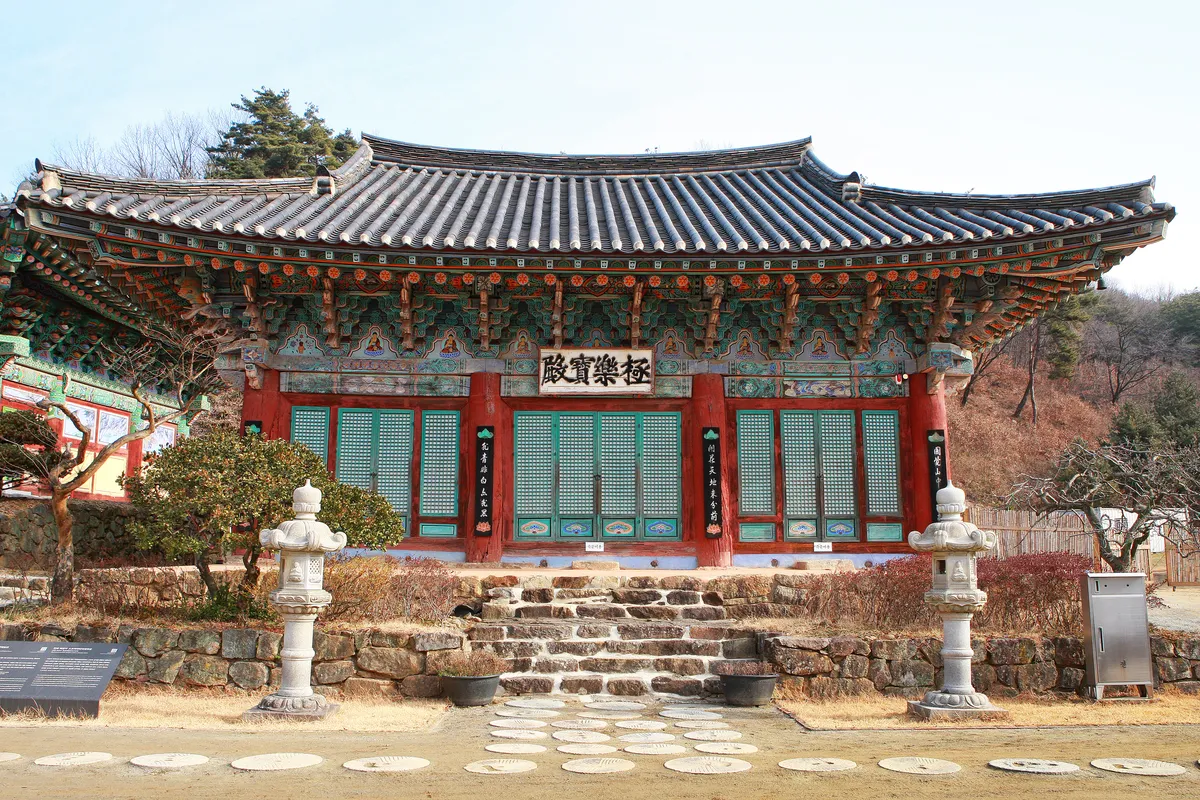
Biamsa Geungnakbojeon Hall, Sejong
世宗 碑巖寺 極樂寶殿
세종특별자치시
Basic information
- Designation
- Treasure No.2119
- Category
- Architecture
- Era
- 조선시대
- Designated year
- 2021
- Location
- , 세종특별자치시— 세종특별자치시 비암사길 137 (전의면, 비암사)
- Coordinates
- 36.611190, 127.192054
AI Docent
Coming soonAn AI-generated, friendly retelling of this heritage site is available in Korean. An English version is on our roadmap — for now, please see the official description below.
Description
Machine-translatedThis English description was machine-translated and may contain inaccuracies. Refer to the original Korean text for details.
Biamsa Temple, a branch temple of Magoksa, is currently located in Jeonem-myeon, Sejong Special Autonomous City. Biamsa is traditionally believed to have been founded by National Preceptor Doseon (道詵) of the Unified Silla period, though other foundation theories exist without definitive confirmation. However, unearthed Biamsa relics including a stone memorial image of Amitabha Buddha from the Gyeyu era (estimated 673) designated as National Treasure and another from the Gichuk era (estimated 689) designated as Treasure confirm the temple's antiquity, and locals continue designating Biamsa as a 'Three Kingdoms Ancient Temple,' tracing its founding to ancient times. The post-seventeenth-century two-bay-side design reflects the historical period following warfare. While three-bays-by-three-bays proportions dominated Joseon multi-bracket Buddhist halls, Biamsa's Amitabha Hall features a two-bays-side design. Though two-bays-side Buddhist halls appear less frequently than three-bays configurations, they rapidly proliferated after the Imjin War, becoming the second most common ratio. The architectural approach—placing main pillars toward the rear and establishing rear Buddha walls to secure front worship space—matches three-bays-by-three-bays halls, but the single-bay reduction creates a cramped worship area, reflecting diminished temple economies in the post-war period. Simultaneously, the interior maintains the main pillar and rear Buddha wall arrangement, with only one example surviving in each of South Chungcheong Province and Sejong City, making it a rare regional case. The bracket work comprises three outer and inner offset stories. During the mid-Joseon period, changes typically appear in inner and outer offset numbers, with inner offsets increasing beyond outer ones. Even among two-bays-side Buddhist halls, hip-roofed structures generally show increased inner offset numbers, while this hall maintains equal inner and outer offsets, similar to Seonunsa Great Treasure Hall and Jikjisa Great Treasure Hall. This bracket-work arrangement uniquely employs all three multi-bracket depths—great, medium, and small—using medium offsets for the first outer and inner story, a technique seen in Seonunsa Great Treasure Hall and Youngguksa Great Response Hall but uncommon. Bracket arm forms demonstrate mixed-period construction techniques, suggesting post-founding repairs. The three-or-more-offset arrangement, outer bracket arm base carving, and inner bracket arm lotus decorations represent characteristics of multi-bracket structures post-mid-Joseon. The structural response to two-bay-side dimensions employed three supporting beams per frame spacing. The two-bay-side configuration while constructing a hip roof created difficulties for standard upper framework solutions. This challenge was resolved by installing three support beams per frame spacing—placing main beams between front columns and interior posts with perpendicular support beams creating the structural framework. Three support beams spanning across the main beam exists to facilitate outer-door-structure formation; three-bay configurations naturally form outer-door structures, and most other two-bay-side Buddhist halls employ single support beams, yet this hall features longer bay spacing requiring auxiliary support beam installation for structural reinforcement against rafter loads. The window and door techniques preserve original-period construction methods. The front window arrangement divides the frame into four sections with middle pairs as swinging doors and flanking single bays featuring lower sills with single swinging doors—techniques consistent with ancient practices seen in Buseoksa Infinite Life Hall and Maengsi Haengdan. Rear windows employ the double-window method—a dual swinging window with center post separator, a mid-structure beam element widely used pre-mid-Joseon and rarely confirmed in post-seventeenth-century Honam region buildings like Daejeon's Dongchun Hall and Yesan's Chusa Old House. Both front and rear window techniques employ relatively ancient methods recovered to their original forms through 1996 restoration work based on remaining traces. Though not originally constructed windows, careful restoration based on documentary evidence restored the appearance matching the Amitabha Hall's construction period. Regional significance and basis: Though lacking historical records, Biamsa preserves one National Treasure, two Treasures, and four Tangible Cultural Properties, establishing it as a temple of considerable antiquity. Seventeenth-century documented cultural activities and works like the '영산회괘불도' (Spiritual Summit Gathering Hanging Scroll) painted by Suin (1657) demonstrate the temple maintained active religious significance in the South Chungcheong region. As Biamsa's principal Buddhist hall, the Amitabha Hall features a three-bays front, two-bays-side multi-bracket single-layer hip-roof design. The two-bays-side Buddhist hall type became widely constructed after the Imjin War, showing construction trends primarily post-seventeenth century, with the Amitabha Hall similarly reflecting this developmental trajectory. While bracket work exhibits mixed pre- and post-warfare style characteristics, overall examples of mid-seventeenth-century bracket assembly patterns. Particularly distinctive is the structural approach—the two-bay-side spacing combined with support beam reinforcement addressing structural challenges represents unique technique visible in regional temple halls. Biamsa Amitabha Hall merits designation as nationally designated heritage for preserving mid-seventeenth-century regional temple characteristics and regional color exemplifying period-specific traits.
Location
지도를 불러오는 중…
Have you visited this place?
Log in and verify your visit on-site via GPS to record a stamp in My Journey. (QR verification coming later.)
Images: KOGL (khs.go.kr) · Data source: Korea Heritage Service Open API (khs.go.kr)